Scientists studying the Great Salt Lake have identified at least one species of nematode that is completely new to science, with evidence suggesting there may be a second. Researchers from the University of Utah recently published a paper describing the tiny roundworm and formally naming it in a way that honors the Indigenous people whose ancestral lands include the lake.
The species has been named Diplolaimelloides woaabi and appears to live only in the Great Salt Lake. That makes it endemic to the lake and potentially an important, though still poorly understood, part of its ecosystem. To choose the name, the research team, led by University of Utah biology professor Michael Werner, worked with the Northwestern Band of the Shoshone Nation. Tribal elders suggested Wo’aabi, an Indigenous word meaning “worm.”
Why Nematodes Matter
Nematodes are among the most widespread animals on Earth. They are found in nearly every environment imaginable, including polar ice, deep-sea hydrothermal vents and ordinary backyard soil. Most are smaller than a millimeter, which is why they often go unnoticed.
Despite their size, nematodes are extraordinarily abundant. Scientists have identified more than 250,000 species so far, making them the most numerous animal phylum in both land and water ecosystems. Roughly 80% of animal life in terrestrial soils and about 90% of animals living on the ocean floor are nematodes.
The First Discovery in the Lake
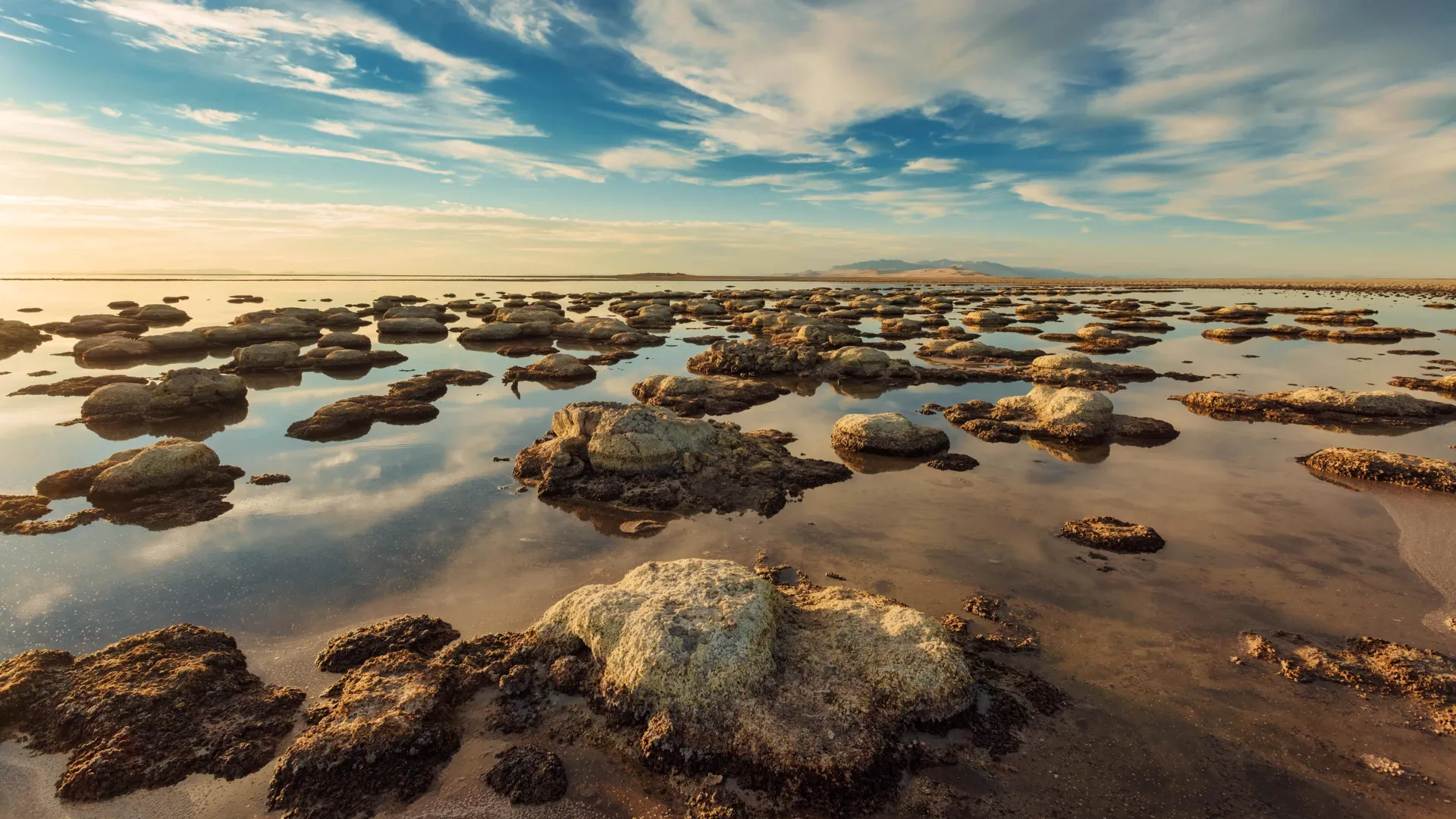
Until recently, no nematodes had been definitively documented in the Great Salt Lake. That changed in 2022, when field expeditions led by Julie Jung uncovered nematodes living in the lake’s microbialites. These are hardened, mound-like structures formed by microbial communities on the lakebed.
Jung, who was a postdoctoral researcher in Werner’s lab at the time, collected samples while traveling across the lake by kayak and bicycle. The team reported that initial discovery in a scientific paper published last year.
“We thought that this was probably a new species of nematode from the beginning, but it took three years of additional work to taxonomically confirm that suspicion,” said Jung, now an assistant professor at Weber State University.
Only the Third Animal Known to Survive There
With this finding, nematodes became just the third group of animals known to live in the Great Salt Lake’s extremely salty water. The other two are brine shrimp and brine flies, which are crucial food sources for millions of migratory birds that stop at the lake each year.
Further research suggests the story may not be finished. Genetic evidence indicates there could be a second, previously unknown nematode species among the samples collected. Thomas Murray, an undergraduate researcher and second author on the paper, has been helping sample different regions of the lake to investigate this possibility.
“It’s hard to tell distinguishing characteristics, but genetically we can see that there are at least two populations out there,” Werner said.
How Did the Worms Get There?
The discovery raises two major questions for scientists. First, how did these worms arrive in the Great Salt Lake? Second, what role do they play in the lake’s ecosystem?
From early on, the team suspected the nematodes belonged to the family Monhysteridae. This is an ancient group of nematodes known for surviving in extreme conditions, including very salty environments. Genetic and physical analyses confirmed that the species belongs to the genus Diplolaimelloides, a group typically found in coastal marine and brackish waters.
That makes the Great Salt Lake discovery especially puzzling. Only one other member of this genus is known to live outside coastal regions, and that species is found in eastern Mongolia. The Great Salt Lake, by contrast, sits about 4,200 feet above sea level and is roughly 800 miles from the nearest ocean.
“That begs some more interesting, intriguing questions that you wouldn’t have even known to think of until we figured out the alpha taxonomy,” Werner said. “There are two hypotheses, two models that are both kind of crazy for different reasons.”
Ancient Seas or Traveling Birds
One explanation comes from coauthor Byron Adams, a nematologist and biology professor at Brigham Young University. He suggests the worms may have been living in the region for millions of years. During the Cretaceous Period, much of what is now Utah was located along the shoreline of a vast inland sea that split North America in two.
“So we were on the beach here. This area was part of that seaway, and streams and rivers that drained into that beach would be great habitat for these kinds of organisms,” Adams said. “With the Colorado Plateau lifting up, you formed a great basin, and these animals were trapped here. That’s something that we have to test out and do more science on, but that’s my go-to. The null hypothesis is that they’re here because they’ve always kind of been here.”
Werner pointed out a major challenge to that idea. Northern Utah has not always been salty. Between 20,000 and 30,000 years ago, the region was covered by Lake Bonneville, a massive freshwater lake.
“If the nematode has been endemic since 100 million years ago, it has survived through these dramatic shifts in salinity at least once, probably a few times,” he said.
The alternative explanation, which Werner admits is even “crazier,” is that the worms were transported by migratory birds. In this scenario, nematodes could have clung to feathers after birds visited saline lakes in South America and were then carried thousands of miles north.
“So who knows. Maybe the birds are transporting small invertebrates, including nematodes, across huge distances,” Werner said. “Kind of hard to believe, but it seems like it has to be one of those two.”
A Potential Early Warning for Lake Health
Back in the lab, researchers noticed another unexpected pattern. Female nematodes were far more common than males in samples collected directly from the lake.
“That’s another confusing part of the story for us. When we sample out there on the lake and bring them back in the lab, we get less than 1% males. But when we have cultured them in the lab, the males make up about 50% of the sex ratio,” Werner said. “We’re super happy to be able to culture them in the lab, but there’s something about it that’s clearly different than the lake environment.”
The worms live within algal mats that coat the lake’s microbialites, feeding on bacteria that thrive there. Researchers found that the nematodes are concentrated in just the top few centimeters of these mats and are absent below that layer.
While scientists are still determining their exact position in the food web, nematodes are known to be ecologically important in many environments. Their presence in the Great Salt Lake suggests they likely play a meaningful role there as well.
Nematodes are also widely used as bioindicators. Changes in their populations, diversity or distribution can signal shifts in water quality, salinity or sediment chemistry. With the Great Salt Lake under increasing pressure from human activity, this newly identified species could become a valuable tool for monitoring environmental change.
“When you only have a handful of species that can persist in environments like that, and they’re really sensitive to change, those serve as really good sentinel taxa,” Adams said. “They tell you how healthy is your ecosystem.”
Because Diplolaimelloides woaabi appears to live exclusively on microbialites, it may have unique relationships with microbes or unusual survival strategies that scientists have yet to uncover. Since microbialites play a central role in producing energy and supporting life in the lake, any interactions involving these nematodes could have effects that spread throughout the ecosystem.
Study Details and Funding
The research appears in the November 2025 issue of the Journal of Nematology under the title, “Diplolaimelloides woaabi sp. n. (Nematoda: Monhysteridae): A Novel Species of Free-Living Nematode from the Great Salt Lake, Utah.”
The study’s authors include Solinus Farrer, Abigail Borgmeier and Byron J. Adams of Brigham Young University; Jon Wang and Morgan Marcus of the University of Utah; Gustavo Fonseca of the Federal University of São Paulo; and Thomas Powers of the University of Nebraska. Funding was provided by the National Institutes of Health, the Society of Systematic Biologists, the National Science Foundation and the Conselho Nacional de Desenvolvimento Científico e Tecnológico.
Source link
-

-

-

-

-