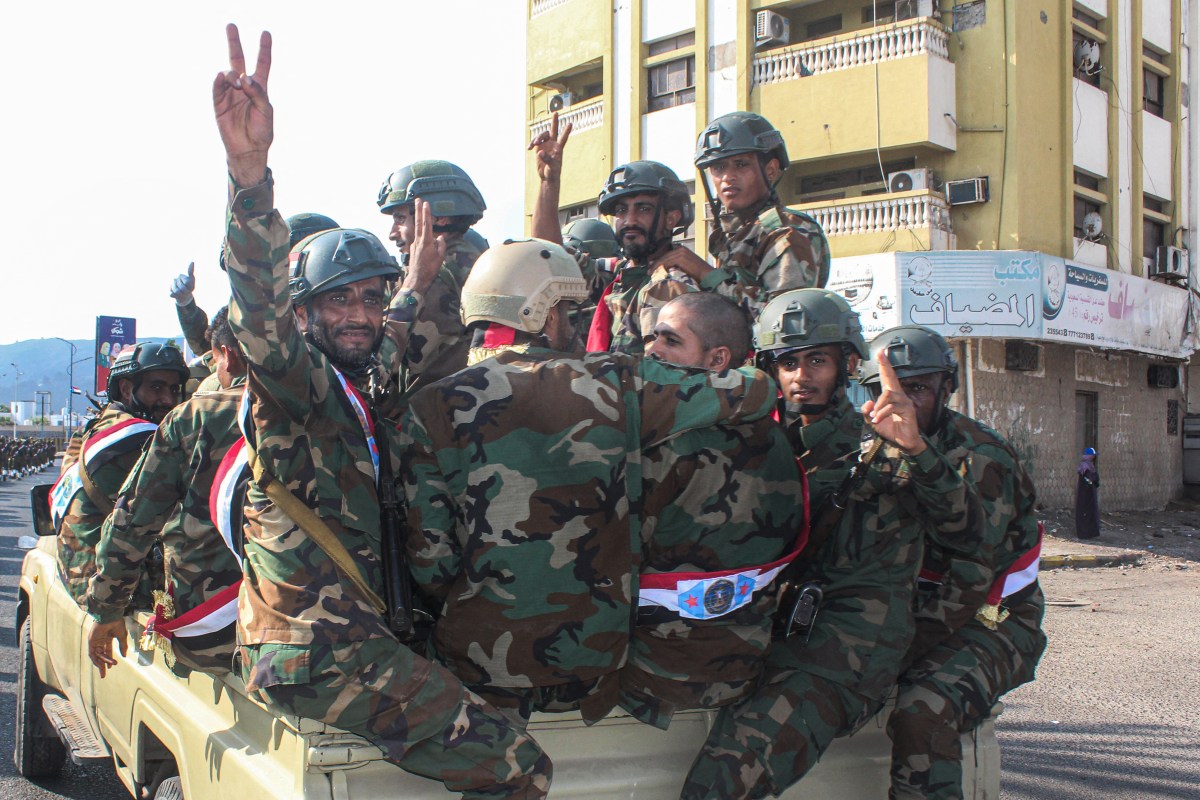
The sudden seizure of key positions across southern Yemen by the Southern Transitional Council (STC), a close ally of the United Arab Emirates, has drawn new international attention to the largely frozen front lines of an 11-year civil war where foreign influence has long been dominated by Saudi Arabia and Iran.
While the STC has been predominantly aligned with Yemen’s Saudi-backed and internationally recognized government in their fight against the Iran-supported Ansar Allah, also known as the Houthi movement, the sweeping offensive launched last week and continuing through Monday took place throughout nominally government-held territory, including the oil-rich province of Hadramawt and neighboring Mahra.
And with the Yemeni government’s influence already limited to the south due to Ansar Allah’s early northern victories that included the storming of the capital Sanaa more than a decade ago, the STC’s presence in the presidential palace in the southern de facto capital of Aden now puts the group at the forefront of the conflict and regional faultlines.
But the shift, while seismic for the future of Yemen, came as little surprise to those closely following the nature of the conflict in which the STC’s presence has steadily eclipsed the waning control of the government and a schism between Saudi Arabia and the UAE, two of the most influential powers in the region and closest partners to the United States, has grown.
“The STC’s most powerful force, the Southern Giants Brigades, has achieved significant battlefield success, and with Saudi–UAE tensions widening, the STC has pushed to consolidate control across southern governorates,” Mohammed al-Basha, founder of the Basha Report, a Virgina-based risk advisory firm focused on the Middle East and North Africa region, told Newsweek.
“Whatever occurred this week was long anticipated,” Basha said, “as any visitor to the temporary internationally recognized government capital in Aden would note that symbols of the Republic of Yemen have largely vanished, reflecting the STC’s growing dominance on the ground.”
The South Rises Again
All across southern Yemen, and even in meetings held in recent days by Southern Giants Brigade commander Abd al-Rahman al-Mahrami, also known as Abu Zaraa, in the office of Presidential Leadership Council Chair and internationally recognized head of state Rashad al-Alimi, the flags and symbols of the national government appear to have disappeared, in many cases replaced with the STC’s official logo that matches the former independent state of South Yemen.
From an uprising against British colonialism in 1967 until unification in 1990, the People’s Democratic Republic of Yemen existed as a separate nation and the Arab world’s only communist state. Today, the STC espouses little in the way of Marxist-Leninist ideology but continues to promote a narrative of southern independence, one that has manifested amid its recent consolidation of power in the form of mass rallies among supporters.
The STC’s separatist goals have long been a point of fissure, even as it fought alongside Yemeni government troops against Ansar Allah, which are primarily comprised of Yemen’s Zaidi Shiite community that ruled the nation for nearly 1,000 years until a 1962 revolution, as well as an array of Sunni Islamist militant groups, including affiliates of Al-Qaeda and the Islamic State (ISIS).
“The Saudi-backed internationally recognized government of Yemen and the UAE-backed Southern Transitional Council are united mainly by shared security threats from Houthi attacks and terrorist activity in southern Yemen, but they remain fundamentally different in vision and structure,” Basha said. “The internationally recognized government seeks a unified Yemeni state, while the STC has steadily built the foundations of an independent southern state since 2017 through its own governing bodies and military, security, and intelligence institutions.”
“The STC has long demanded the removal of the 1st Military Region Command from Sayoun and the Wadi and Desert districts of Hadramawt because it views these northern units as remnants of the 1994 occupying forces and wants them redeployed to fight the Houthis in Marib,” he added. “Rivalry over territory, influence, appointments, and revenue has produced recurring clashes, including major confrontations in 2017, 2018, 2019, and most recently in Hadramawt in 2025.”
The tug of war has also played out at the highest levels of Yemeni governance. Under a power-sharing agreement reached in 2022, southern factions were given influential representation under Yemen’s newly formed Presidential Leadership Council, with Mahrami, STC Chair Aidarus al-Zoubaidi and Vice Chair Faraj al-Bahsani bestowed vice presidential seats in the eight-person executive body led by Alimi.
Two of the four remaining seats are occupied by Islamist Al-Islah Party members Sultan Ali al-Aradah, who is also governor of Marib province, and Abdullah al-Alimi Bawazeer. The other are held by Tareq Saleh, who is the National Resistance military coalition leader and nephew to late longtime President Ali Abdullah Saleh, and influential tribal leader Othman Hussein Megali, who hails from the Houthi homeland of Saada and is fiercely opposed to the group.
Basha argued that the government’s alignment with the Al-Islah Party, officially known as the Yemeni Congregation for Reform, has proven problematic for the STC, which he said has a different outlook on who should lead operations against Ansar Allah.
“Although both oppose the Houthis, they differ sharply on political goals and security structures,” Basha said, “and the STC rejects supporting northern forces aligned with the Islah Party, preferring that its UAE-backed ally Tariq Saleh lead operations in the north.”
Friends and Foes
In fact, the STC has framed its operations in the south not as a challenge to the government but rather as an effort to uproot the influence of military units loyal to the Al-Islah Party, which emerged out of a Muslim Brotherhood coalition to rival leftist forces during the Cold War that fueled several wars, crises and conflicts in Yemen.
“What has transpired in recent days is that a vast strategic area—the Hadramawt Valley and Desert, and Al-Mahra Governorate—was controlled by military formations affiliated with the Muslim Brotherhood,” STC spokesperson Anwar al-Tamimi told Newsweek.
“These formations had managed, over the years, to present themselves as part of the legitimate Yemeni forces,” he said, “but it is widely known that they are merely the military wing of the Yemeni Congregation for Reform (Al-Islah Party), the Yemeni branch of the Muslim Brotherhood.”
The STC’s feud with Al-Islah is rooted beyond its Muslim Brotherhood leanings, however. Tamimi accused its allied factions in the south of Yemen of allowing these territories to become “a conduit for weapons to the Houthis, thus contributing to their strength and prolonging the war.”
“The smuggling was not limited to the Houthis; the area also became a conduit for weapons to other terrorist groups operating in other countries, such as the Somali al-Shabaab movement,” Tamimi said. “Furthermore, it became a safe haven for drug traffickers and international smuggling gangs.”
“Faced with this abnormal situation, the Southern Forces moved to address and secure the deteriorating conditions, and to organize the military situation in preparation for confronting the Houthis, who were preparing to attempt to storm these areas,” he added, noting this situation pertained specifically to operations conducted in the provinces of Hadramawt and Shabwah.
As for Aden, he said that the STC had been present in the crucial port city since the defeat of Ansar Allah there in the early stages of the civil war in 2015. And while Aden has also hosted clashes between the STC and government forces in past years, notably the 2018 battle that resulted in the southern factions gaining control of much of the city, Tamimi asserted that the more recent withdrawal of the government’s “symbolic” Presidential Guard did not come at the orders of the STC, but rather Alimi himself.
The UAE has also sought to dispel notions that it was staging any form of challenge to Yemen’s government or its powerful partner, Saudi Arabia.
Reached for comment, a UAE official shared with Newsweek a statement in which the country declared that its “unwavering position on the Yemen crisis is in line with Saudi Arabia in supporting a political process that is based on the GCC initiative and its implementation mechanism, in addition to the outcomes of the Yemeni comprehensive national dialogue, and UN Security Council resolutions, including UNSCR 2216.”
“We remain committed to all international peace efforts that lead to a resumption of the political process, ultimately serving the aspirations of the Yemeni people for security, stability, and prosperity,” the UAE official added. “The UAE asserts that the governance and territorial integrity of Yemen is an issue that must be determined by the Yemeni parties themselves.”
The official also pointed to the UAE’s status “as one of the largest providers of humanitarian assistance to Yemen—having provided Yemen with a total of USD 7.3 billion in aid since 2015,” and said that “the UAE will continue working in partnership with the international community to end the suffering of the Yemeni people.”
Newsweek has also reached out to representatives of the Yemeni government, Saudi Arabia, the U.S. State Department and Ansar Allah for comment.
In a statement issued by his office following a meeting with ambassadors in the Saudi capital of Riyadh on Monday, Alimi condemned what he called the “unilateral steps taken by the Southern Transitional Council,” arguing they “violate the frameworks guiding the transitional phase, undermine unified security and military decision-making, weaken the legitimate government’s authority, and threaten overall stability and the political process.”
Alimi also “called on the international community to reject any challenge to the government’s exclusive authorities, to press for the withdrawal of forces deployed from outside Hadramawt and Al-Mahra,” and expressed gratitude to Saudi Arabia role in facilitating de-escalation in Hadramawt, including efforts to protect oil facilities and prevent escalation.”
The U.S. Embassy in Yemen later issued a statement detailing a meeting between a delegation and Alimi, with whom the U.S. delegation discussed “shared concerns regarding recent developments in Yemen, particularly in Hadramout and Al-Mahrah.”
“We welcome all efforts towards de-escalation,” the U.S. Embassy said, adding that Washington “continues to support” the work of the Yemeni government and Presidential Leadership Council “to strengthen the security and stability of Yemen.”


A Clash of Titans
While traditional partners Abu Dhabi and Riyadh continue to work together on a number of bilateral and regional initiatives, some analysts view the latest episode in Yemen as part of a broader rift emerging between the two top Gulf Cooperation Council powers that extends to North Africa as well.
Adel Dashela, fellow at Middle East Studies Association Global Academy in North Carolina, told Newsweek that “the regional situation is witnessing intense competition between Saudi Arabia and the UAE, which has been clearly manifested in their positions on the Sudanese crisis: Saudi Arabia stands with the Sudanese government represented by the Transitional Council led by Abdel Fattah al-Burhan, while the UAE stands with the Rapid Support Forces, providing them with financial and military support and even bringing in mercenaries from other countries.”
Similar reports have arisen regarding the UAE’s alleged support for Libyan National Army chief Field Marshall Khalifa Haftar, who effectively leads a rival administration against that country’s Tripoli-based internationally recognized government.
In both cases, UAE officials have rejected any direct military aid to non-state actors, though Abu Dhabi has openly embraced its partnership with the STC given its formal integration into the government.
Still, Dashela felt a Saudi-UAE rivalry has “negatively impacted the Yemeni issue, as the UAE has supported the Southern Transitional Council to militarily seize control of the governorates of al-Mahra and Hadramawt, Yemen’s largest governorates, which are theoretically supposed to be areas of Saudi influence.”
Noting Alimi’s tough talk on the events, Dashela argued that “this rhetorical strength, appearing for the first time, indicates that the parties have reached a deadlock, at a time when the STC realizes it cannot declare secession because the international community is not prepared to recognize a unilateral step, and Saudi Arabia is not ready to bear the consequences of such a choice,” one made all the more complicated by the United Nations’ wartime pledge to respect Yemen’s territorial integrity.
Thus, he said the two regional powers were engaged in a battle of clout, with the head of Saudi Arabia’s special committee on Yemen being dispatched to Hadramawt for the first time in a decade as part of an “attempt to regain the initiative in the east, while the STC has managed to extend its influence there with Emirati support as a kind of response to the Saudi position on Sudan, pushing the relationship between Riyadh and Abu Dhabi into a new phase of field tension.”
“At the same time, Saudi Arabia continues to insist on the necessity of the STC withdrawing its forces from Hadramawt and al-Mahra, and Saudi Arabia has also withdrawn some of its military formations from Aden,” Dashela said, “while the STC decided to organize large-scale popular demonstrations as a clear reaction with Emirati direction, with the possibility of escalation or even attempting to declare secession—despite the significant risks involved.”
With these risks now mounting and the STC becoming increasingly powerful on the ground, he felt even a reconciliation agreement and UAE call for the influential southern force’s withdrawal may not be enough to reverse these recent developments. And “the alternative scenario” in which Saudi Arabia effectively accepts the new status quo “would leave its allies in the legitimate government forced to fight their own battle.”
“Ultimately, the internationally recognized legitimate Yemeni government may fight the forces of the STC council and Houthis at the same time,” Dashela said. “However, this may help Houthi expansion southward and return the country to a cycle of conflict that no party can easily win.”
Ibrahim Jalal, a consultant and adviser focusing on Yemen, the Persian Gulf region and the Horn of Africa, pointed out that “divergence in strategic visions between states is not too odd, and the Saudi-Emirati divergence in Yemen is no exception.”
More often than not, he said, manifestations of divergence have managed to steer clear of direct confrontation. And even with the dynamics now shifted by the STC taking the issue to the field in Yemen, building on existing perceptions of a Saudi-UAE split over the war in Sudan, he said “such differences are typically managed through bilateral channels among strategic allies.”
But “when these mechanisms reach an impasse,” he warned, “their negotiations may shift to alternative forms—occasionally producing short-term destabilizing effects.”
“As for the Houthis, they are exploiting these fractures to expand public mobilization, recruitment, and ideological indoctrination, while simultaneously discrediting the Arab Coalition, the Yemeni government, the STC, and Islah,” Jalal told Newsweek. “Hence, they could choose to test the military readiness of the government camp, if they wanted, given the distractions.”
“This is the moment when the government camp can least afford such internal and external divisions, especially given the developing international stances,” Jalal said. “Now the government’s international friends are watching, and recalibrating policy choices respectively as they seek answers to new questions.”

A New Challenge for Trump
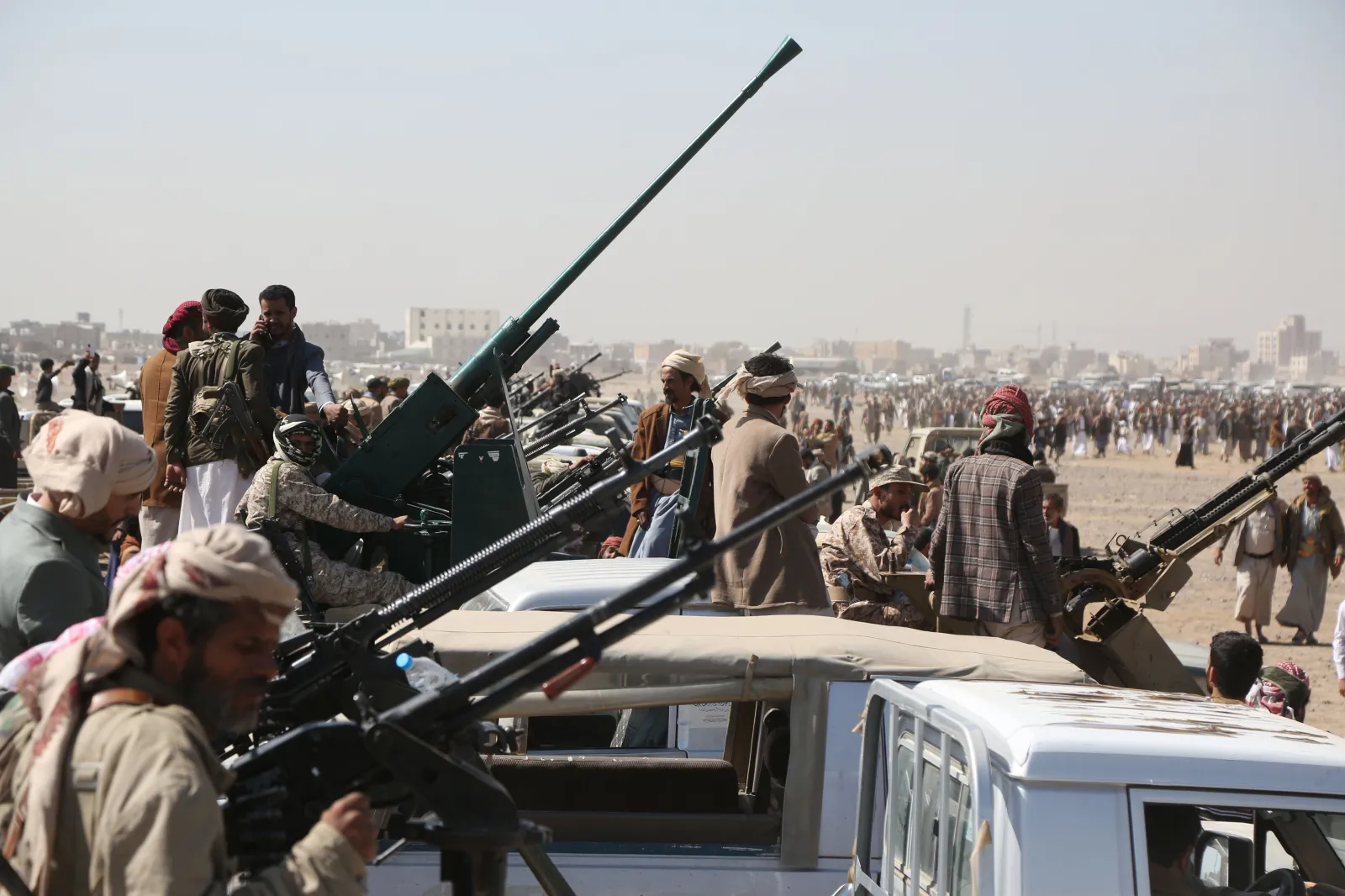
Yemen has long proven a challenging frontier for competing foreign forces and Ansar Allah has emerged as one of the most frustrating factions for far more powerful foes.
Rooted in a 1990s Zaidi Shiite revival movement founded by Hussein al-Houthi, who was killed in a 2004 clash with Yemeni security forces, the group—then led by his son, Abdul Malik—grabbed global headlines a decade later as it seized upon post-Arab Spring unrest that toppled Saleh’s 34-year rule in 2012 to challenge his successor, then-President Abed Rabbo Mansour Hadi, ultimately ousting him from Sanaa in 2015.
Saudi Arabia responded with force, with rising Prince Mohammed bin Salman—still yet to be named heir to the throne—assembling a coalition of allies, including the UAE and backed by the U.S., to stage an intervention that March in support of the embattled government forces. Years of fighting produced some notable wins for Riyadh’s partners, notably the retaking of Aden, but a ceasefire reached with U.N. support in 2021 left Ansar Allah firmly in control of Sanaa along with much of the north and west, altogether constituting up to 80 percent of Yemen’s population.
While the truce has largely held, also protecting Saudi Arabia and the UAE from unprecedented missile and drone strikes launched by Ansar Allah on their own territory, the group directed its vast arsenal widely suspected to be provided by Iran elsewhere two years later. As part of the Tehran-led Axis of Resistance coalition, Ansar Allah began a long-range campaign of strikes against Israel following the outbreak of the war in Gaza and began striking ships transiting the Red Sea to impose an effective blockade against its foe located roughly 1,000 miles away.
Ansar Allah’s action drew direct retaliation from Israel and the U.S., a campaign that was ramped up when President Donald Trump took office earlier this year. The costly U.S. operation would last less than two months of high intensity, however, before the White House announced it had reached a deal with Ansar Allah that would prevent maritime attacks, though the group continued to fire at Israel until an Israel-Hamas ceasefire reached under Trump’s lead in October.
Today, as the U.S. strives to keep the Gaza truce together, “Yemen is not a priority for the Trump administration,” said Thomas Juneau, associate fellow with the Chatham House’s Middle East and North Africa Program and professor at the University of Ottawa’s Graduate School of Public and International Affairs.
“It has gone down the list now that strikes against the Houthis have stopped,” Juneau told Newsweek. “To the extent that the Trump administration is concerned with Yemen, it very much looks at it from the perspective of an eventual resumption of Houthi strikes in the Red Sea or on Israel. Events in the south are simply not much of a priority.”
He argued this could change, however, as the situation threatens to escalate from a localized dispute to a broader feud between two of the U.S. leader’s closest and most influential Arab partners.
And the risk of such an escalation is real, Juneau pointed out, given that the southern question in Yemen has already emerged in the open as “a very difficult issue between Saudi Arabia and the UAE,” with the former now faced with another potential blow to its position just across the border and few paths toward reestablishing a united front against Ansar Allah.
“My reading of Saudi inaction has been paralysis because of a lack of good options,” Juneau said. “It’s not clear to me what Saudi Arabia could have done without, at least becoming bogged down again in the war in Yemen, which it absolutely wants to avoid.”
“At the very least, this has not been a good week for Saudi Arabia. This is very good news for the Houthis,” he added. “The Houthis have always benefited from the weakness and fragmentation of the internationally recognized government. This is further weakening the internationally recognized government, thereby de facto strengthening the Houthis.”
Without a clear path toward resolution, the issue could soon become yet another pressing file on the desk of a U.S. president who has vowed to put a stop to global conflicts that appear to just keep piling up.
“In the longer term, it does raise the issue of the American position on the question of a unified Yemen or not,” Juneau said. “It’s a question that the U.S. can punt down the road for now, but if or when the STC tries to seriously and formally move towards independence, then that will raise the issue of what is the American position on this.
“So, in the longer term, that will be an important challenge.”
Update 2:30 p.m. ET: This article has been updated to include addition statements from a UAE official and the U.S. Embassy in Yemen.
Source link
-

-

-

-
-