
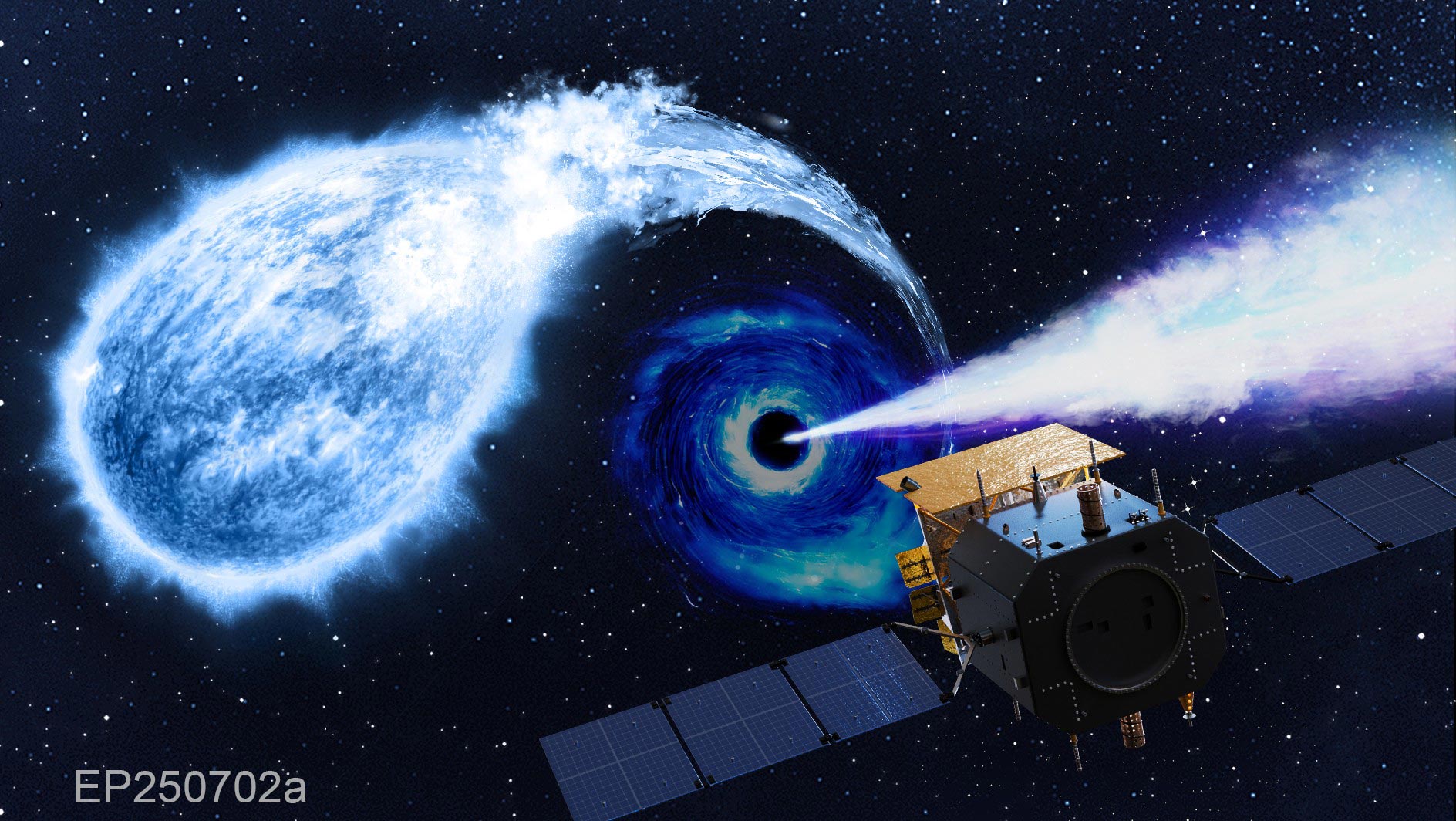
A newly detected X-ray transient may reveal the first direct evidence of an intermediate-mass black hole consuming a white dwarf.
A newly observed cosmic outburst is giving astronomers a rare glimpse into some of the most extreme processes in the universe.
On July 2, 2025, the China-led Einstein Probe (EP) space telescope identified an extraordinarily bright X-ray source while conducting a routine survey of the sky. What immediately caught scientists’ attention was how rapidly the object’s brightness changed. Its unusual behavior distinguished it from typical high-energy sources and prompted observatories around the world to begin immediate follow-up observations.
The investigation was led by the EP Science Center at the National Astronomical Observatories, Chinese Academy of Sciences (NAOC), and involved contributions from research institutions across China and other countries. Scientists from the Department of Physics at The University of Hong Kong (HKU), key members of the EP science team, collaborated closely with international partners to analyze the event.
Their analysis suggests the signal could capture the moment when an intermediate-mass black hole rips apart and absorbs a white dwarf star. If this interpretation is verified, it would represent the first direct observational evidence of such an extreme black hole “feeding” event. The study has been published as a cover article in Science Bulletin.
A Cosmic Event that Broke the Usual Pattern
The discovery relied on EP’s two complementary X-ray instruments. During its routine observations on 2 July 2025, the Wide-field X-ray Telescope (WXT), which uses lobster-eye micro-pore optics to achieve both a wide field of view and high sensitivity, detected a highly variable X-ray transient. The source was later named EP250702a (also known as GRB 250702B). At nearly the same time, NASA’s Fermi Gamma-ray Space Telescope recorded multiple gamma-ray bursts coming from the same region of the sky.
The full importance of the detection became clear only after researchers reviewed earlier WXT data. The telescope had already recorded steady X-ray emission from that exact location roughly a day before the gamma-ray bursts occurred, an unusual sequence for powerful high-energy explosions. About 15 hours after the first signal, the source flared dramatically, producing intense X-ray bursts that reached a peak luminosity of approximately 3 × 10⁴⁹ erg s⁻¹. That brightness ranks it among the most powerful instantaneous outbursts ever observed in the Universe.
“This early X-ray signal is crucial,” said Dr Li Dongyue, first author of the paper from the National Astronomical Observatories of China. “It tells us this was not an ordinary gamma-ray burst.”

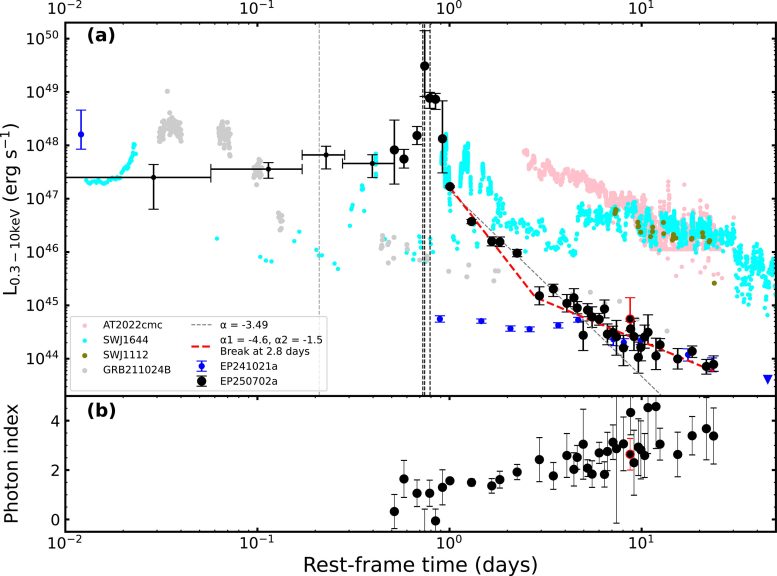
Thanks to the precise coordinates provided by WXT, several large telescopes worldwide rapidly followed up, successfully pinpointing the celestial object across multiple wavelengths and confirming its location in the outskirts of a distant galaxy. Subsequently, EP’s other instrument—the Follow-up X-ray Telescope (FXT) took over, tracking the source’s dramatic evolution. Over about 20 days, its brightness dropped by more than a hundred thousand times, while its X-ray emission shifted from higher-energy (“hard”) to lower-energy (“soft”) states.
By combining data from the EP with follow-up observations across the electromagnetic spectrum, scientists found that EP250702a exhibited a set of unusual features that existing models could not fully explain. Its X-ray emission appeared before the gamma-ray burst, was extraordinarily bright, evolved on a remarkably fast timescale, and occurred in the outskirts of its host galaxy rather than at its center—a pattern rarely seen in known high-energy cosmic events. Among the many theoretical scenarios considered, one explanation finally stood out: an intermediate-mass black hole tearing apart a white dwarf star.
HKU Astrophysicists Provide Key Model Support
The HKU team played vital roles in data interpretation and theoretical modeling, leading to the identification of the underlying physical mechanism of the phenomenon. The team of Professor Dai Lixin from the Department of Physics and the Hong Kong Institute of Astronomy and Astrophysics (HKIAA) at HKU provided the crucial theoretical judgment that led to the focus on this model. As a co-corresponding author, she explained, “The white dwarf–intermediate-mass black hole model can most naturally explain its rapid evolution and extreme energy output.”
Dr Chen Jinhong, a co-first author of the paper and a postdoctoral fellow in the HKU Department of Physics, conducted in-depth numerical simulations to analyze the model. “Our computational simulations show that the combination of the tidal forces of an intermediate-mass black hole, combined with the extreme density of a white dwarf, can produce jet energies and evolutionary timescales that are highly consistent with the observational data,” he said.
Professor Zhang Bing, Director of HKIAA at HKU and a co-author of the paper, stated, “Hong Kong possesses an internationalized research vision and technical expertise in astronomy. The HKU team’s deep involvement and contribution to this significant discovery fully demonstrate the unique value and critical role of Hong Kong’s scientific research capabilities in the forefront of global scientific exploration.”
Professor Dai Lixin added, “The robust discussion among international teams, each with their competing models to explain this event, is precisely what highlights its immense scientific value.”
A missing class of black holes comes into view
“The mission of the Einstein Probe is to capture unpredictable and extreme transient phenomena in the universe,” said Professor Weimin YUAN from the National Astronomical Observatories of China, Principal Scientist of the Einstein Probe mission. “The discovery of EP250702a fully demonstrates our capability to be the first to capture the Universe’s most extreme moments and further exemplifies China’s ability to make decisive contributions to international astronomical exploration.”
If ultimately confirmed, this event would provide the first clear, direct evidence of an intermediate-mass black hole tearing apart a white dwarf and producing a relativistic jet. Such a discovery would help shed light on the long-missing population of intermediate-mass black holes and open new avenues for studying how black holes grow, the ultimate fate of compact stars, and the emerging field of multi-messenger astronomy.
Reference: “A fast powerful X-ray transient from possible tidal disruption of a white dwarf” by Dongyue Li, Wenda Zhang, Jun Yang, Jin-Hong Chen, Weimin Yuan, Huaqing Cheng, Fan Xu, Xinwen Shu, Rong-Feng Shen, Ning Jiang, Jiazheng Zhu, Chang Zhou, Weihua Lei, Hui Sun, Chichuan Jin, Lixin Dai, Bing Zhang, Yu-Han Yang, Wenjie Zhang, Hua Feng and Yonghe Zhang, 13 February 2026, Science Bulletin.
DOI: 10.1016/j.scib.2025.12.050
Never miss a breakthrough: Join the SciTechDaily newsletter.
Follow us on Google and Google News.
Source link
-

-

-

-

-


