
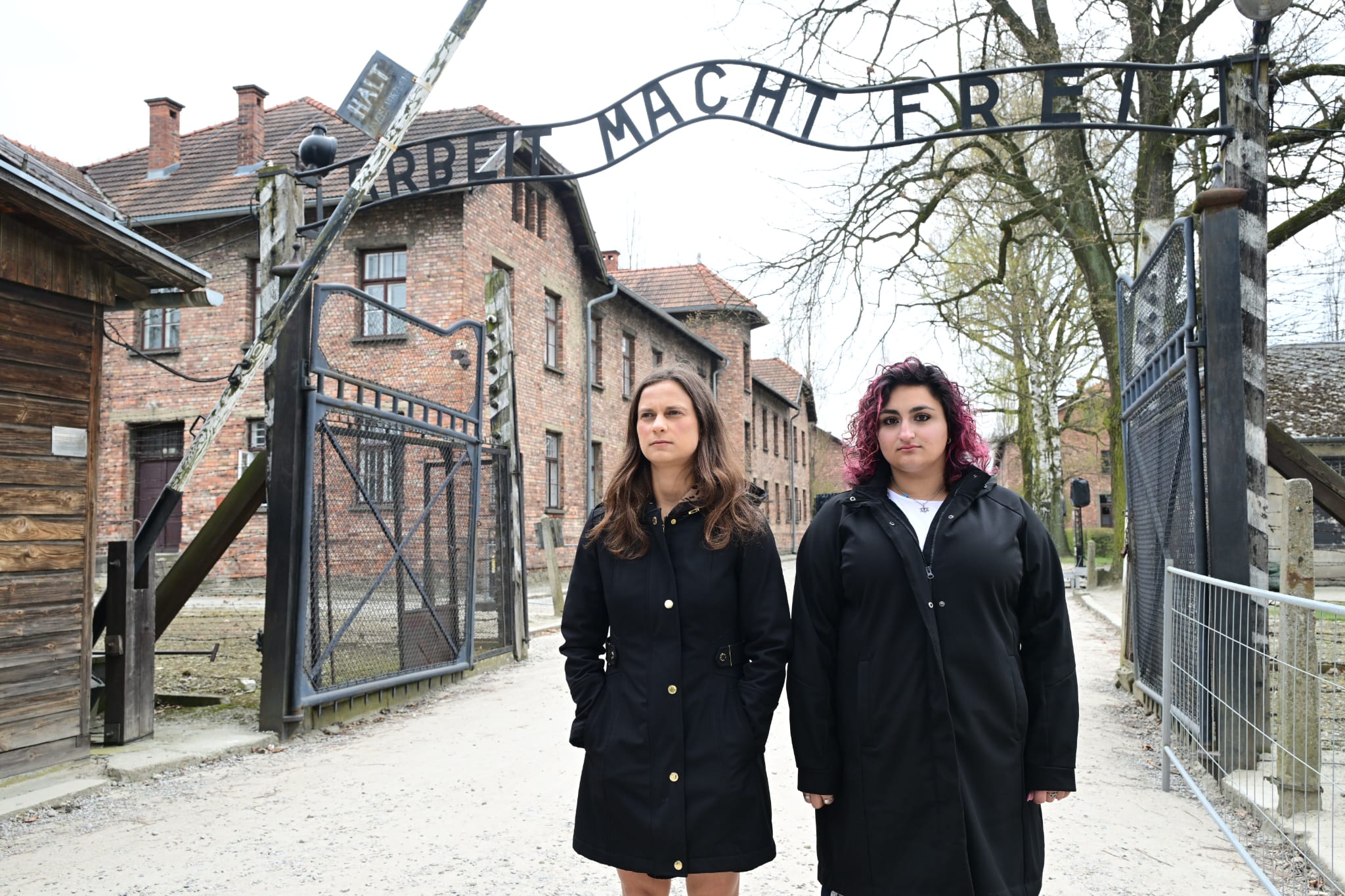
OSWICIEM, Poland — Abbie Talmoud said she can still hear the screams from a terror attack outside a Jewish museum in Washington, DC, last year, in which Israeli Embassy staffers Sarah Milgrim and Yaron Lischinsky were fatally shot.
Standing outside the gates of Auschwitz on Monday, Talmoud told The Times of Israel that she was coming to terms with the fact that the attacker murdered her colleagues, and tried to kill her, “because of antisemitism.”
“I have to be stronger, and I have to love my Judaism more than they will ever hate me,” she said.
Talmoud and fellow survivor Catherine Szkop, both embassy staff who were colleagues of the victims, are in Poland for the 38th International March of the Living, which takes place on Tuesday, Israel’s Holocaust Remembrance Day. There, they lit a memorial torch together with survivors of antisemitic terror attacks this year in Manchester, England, and Sydney, Australia.
“One of the suggestions through therapy has been to talk to Holocaust survivors,” Talmoud told The Times of Israel. “To learn from their resilience and their ability to move forward with life, and how to really live with this trauma while also living and continuing on. In short, to be resilient.”
Talmoud said Monday she looked forward to meeting with fellow survivors from global antisemitic attacks, “because they will understand me in the way that the average Joe does not.”
On Tuesday, that meetup between survivors of antisemitic attacks from three continents took place during a moving event ahead of the march.
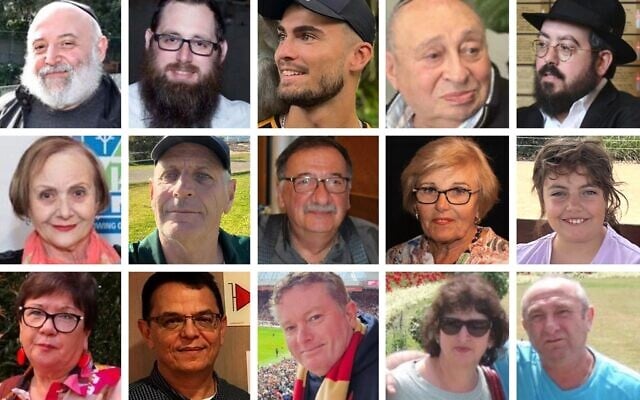
Hanna Abesidon was at Sydney’s Bondi Beach when gunmen attacked a Hanukkah celebration on December 14, killing 15 people, including her father, Tibor Weitzen. On Tuesday, exactly four months later — and one day before the 81st anniversary of her grandmother’s liberation from Bergen Belsen — Abesidon described the ordeal to the audience of gathered journalists and dignitaries.
She described attending the event with her parents, nine-month pregnant daughter, and 3-year-old grandchild. It was only when she managed to get her grandchild to safety that Abesidon returned to check on her parents.
“I came closer to the area where Mom and Dad were sitting, and I recognized Dad’s shoes and pants, but he was covered already, so I knew that he was gone,” she said. “He didn’t make it because he was a Jew, nothing else.”
Abesidon’s mother, Eva, survived, although her best friend was also murdered at the scene.

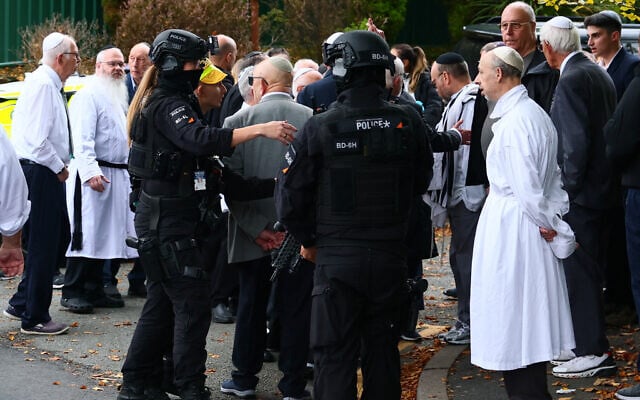
Heaton Park survivor Yoni Finlay described arriving at his Manchester synagogue early on Yom Kippur, which this year fell out on October 2, as he was due to lead the morning service. Finlay recalled saying hello to the guard and to other congregants, two of whom died in the terror attack that morning, when a British citizen born in Syria rammed his car into pedestrians outside the synagogue and then went on a stabbing rampage.
“There were about seven or eight people holding the [synagogue] doors closed while a very large, very, very angry person was doing his level best to get in, and he had a knife,” Finlay said. “He was using the knife to try and break through. He was picking up things from the grounds of the shul, trying to break in, and he had what looked like a bomb around his waist.”
When police arrived at the scene, they shot and killed the attacker, but a stray bullet hit Finlay in the chest. Someone at the scene found Finlay’s father and brought him to his side.
“I remember his face — no child should ever see their parent like that,” said Finlay. “He said afterwards that he’s a doctor, but he’s not trained for that.”
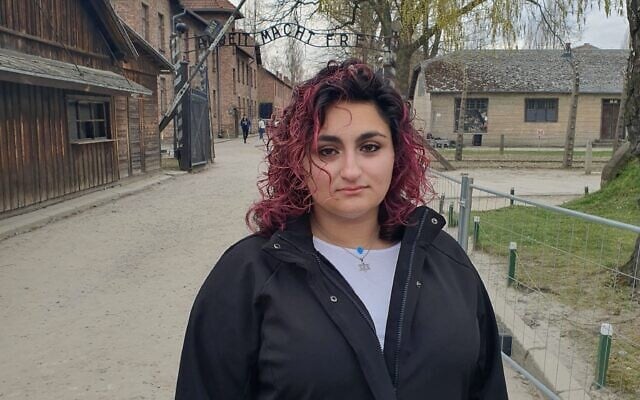
Talmoud also recounted the horrors of the day that her colleagues from the Israeli Embassy were murdered at an event outside the Capital Jewish Museum in Washington, DC, last May.
Talmoud and Szkop had carpooled to an event at the Capital Jewish Museum together with Milgrim and Lischinsky on May 21, 2025. When they left at around 9 p.m. to return to Talmoud’s car, a gunman opened fire, killing their colleagues. Both Talmoud, 25, and Szkop, 29, cowered on the ground just feet from where their colleagues were murdered in cold blood.
“I still am looking over my shoulder to see if someone is going to shoot me again,” said Talmoud. “On the other hand, I still wear my Star of David, and I’m decked out in it, because just because you tried to kill me doesn’t mean I’m not going to be more Jewish. In fact, try again.”
Abesidon admitted she does feel unsafe, but does not make it obvious.
“I don’t want to show that I’m scared, because these people, they thrive on us being scared,” she said. “We are here to stay. We’re not going anywhere. All the ones that try to persecute us, they’re not here anymore. We are here.”
All three of the terror survivors said that they no longer felt safe in their home countries of Australia, the UK and the US, respectively. Their feelings are born out in a recent Tel Aviv University report saying that 2025 was the deadliest year on record for Diaspora Jews in three decades.
Another tough year
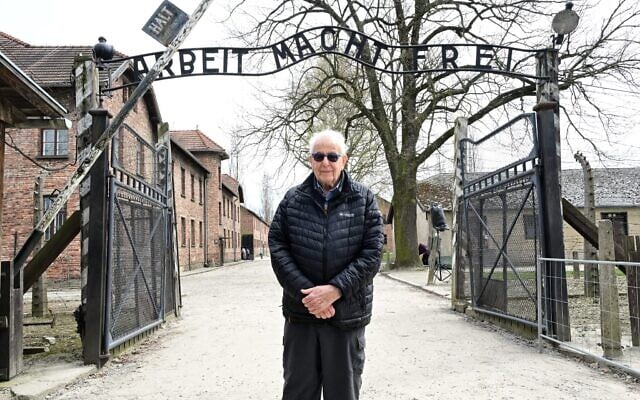
Auschwitz survivor Nate Leipciger was returning to the March of the Living for the 22nd time from his home in Toronto.
Speaking to the press on Tuesday and addressing the terror survivors and delegation of international police leaders, 98-year-old Leipciger said that he “grew up in a world of antisemitism.”

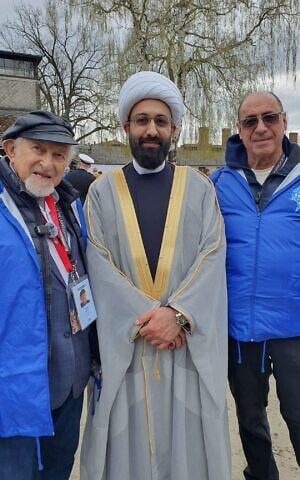
“Antisemitism, as you know, has existed for centuries,” he said. “Its form may change, its language may evolve, but its consequences are always the same: tragic. For many decades following the Holocaust, it became less visible, less acceptable, less fashionable, but it never disappeared. It went into hiding.”
“Now it has emerged with alarming force, fueled by extremist ideologies and terrorist organizations,” Leipciger said.
Leipciger said that when mezuzahs were torn from houses in the condo block where he lives, he felt like his “skin was invaded by a virus.”
“I was afraid who may be standing on the other side of my door, somebody who again wishes to harm me,” he said. “These events bring back feelings that we hoped would never again have to be experienced. It brings fear, vulnerability and uncertainty.”
The survivors on this year’s march include 11 people from Israel who were only able to join at the last minute, when a ceasefire was declared in the conflict with Iran, which has severely disrupted air travel to and from the Jewish state.
Revital Yakin Krakovsky, deputy CEO of International March of the Living and CEO of March of the Living Israel, said this year’s march has been the most challenging one yet to stage.
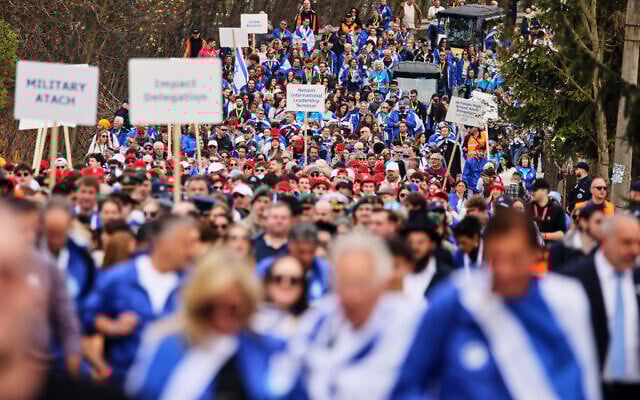
She said that in the years before the coronavirus pandemic, between 10,000 and 12,000 people would regularly attend the annual event, which draws large numbers of students from around the world. When the march resumed after the COVID hiatus, it first garnered 3,000 attendees, and then 5,000 the following year. This year’s program is welcoming 7,000.
“We hope that next year there will be no challenge, no war, no epidemic, and over 10,000 marchers will pass through the gate,” Yakin Krakovsky said.
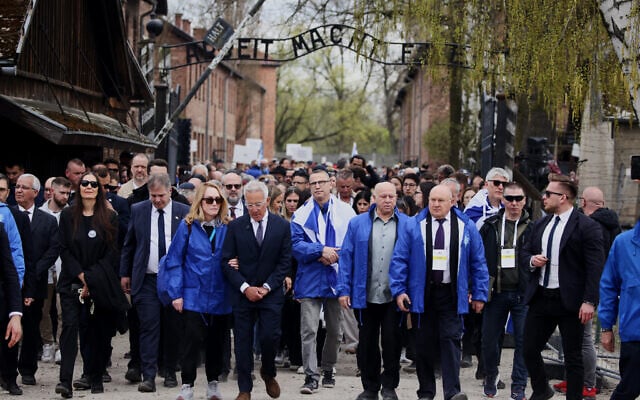
Sylvan Adams, president of the World Jewish Congress Israel, led this year’s march alongside Talmoud, Szkop and the other terror survivors. Together, they lit the first torch dedicated to combating antisemitism, along with US special envoy to monitor and combat antisemitism, Rabbi Yehuda Kaploun.
“We had a post-Holocaust slogan of ‘Never Again,’” Adams said on Monday. “I am the son of Holocaust survivors. In my life, I would never have believed what we have seen since October 7. We are under attack.”
Calling on Western nations to “wake up,” Adams said that “it starts with the Jews, but it never ends with the Jews. We are fighting the fight of all decent people and of our Western way of life.”
Also on the Israeli delegation was 93-year-old Naftali Furst, who survived Nazi death marches and now lives in Haifa. On the eve of Holocaust Remembrance Day, he returned to the site of the former Auschwitz subcamp of Budy, where he was once housed.
There was virtually nothing to differentiate the little-known site, about seven kilometers (4.3 miles) away from the main camp.
“This morning, for the first time in 80 years, thanks to the March of the Living, we discovered this place,” he said, adding that there is nothing there to commemorate its dark history.
Furst and his family were in the Sered concentration camp in Slovakia in 1942. They managed to escape two years later but were recaptured, and on November 3, 1944, arrived in Auschwitz-Birkenau, where Furst and his older brother were separated from their parents.
The boys were sent to Budy before going on to Buchenwald, from where they were liberated. They were reunited with their parents after the war, and the family eventually moved to Israel.
Furst said coming to Auschwitz obviously brings up “mixed feelings,” but that he was feeling positive about joining other survivors and “carrying thousands of people who were burned and killed here on me.”
He said he felt “proud” to represent those who “don’t have a voice anymore.”
Yakin Krakovsky echoed the need to listen to those who are still able to speak up and share their survival stories.
“Time is of the essence. We have a decade to march with the survivors who still remember what happened to them,” she said. “We are hugely privileged to still hear these stories from them, and we don’t have many more years to do that.”
‘It’s a more jarring experience because it happened to me’
After surviving the murderous antisemitic attack in DC, Talmoud said Monday that this visit to Auschwitz — her second since 2022 — feels different.
“This time it’s a more jarring experience because it happened to me,” she said. “Obviously, not in this capacity, but they still came to try and kill me, the Jew. It doubled down for me that no one really learned from the history that we are supposed to be learning from, that we keep saying never again, yet clearly that it happened.”
Szkop was raised Catholic in a Polish family in Michigan, but has Jewish roots on her father’s side. This is her second time at Auschwitz since the DC attack, having joined a Polish delegation just four weeks afterward.
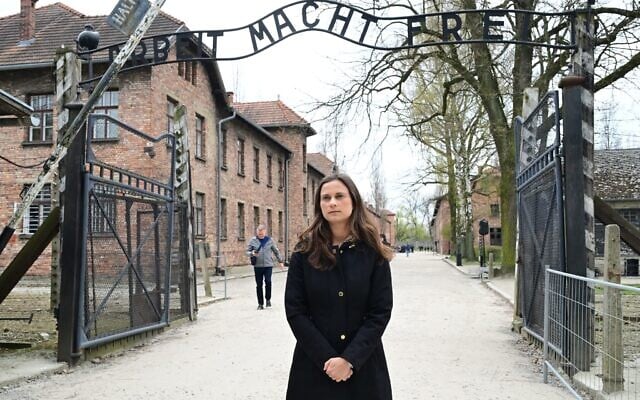
Szkop admitted that visiting the notorious Nazi death camp, where over 1 million people were murdered, was “very difficult,” especially so soon after her experience, but said speaking to a Holocaust survivor named Allan Hall, who was part of that group, was “wonderful.”
“I was in a really dark place,” Szkop said of the time after the terror attack. “It was very difficult for me with survivor’s guilt and pain, and people on the delegation… really recommended that I speak to him.”
Szkop asked Hall for advice, specifically about survivor’s guilt.
“The first thing he said was, ‘When young people come face to face with the very real reality of death, it’s very, very traumatizing. It’s unnatural,’” said Szkop.
Hall went on to tell her that what she was feeling was “normal and valid,” but that there is no “antidote.”
Born in Krakow in 1935, Hall and his family survived the Holocaust by posing as Christians. Now living in Florida, Hall is one of the 50 Holocaust survivors who joined the march as educators.
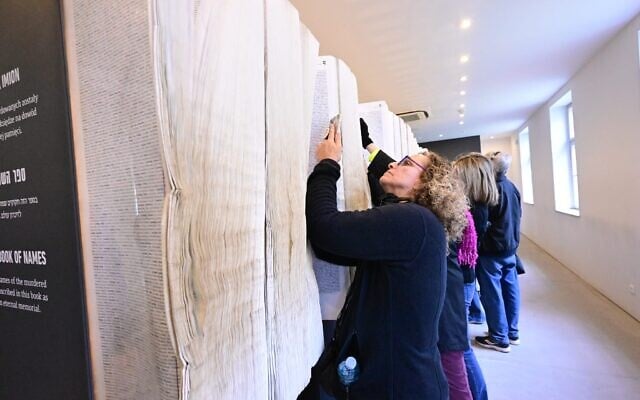
Szkop said that during her previous visit, she discovered a page with her surname in the Book of Names, which records the Jewish victims of the Holocaust.
“I saw a good chunk of this huge page that’s taller than me, and I saw the name Szkop everywhere, with dates and places,” she said. “I thought to myself, ‘I could have had my name [there] and murdered in Washington, DC.’”
-
-
-

-

-


