
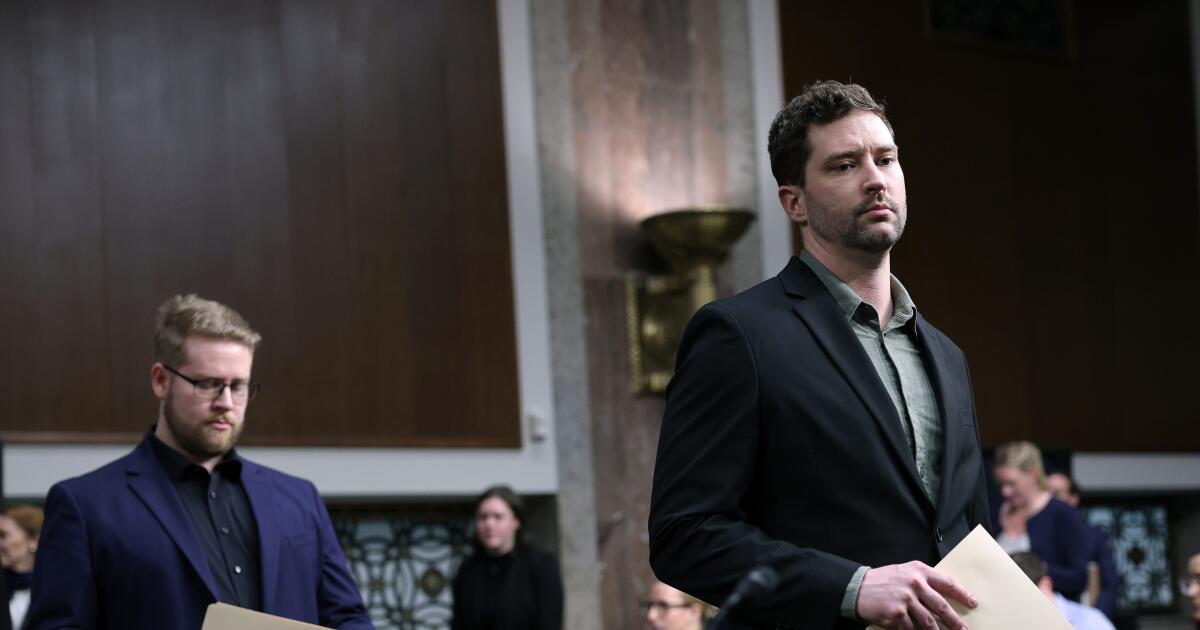
WASHINGTON — One of the brothers of Renee Good, the 37-year-old mother of three who was shot and killed by an immigration agent in Minneapolis, told congressional Democrats on Tuesday that he needed their help.
Luke Ganger said their family had taken some consolation in the thought that his sister’s death might spark a change.
“It has not,” he said.
That is why Ganger and people who had been violently detained by immigration agents gathered to share their experiences with U.S. Immigration and Customs Enforcement and to ask the government to rein in an agency they described as lawless.
Tuesday’s forum — not an official hearing because Republicans did not agree to it — was led by Rep. Robert Garcia (D-Long Beach), the top Democrat on the House Oversight Committee, and Sen. Richard Blumenthal (D-Conn.), the top Democrat on the Senate Permanent Subcommittee on Investigations. It was held not in the Capitol, but a nearby Senate office building.
Garcia and Blumenthal convened the forum to gather testimony “on the violent tactics and disproportionate use of force by agents of the Department of Homeland Security.”
All of the incidents referenced in the forum were captured on video.
Democrats heard from three U.S. citizens who are residents of San Bernardino, Chicago and Minneapolis. Also present were Good’s two brothers and an attorney representing their family.
Good’s killing on Jan. 7 has led to a wave of national protests, further inflamed after agents fatally shot ICU nurse Alex Pretti, 37, two weeks later. Protesters have called on federal agents to stop using violence in pursuit of the Trump administration’s mass deportation effort.
From left, Sen. Richard Blumenthal (D-Conn.), Luke Ganger and Brent Ganger arrive for a public forum on violent use of force by Department of Homeland Security personnel.
(Win McNamee / Getty Images)
“Let’s be very clear: these stories are not just about Minneapolis,” Blumenthal said. “These stories span the country.”
Blumenthal called for a “complete overhaul, a rebuilding” of the Department of Homeland Security and its sub-agencies. Such an overhaul, he said, would require body-worn cameras and that officers wear identification and undergo rigorous use-of-force training. In addition, acts of violence would require full investigations under the supervision of an independent monitor. Without those reforms, he said he wouldn’t support more funding for DHS.
Ganger said the “surreal scenes” taking place in Minneapolis and beyond are not isolated and are changing many lives.
“The deep distress our family feels because of Renee’s loss in such a violent and unnecessary way is complicated by feelings of disbelief, distress and desperation for change,” he said.
Ganger said his family is “a very American blend” that votes differently and rarely agrees fully on the details of what it means to be a citizen of the U.S. Despite those differences, he said, they have always treated each other with love and respect.
“We’ve gotten even closer during this very divided time in our country,” he said. “We hope that our family can be even a small example to others not to let political ideals divide us.”
The panel heard from Martin Daniel Rascon, 23, of San Bernardino, and three others who described harrowing experiences with immigration agents. Rascon was in a truck with two family members last August when they were stopped by more than a dozen federal agents who pointed rifles at them and shot at the car multiple times.
Francisco Longoria, the man driving the truck, was later arrested and charged by federal authorities, who alleged he had assaulted immigration officers with his truck during the incident. Longoria’s attorneys said he drove off because he feared for his safety. The charges were dropped a month later.
Describing the moment the unidentified men shattered the truck’s windows and punched Longoria in the face, Rascon said: “In that moment, the whole world felt like it was the size of the inside of our pickup, and we were sitting in harm’s way with nothing to do but record it.”
Rascon, who cried while giving his testimony, said federal agents returned to his home at 4 a.m. two weeks later, broke the locks and pointed a gun at his then-pregnant fiancee. He said the incidents left him feeling unsafe everywhere, even at home.
Marimar Martinez, 30, of Chicago, was shot five times by a U.S. Customs and Border Protection agent and then charged with assaulting the agent who shot her. Those charges were also later dropped.
Martinez testified that she was on her way to drop off a bag of clothing for donation to her local church when she noticed an SUV with federal immigration agents. She began following the vehicle for the next 20 or so minutes while shouting out “la migra!” to warn immigrant neighbors of their presence.
Eventually, the vehicle with federal agents side-swiped Martinez’s car. She said an agent got out and pointed his gun at her, then she looked down and noticed blood gushing from her arms and legs. She pulled into a mechanic shop and called 911. After her release from a hospital, Martinez saw on the news that she was being called a domestic terrorist.
Rep. Ro Khanna (D-Fremont) told Martinez he was angry on her behalf. “Tell me, what do you want this government to do to apologize to you?” he said.
“Just a sorry, you’re not a domestic terrorist,” she replied. “That’s it. …For them to admit that they were wrong [about] everything that they said about me. I just want accountability.”
Aliya Rahman, of Minneapolis, was dragged from her car on the way to a doctor’s appointment and detained by ICE agents after telling them she has a disability. Rahman has autism and is recovering from a traumatic brain injury.
DHS said Rahman was arrested because she ignored multiple commands. Rahman said it takes time for her to understand auditory commands.
Rahman said agents yelled threats and conflicting instructions that she couldn’t process while watching for pedestrians. As she hit the ground face-first, she said, she felt shooting pain as agents leaned on her back. She thought of George Floyd, who was killed four blocks away.
Rahman said she was never told she was under arrest or charged with a crime. The agents taking her to the federal Whipple Building referred to detainees as “bodies.” She said she received no medical screening, phone call or access to a lawyer, and was denied a communication navigator when her speech began to slur.
Eventually, she became unable to speak.
“The last sounds I remember before I blacked out on the cell floor were my cellmate banging on the door, pleading for a medic and a voice outside saying, ‘We don’t want to step on ICE’s toes,’ ” she said.
Rahman said she later woke up at a hospital, where doctors told her she had suffered a concussion.

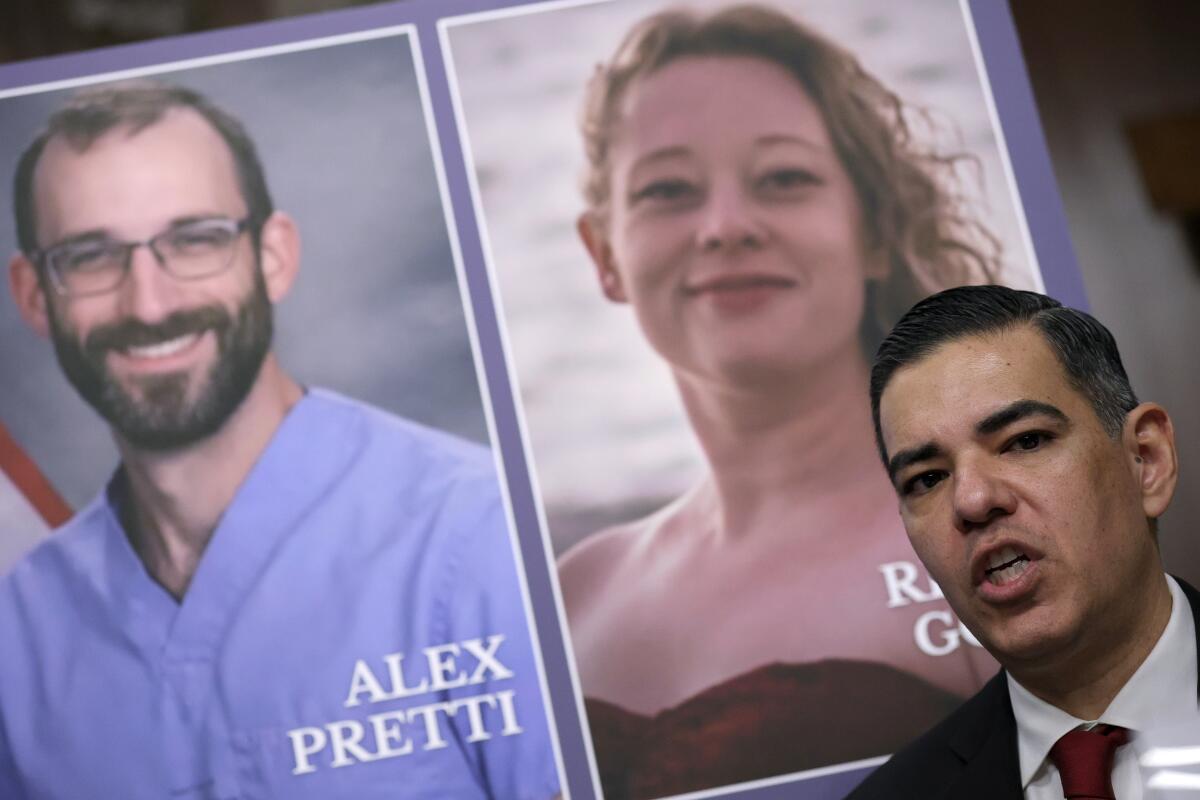
Rep. Robert Garcia (D-Long Beach) speaks during a public forum on violent use of force by Department of Homeland Security personnel.
(Win McNamee / Getty Images)
Garcia called the forum a move toward accountability because Congress has the right to step in when constitutional rights are violated. He said Democrats have tracked at least 186 incidents of problematic uses of force by federal immigration agents.
Antonio Romanucci, the attorney representing Good’s family and who also represented the family of George Floyd, said that while he has handled excessive force cases for decades, “this is an unprecedented and deeply unsettling time.” Floyd was murdered by a Minneapolis police officer in 2020.
“The occupation by ICE and CBP in our cities is way beyond their mission, leading to unnecessary provocation that causes needless harm and death,” he said. “These operations in multiple states have routinely and consistently included violations of the Constitution.”
The current path to hold federal officers accountable is narrow, he said. Congress could pass legislation to add language making it easier for people to file civil lawsuits in cases such as Good’s.
Sen. Alex Padilla (D-Calif.) questioned why the hearing was made up only of Democrats. He said Republicans can’t be let off the hook.
“Under normal circumstances — regardless of who’s in the majority — when tragedies like this happen congressional committees convene to conduct our job to provide that oversight,” he said. “But our Republican colleagues refused to.”
Source link
-

-

-

-

-


