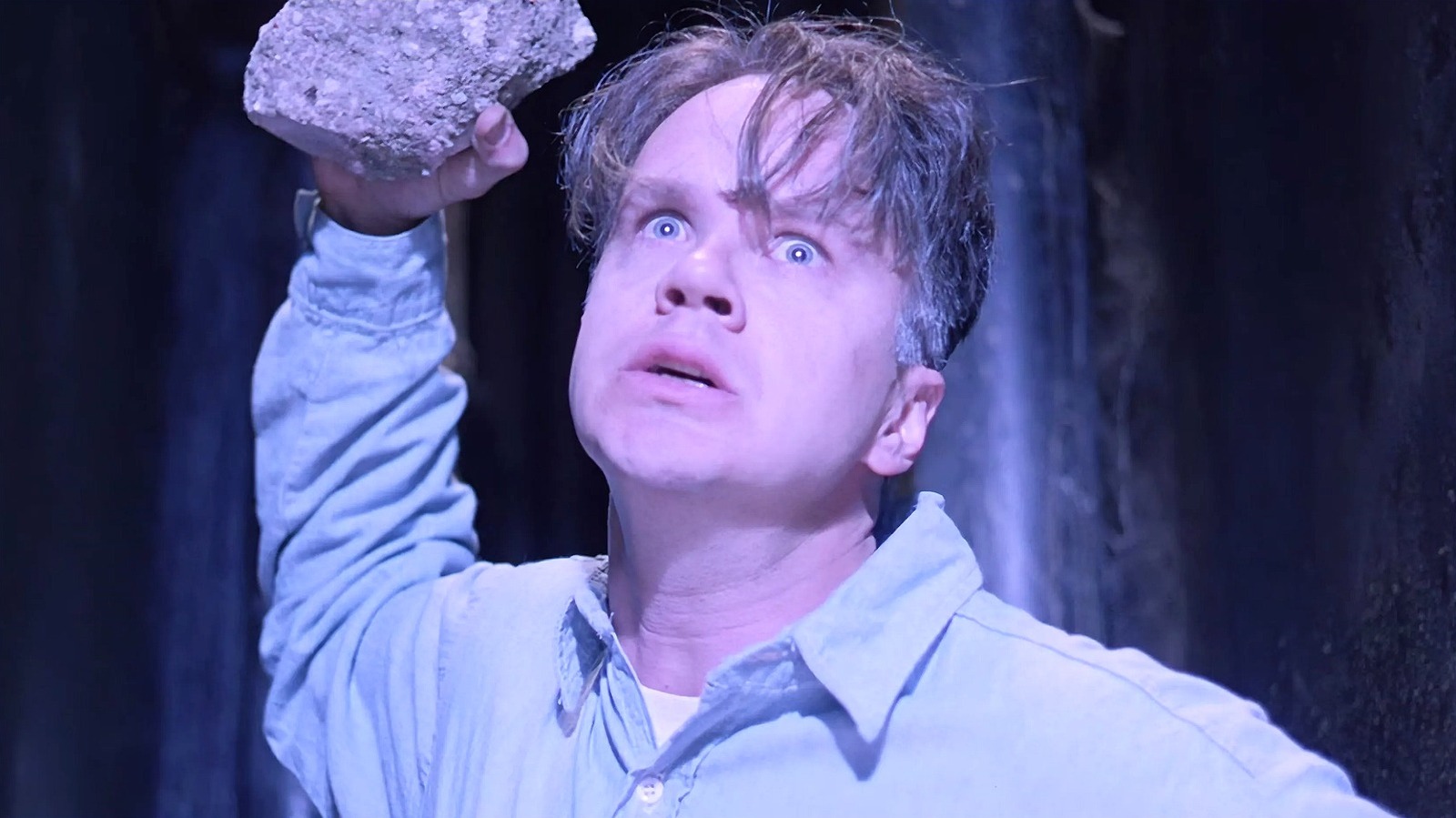
Several movies are opening today, a traditional day of moviegoing, including “Marty Supreme,” “Song Sung Blue,” “The Testament of Ann Lee,” The Choral” and ‘No Other Choice.” Below are my quick takes on these and several other feature films currently available in cinemas. A surprising number of these new movies are related to live theater in some way – as direct recording (Merrily We Roll Along), adaptation (Wicked for Good), subject (Hamnet), or because some or all of the characters are theater artists/performers (Marty Supreme, The Choral, Song Sung Blue.)
My reviews are organized roughly in descending order from those I most enjoyed.
Merrily We Roll Along
This a recording of the live 2024 Tony-winning Broadway production that turned the Stephen Sondheim and George Furth musical from a notorious 40-year-old flop into an acclaimed hit, the stuff of Broadway legend.
The strength of the show has always been in Sondheim’s clever and tuneful songs. The strength of this production in particular rests on its three talented leads. The book has always been the weakest aspect of the musical. It tells the story of three old friends — Jonathan Groff as composer turned movie producer Franklin Shepard Jr, Lindsay Mendez as novelist Mary Flynn, Daniel Radcliffe as lyricist and playwright Charley Kringas — in reverse chronological order, from 1976 to 1957. They “start” off cynical and estranged and “end” up nineteen years earlier and eight scenes later at the birth of their friendship, idealistic and collaborative.
If the film offers a different experience from the stage musical – I’m not crazy about some of the editing choices — there is something worthwhile in offering a chance at experiencing such a show to theater lovers who didn’t make it to New York or couldn’t afford Broadway prices.


Hamnet
The scenes from the play “Hamlet” will make you cry in this latest film from Oscar-winning director Chloé Zhao (“Nomadland”), but there is a catch. The scenes don’t occur until more than 90 minutes into “Hamnet,” after a story that focuses on a free-spirited woman named Agnes. Her story becomes a romance, then a family drama, then a study of grief, all during which, somewhat coyly, the name “William Shakespeare” is never uttered. We only hear it after the movie moves from the fields and farmhouses of Stratford to the playhouse in London.
But it may well be necessary to sit through these lyrical, leisurely, sorrowful 90 minutes to experience Shakespeare’s words the way the director intends. After the death of their son Hamnet (Jacobi Jupe), Agnes (Jessie Buckley) visits London for the first time to see a play by Will (Paul Mescal.) As she watches, a range of emotions play out on her expressive face; she is won over at last by the actor who portrays Hamlet. So are we. The actor is Noah Jupe, and, not coincidentally, he is in real life the older brother of Jacobi Jupe. It is a quite brilliant piece of casting, and a payoff to which purists might call sentimental, but only after they’ve wiped away their tears.
For what it’s worth, “Hamnet” is one of the five movies released this year that some prognosticators say are shoo-ins for Best Picture Oscar nominations. (The others are “Marty Supreme,” “One Battle After Another,” “Sentimental Value” and “Sinners.”)


The Choral
Ralph Fiennes portrays a choirmaster hired in 1916 to oversee a small English town’s choral society that’s hobbled in several ways because of World War I: Most of the best male singers and the previous choirmaster have been called up to military service, and the choral music that they can perform is severely limited because of the British townsfolks current hatred of all things German – which means nothing by Bach, Beethoven, Handel, Brahms, etc. Inspired by a true story, and created by the Tony-winning team of playwright Alan Bennett (The History Boys) and theater director Nicholas Hytner (War Horse, Carousel, Giant, which is opening on Broadway in March), “The Choral” chronicles with understated humor and pathos the effort to put together a performance of “The Dream of Gerontius,” an oratorio by Edward Elgar, chosen only because Elgar was British.
Fiennes’ Dr. Henry Guthrie is an outsider viewed with suspicion because he lived in Germany for years and still expresses admiration for their culture, and also because (although this is unstated) he is gay, but he wins the town over with his dedication to the music, and his unconventional approach – seeking recruits for the chorus among teenagers and in pubs and veteran hospitals.
Fiennes is at the center of a large cast of characters with many subplots, not all of which land, but together paint a picture of the prejudices, longings, and sacrifices in a small town during wartime.


Song Sung Blue
Hugh Jackman and Kate Hudson star as aging would-be entertainers who find each other and form a Neil Diamond tribute act – they call themselves Lightning and Thunder — that leads to unexpected success, at least in their hometown of Milwaukee, where Pearl Jam asks them to be their opening act. Although based on the true story of Mike Sardina and Claire Stengl (who were the subjects of an earlier documentary), the movie starts off as a comedy that treats its characters with mocking affection, reveling in their chintzy world of show business. Fisher Stevens portrays Mike’s dentist who is also his agent, Jim Belushi is a tour bus driver who becomes their manager. But suddenly a bizarre tragedy strikes, and the movie abruptly changes tone. Some of the scenes, especially those that diverge from what really happened, veer toward melodrama. But the film winds up offering an uplifting story, and a study, of resilience.
The casting helps. Yes, Hugh Jackman is exactly the right performer to deliver the 20 or so Diamond hits and lesser known melodies, including the title song. But he nails his character from the opening scene, when there is a close-up of his explaining his show business career, until the camera pans out and we learn he is addressing a meeting of Alcoholics Anonymous on his 20th “sober birthday”


Marty Supreme
Timothee Chalamet gives a skillful and electrifying performance as Marty Mauser, a hustling table tennis player in 1950’s New York, in the sort of frenzied, edgy, cartoonishly violent film that some cineastes love. But Marty is so single-minded in his pursuit of ping pong that he is reckless and amoral, and even downright cruel. Actually, he is all that even when it has nothing to do with ping pong: He beds a longtime (and married) friend who gets pregnant, then denies he’s the father; he leaves a dog at the side of the road. And all of the other main characters in the film sooner or later say and do things so off-putting that you can’t help but turn against them. So, it’s easier for me to be impressed by aspects of “Marty Supreme” than to embrace it.
Directed by Josh Safdie (half of the brother team behind “Uncut Gems,” about another similarly flawed anti-hero), the movie was reportedly inspired by an actual table-tennis champion and colorful New York character,r Marty Reisman, who died in 2012 at the age of 82.
But most of Marty Mauser’s misadventures feel at best implausible, as he jumps around from one to another – yes, like a ping pong ball, or, more precisely, a pinball, since he crashes into everything and makes a lot of noise. (At one point he crashes through the floor of a hotel bathroom while taking a bath.) His main immediate aim is to get to Japan and participate in a table-tennis tournament. And when he does, the actual matches (which are presented at some length) are spectacular. He reportedly practiced his game for six years, and it shows, holding his own against actual Japanese champion Koto Kawguchi, portraying a fictitious deaf Japanese champion Koto Endo. I guess it’s a singular achievement that “Marty Supreme” is able to engross us in ping pong.
There are many bold-faced names in the cast — Fran Drescher, Sandra Bernhardt, Penn Jilette, Abel Ferrara,Philippe Petit, David Mamet — but these are largely cameos. The one stand-out is Gwyneth Paltrow, who portrays Kay Stone, a fading movie star who married a filthy rich, sadistic pen magnate Milton Rockwell (Kevin O’Leary.) Marty makes the moves on Kay, to which she responds with snark and disgust, and yet he does wind up bedding her, several times (plausible?) — at the same time he’s pitching, then begging Mr. Rockwell for financing. At one point, we see the beginning of a Broadway play that stars Kay in her attempt to make a comeback. Her character is yelling at her son from the stage, for dropping some trash from a second floor window of the house on the set. “I’m just practicing my aim, Mama. You always said, shoot for the stars.” Later, at the cast party, we see her publicist start reading the review of the show from the critic at the New York Times. The scene cuts away, but shortly afterwards we see her crying.
Is filmmaker Safdie taking aim at the stars?


No Other Choice
“No other choice” is one the American businessmen tell the workers they are laying off in a Korean paper company they have taken over. And “No other choice” is what You Man-soo (Lee Byung-hun), a family man who has worked for the company for 25 years, tells himself when, suddenly unemployed, he decides to kill off the competition. He means this literally in director Park Chan-wook’s new movie, which he manages to pull off as a mix of pointed satire and a literal kind of pulp fiction.


Wicked: For Good
“Wicked: For Good,” has made almost as much money at the box office as “Wicked,” but it’s not as good a movie, and both parts of this movie adaptation of Stephen Schwartz’s Broadway musical don’t work as well for me as the original, which is still playing every day at the Gershwin Theater, telling the origin story of the Wicked Witch of the West at what now seems a brisk two and a half hours (plus intermission.)
Yes, Cynthia Erivo and Ariana Grande are still grand, and I enjoyed the inventive first scene, where Elphaba sweeps down to liberate the huge ox-like animals being exploited in the construction of the yellow brick road. But part 2 won’t make sense to anyone who hasn’t seen part 1, and a total of five hours is just too much for a story that already depends on your prior knowledge of the wonderful world of Oz. This is especially true since most of the memorable songs are in Act I, and the weakest aspects of the musical are in Act II, which the greater length now emphasizes – the scenes involving Dorothy that turn this supposed “prequel” into an inferior retelling of the beloved tale, and the strained and convoluted effort to affix a happy ending.


The Testament of Ann Lee
Amanda Seyfried stars in the title role as the impassioned and persecuted 18th century leader of the Shakers, a Christian sect probably best-known now for their belief in universal chastity and for their furniture. The film is directed by Mona Fastvold and co-written by her and Brady Corbet, the same writer-director couple who brought us last year’s much better “The Brutalist.” If “The Testament of Ann Lee” is seemingly just as earnest in its depiction of similarly severe tribulations, I couldn’t help wondering whether it’s actually a Monty Python-like put-on. It is, first of all, the strangest movie musical you’ll ever see, featuring more than a dozen musical numbers that we’re told are based on actual Shaker hymns, with the performers executing choreography by Celia Rowlson-Hall that resembles collective seizures (hence the name “Shakers.”) On the ship taking them from their native Manchester, England to settle in New England, the Shakers’ relentless singing causes the ship’s crew to curse them out and try to shut them up; you may find it just as annoying.
And then there are the decidedly non-spiritual scenes. The torture porn that would make Mel Gibson proud. The lingering shot of a man’s smooth naked rump, as his bedmate rises up to embrace Ann’s call for chastity, saying “You’ve been such a friend to me, Jacob.” The confrontation by Ann’s husband, portrayed by Christopher Abbott, hot as ever, who is understandably frustrated that Ann has refused to “live in sexual cohabitation,” as he puts it, for the past six years. She apologizes and starts to explain, but he angrily interrupts: “The more you talk of ‘the exuberant bliss of Divine intercourse’ the more I shall drink and not stop myself until I am dead.”
Related
Source link
-
-

-

-

-