
Two Waters Mental Health Center plans to divert mental health patients from the most expensive care at ERs and the jail.
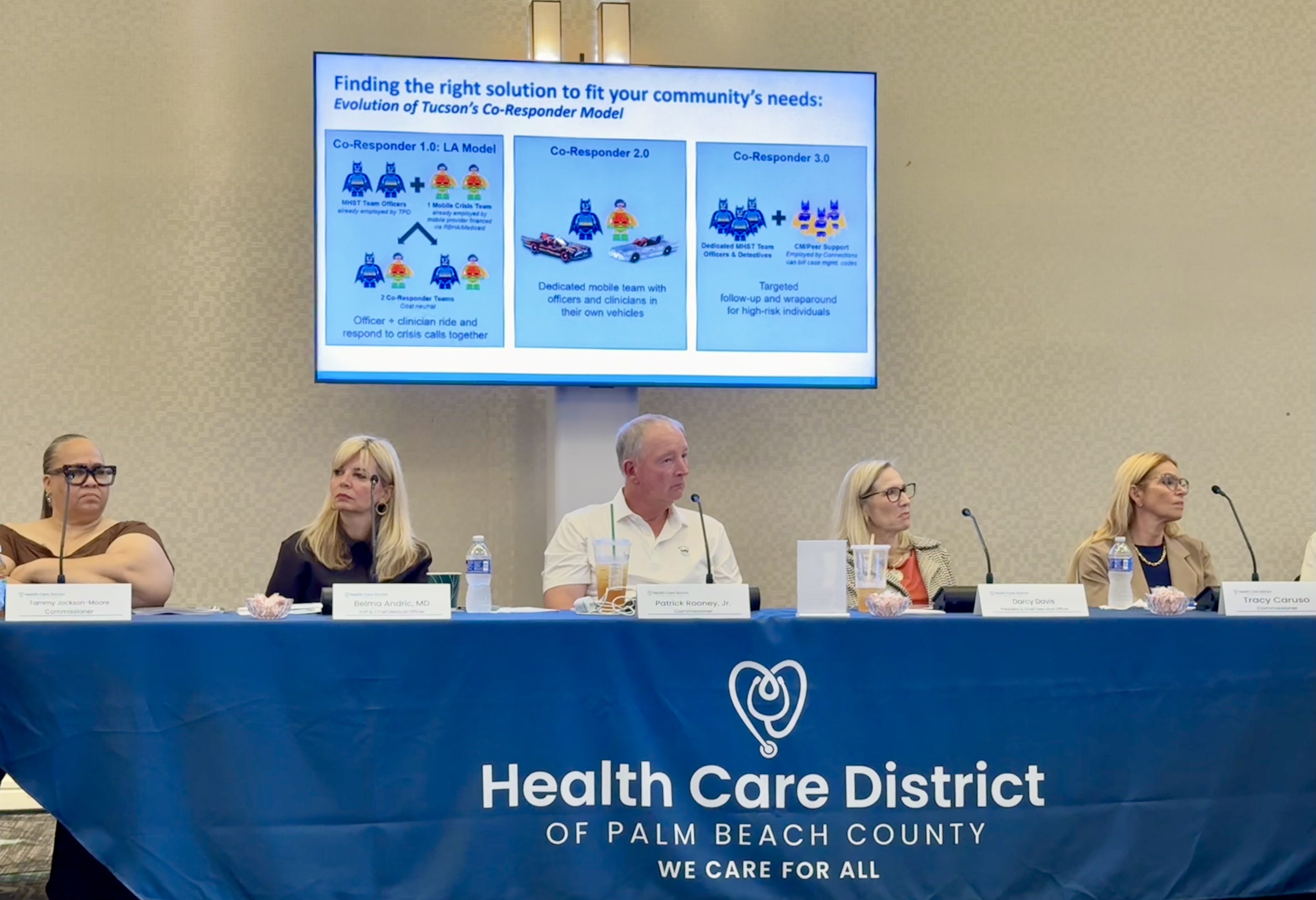
A new approach to treating mental health emergencies is cheaper, frees police for crime-fighting and treats patients in a way that keeps them out of crisis in the future instead of putting them behind bars, a national expert told the Palm Beach County Health Care District in a special session March 12.
The district’s proposed $145 million Two Waters Mental Health Center, whose name was announced at the meeting, is a means to that end, officials say. The district paid $16.7 million for nearly 10 acres on Benoist Farms Road north of Southern Boulevard and west of Florida’s Turnpike for the center. Construction begins next year, and it’s slated to open in 2029.
Dr. Margie Balfour, a national leader in mental health crisis care who contributed to national guidelines, offered a broad community treatment approach that reflects that mental illness is a disease and needs medical care, usually not criminal justice intervention.
“The defaults in most communities is that you call 911 for chest pain, you get an ambulance. Staff take care of your medical needs and take you to the emergency room. Whereas for mental health, the default is 911 if you’re suicidal, you get law enforcement.
“If the response was the same for medical emergencies, you wouldn’t stand for that.”


Leaving mental health crisis care to the county jail and hospital emergency departments, as is usually the case, is the most expensive approach, Balfour said
Often, it depends on receiving care from people who do not specialize in mental health.
Half of hospital emergency departments in the country do not have psychiatric services, a national survey by the Mayo Clinic published in 2022 states. Waits in hospital hallways for mental health patients before being seen by a doctor average 18 hours, the 2025 Behavioral Health True Costs Report by Connections Health Solutions states.
Police can spend a lot of time waiting with patients before they’re treated, which takes them off the streets for hours. If an arrest is involved, often for misdemeanor crimes, the patient goes to jail. When they get out, they often reoffend and are arrested again because they haven’t been treated.
Breaking those traditional approaches also helps to take homeless people off the streets.
And even taking patients to the hospital or jail can be traumatizing as they’re placed in handcuffs and put into the back of a police cruiser. Hospitals are loud and noisy, and some patients get violent without proper care, Balfour said.
Patients are afraid of going to the hospital or jail so they don’t seek help. And getting them help faster would make for fewer emergencies, said Balfour, a psychiatrist and associate professor of psychiatry at the University of Arizona
“The more crisis services that you have, that’s gonna get a lot of people asking for help,” she said.


A crisis of death and severe impairment
The mental health crisis is real, and its consequences can be deadly, studies show.
The suicide rate in the United States keeps rising with 49,000 people taking their lives last year.
At least two-thirds, some say up to 90%, involve people with severe mental illness, Dr. Thomas Insel wrote in his book, “Healing: Our Path From Mental Illness to Mental Health.” Insel, a psychiatrist and neuroscientist, was the director of the National Institute of Mental Health for 13 years.
People treated in the U.S. mental health system have extraordinarily shorter life spans — 23 years less than the average U.S. life span of 79, a 2006 study by the Substance Abuse and Mental Health Services Administration, known as SAMHSA, revealed. Many deaths were the result of inadequate medical care for diseases such as cancer or illnesses affecting the heart or lungs, Insel wrote.
Then there are the 6% of adults and 11% of youths ages 18 to 25 who live with serious mental illness, which causes severe impairment, a 2022 national survey by SAMHSA reports. Half of adolescents have some kind of mental disorder, the survey also found.


How the crisis system works
The new crisis system in Palm Beach County could start with a call to a crisis line answered by workers who have been trained in mental health emergencies. A national hotline number for mental health — 988 — kicked off in 2022. Patients can also call 211 in Palm Beach County.
Operators trained in mental health care could send a mobile response team to the person in crisis, send them to the crisis center and even arrange transportation. Or, if the person is stable, the operator can make an appointment with a professional for them while they’re on the phone.
Two mobile response teams serve Palm Beach County 24/7, and they are free. In general, these types of teams can involve police officers or not, depending on how the emergency operator assesses the crisis.
Two Waters would provide a place where anyone — police or paramedics delivering patients, transfers from emergency departments, involuntary care, as well as people walking in who just need help — could receive care 24/7.
The district plans multiple doors to separate law enforcement patients from walk-ins and promises that no one will be turned away.
The district unveiled a video to explain how it chose the name Two Waters: The county sits between the calm waters of Lake Okeechobee and the turbulent Atlantic Ocean, which can mirror a person’s emotions.
The crisis center also will have two retention ponds, positioning it between two waters.


At the crisis center, assessments would begin quickly — 20 minutes is the target, Dr. Belma Andric, the district’s executive vice president and chief medical officer, told Stet news in a February interview.
Patients would sit in recliners in pods in an open setting, unlikely to find themselves in a private room on the first day, Andric said. They could talk to peers trained to support them, people who have felt what they’re feeling. A professional would be watching constantly, but families could be there, too.
After 23 hours, if the patient needed longer care, they’d be assigned a bed.
If the center can’t meet their needs, the staff would be responsible for arranging treatment elsewhere, Balfour said. It’s part of having a coordinated system.
Patients who are stabilized and ready to leave would go to the discharge lounge, where case managers are ready to help them arrange housing, appointments for further treatment and other needs. They could get medicine at an on-site pharmacy and come back to the center for maintenance.


Police are vital to the system
Police have been widely criticized for shootings involving people in mental health crises. Nearly one-quarter of those killed in police shootings were displaying symptoms of mental illness, a 2015 study of such incidents by The Washington Post and Guardian newspapers found.
But police are a vital component of the system designed to get patients help.
Five police agencies — West Palm Beach, Riviera Beach, North Palm Beach, Palm Beach Gardens and the Palm Beach County Sheriff’s Office — have been working with the district since last year to keep patients out of jail.
Officers go out on emergency calls with a health-care expert. By the time officials announced the program in August, nearly all of its initial 300 patients had avoided going to the hospital under the Baker Act and received treatment elsewhere.
Because of that key role, police are vital in the new system, Balfour said, with several police officers attending her one-hour presentation. Therefore, it’s important to meet their needs.
Two Waters will have a sally port for quick first-responder dropoffs that’s open 24/7. This avoids parading people who might be in handcuffs through a lobby in front of other patients. The police entrance also would allow officers to keep their guns, Balfour said.
Crisis centers also help police in getting homeless people often suffering from mental illness off the street.
From a count on a single night in January 2024 conducted by the federal Department of Housing and Urban Development, 22% of sheltered and unsheltered people fit a federal definition of severe mental illness. That count estimated the country had 770,000 homeless people at the time.
How it all began
One of the nation’s first crisis systems to divert patients from jails was developed by a Miami-Dade County circuit judge in 2000 after a man had a psychotic episode in his courtroom.
Steven Leifman started the Criminal Mental Health Project in which misdemeanor suspects awaiting trial are evaluated at the jail and sent out for treatment if they show signs of mental illness instead of being incarcerated. The program has expanded to include nonviolent felonies.


The project sees to it that all police officers in the county are trained in crisis intervention, which cuts down dramatically on the number of arrests.
The cost per bed in the jail each day is $265. In Miami-Dade, 57% of inmates need mental health treatment, “Jail Diversion: the Miami Model,” stated in a 2020 article in the journal CNS Spectrums. The estimated cost to taxpayers was $636,000 per day.
The project cut Miami-Dade’s jail population nearly in half, and the recidivism rate dropped from about 70% to 20%. It saved the county about $232 million a year.
By 2016, the project had kept 4,000 people out of jail, states a biography of Leifman on Law Enforcement Action Partnership’s website. The program also seeks to improve psychiatric treatment for inmates in the jail awaiting trial.
Leifman is fighting to get a crisis center in Miami-Dade and has secured opioid settlement money for the effort, he told Local news 10 in Miami on March 13. He needs county approval, though, and commissioners have not moved forward.
There have been crisis centers for what are known as lower acuity patients — those experiencing low anxiety, depression and stress but aren’t a danger to themselves or others — since the 1990s, Balfour told Stet news in a March 19 interview.
The first crisis center for high acuity patients started operating in Texas in the mid-2000s. Then the model was brought to Arizona, where Balfour helped turn Connections Health Solutions, a crisis center in Tucson, into a national model for an integrated system.
The Health Care District, an independent agency financed by a countywide property tax, is looking to take on both high and low acuity patients so someone who needs help but isn’t trying to harm themselves, for example, could get help.
The district governing board, headed by former state Rep. Patrick Rooney, has been solidly behind the district’s entry into the mental health care arena.
More recently, SAMHSA issued the first guidelines for high acuity centers, the 988 hotline emerged, efforts increased to reduce the stigma of mental illness, and officials embraced the notion that law enforcement shouldn’t always be the first to respond.
“You’ve seen a huge explosion of communities trying to create these in the last five years,” Balfour said. As of August, 47 states, including Florida, host 807 crisis centers, the National Association of State Mental Health Program Directors reports.


The ways crisis centers save money
The current budget for the county facility is $145 million, which includes land costs, improvements to the site, construction of a 71,000-square-foot building and $27 million set aside for contingency.
Palm Beach County committed $10 million in federal COVID relief money toward construction. The Health Care District plans to tap its reserves, which approach $200 million, to pay the rest.
It is expected to cost $35 million a year to run the center, with money coming from patient insurance, federal and state programs and the Health Care District.
How will the community save money on mental health care?
A typical hospital inpatient emergency visit costs between $500 and $3,000, Balfour said. Boarding people who are stuck there for hours or days is another $2,400. It’s typically $10,000-$20,000 for a hospital stay, the True Costs Report states.
Though only 6% of the population is severely mentally ill, they drive 44% of all medical costs, the True Costs Report says.
Jail costs are harder to estimate because counties do things differently, she said, though the costs of rearrest and new treatment are high.
The average cost for a stay in a crisis center is $4,000, Balfour said.


Nuts and bolts of county’s facility
Two Waters is expected to have 48 chairs — two pods of 32 chairs for adults separated from two pods of 16 chairs for youth.
The Health Care District’s latest proposal calls for 32 beds for patients who need longer treatment.
Staffing is expected to total 120.
The clinic will serve children involuntarily committed under the Baker Act, a critical gap in local treatment options. Since HCA Florida JFK North Hospital quit receiving children under 12 in December 2024, families have been forced to find care outside of Palm Beach County, a major imposition.
The plans for Two Waters also include space for families and encourage their involvement in care.
“That was very high on our list” of priorities, Andric said.
Balfour pointed out that in addition to inviting family support, it gives clinicians a chance to observe family dynamics, which is a great help in treatment.
The architecture will be soothing, Andric said, with calm colors, courtyards and open-air features. The open-air features are therapeutic and encourage interaction with others, Andric said. The furniture will be designed to prevent injury.
“We tell people, hey, if you are in distress again, we want you to call us and ask for help,” Balfour said.
“We don’t want a traditional look,” Andric said. “We want people to come back.”


Holly Baltz is an editor and a reporter at Stet news. Her 40-year career of award-winning journalism included 34 at The Palm Beach Post. Holly lives with her husband in Lake Worth Beach.
-

-
-

-

-


