
January 31, 2026
Dog sledding competition kicks off in Bavaria
More than 100 teams featuring over 500 dogs gathered at the southern border of Germany and Austria for an international dog sledding competition that drew race enthusiasts from across Europe.
The race will take place over the weekend, with a course stretched from Bad Hindelang in Germany’s southern Allgäu region to the neighbouring Austrian town of Schattwald just across the border and back.
The routes range from 6 to 18 kilometres (3.5 to 11 miles).
The two-day race around Bad Hindelang, organized by the Baden-Württemberg Sled Dog Sports Club, is billed to be technically demanding, with the club saying it is “one of the most challenging races on the circuit, featuring spectacular descents.”
Race categories are separated by the number of dogs pushing the sleds.
Teams from Germany, Austria, Switzerland, Czech Republic, Italy, the Netherlands, Poland and France, among other nations, are all participating in the event.
https://p.dw.com/p/57oXj
January 31, 2026
Holocaust items from canceled auction sent to Auschwitz
The Holocaust-related items of a planned auction in Germany were handed over to the Auschwitz-Birkenau Foundation.
“I am grateful that we have found a way to hand over the documents to the archives of the memorial sites concerned. Remembrance in archives and museums preserves the dignity of the victims and serves further research and education about the inhuman National Socialist persecution and extermination processes,” said by Andre Kuper, the president of the state parliament of Germany’s western state of North Rhine-Westphalia.
The items were part of a collection of planned auction in the western city of Neuss, near Düsseldorf, which sparked outrage about the event and prompted its cancellation.
Among the documents were concentration camp postcards, letters written by perpetrators, camp-issued currency, and worn Stars of David. There were records of companies forcefully sold to Nazis, as well as identification documents and passports of Jews who managed to flee persecution to Chile and Argentina.
The collection even included Nazi documents on a forced sterilization carried out at the Dachau concentration camp.
The Central Council of Jews in Germany welcomed the handover of the documents, with Vice President Abraham Lehrer saying it was vital for survivors and for the memory of those murdered during the Holocaust that the documents end up in the right places and hands, where they can be protected and preserved for future generations.
https://p.dw.com/p/57oVG
Germany’s AfD bonds with Austrian far-right extremists
Officials from the far-right Alternative for Germany (AfD) party have been openly rubbing shoulders with Austrian right-wing extremist Martin Sellner.
The meetings between state and federal parliamentarians of the AfD party from the eastern German states of Brandenburg and Thuringia and Sellner were carefully orchestrated.
In Brandenburg, it was a panel debate, while in Thuringia, it was a discussion in the state parliament. The branches of the AfD in both states have been categorized as right-wing extremist by German federal security authorities.
While AfD leadership at the federal level is oriented more toward moderation, the AfD’s regional associations in eastern Germany lean toward radicalism.
Read more to find out why AfD politicians are seeking closer ties to Sellner.
https://p.dw.com/p/57nIr
German conservatives draw level with far-right AfD — poll
Support for German Chancellor Friedrich Merz’s conservative bloc is level with that of the far-right Alternative for Germany (AfD), according to a recent opinion poll.
If a federal election were held this Sunday, 26% of respondents said they would vote for Merz’s Christian Democratic Union (CDU) or its Bavarian sister party, the Christian Social Union (CSU), according to a survey conducted by the INSA polling institute for tabloid newspaper Bild.
The CDU/CSU bloc gained one percentage point, while support for the AfD remained unchanged at 26%. The two parties were last tied in an INSA survey in September 2025.
Merz’s junior coalition partner, the Social Democratic Party (SPD), also gained one percentage point, reaching 16%, its highest level since June 2025.
Support for other parties was unchanged. The Green Party polled at 11%, while the Left Party remained at 10%.
Two smaller parties, the BSW and the Free Democratic Party (FDP), received 4% and 3%, respectively, below the 5% threshold required to enter parliament.
The INSA poll was conducted between January 26 and 30 among 1,204 eligible voters in Germany.
https://p.dw.com/p/57ntF
EU asylum policy: What changes for refugees in Germany?
The German government is about to implement the EU’s Common European Asylum System (CEAS) to limit irregular migration and speed up asylum procedures.
The CEAS is the European Union’s legal framework to create uniform, fair and efficient standards for processing asylum applications.
The system’s reform, agreed in 2024, will become legally binding in Germany and throughout the EU in June 2026.
What will that mean for refugees in Germany? Learn about all the changes here.
https://p.dw.com/p/57nIw
January 31, 2026
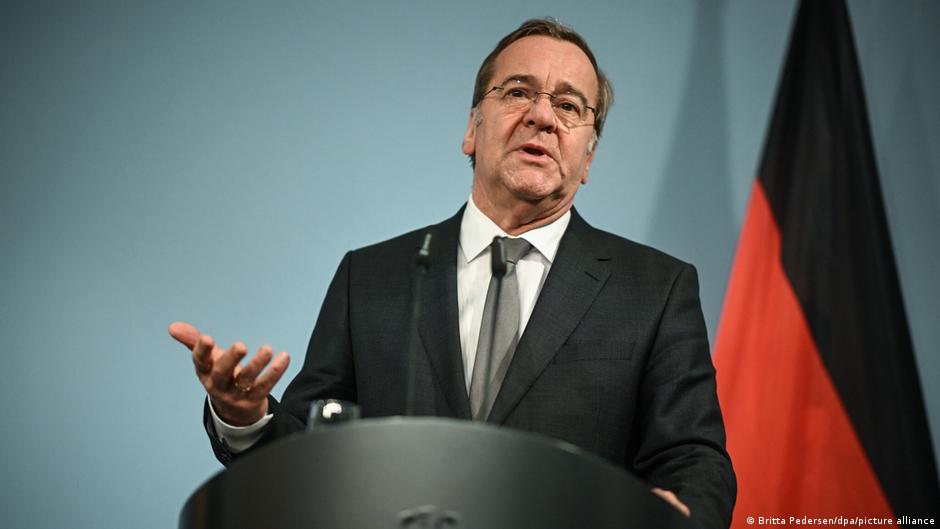
‘No signs that Russia seriously wants peace,’ says Pistorius
German Defense Minister Boris Pistorius has said he doubts that Russian President Vladimir Putin really desires peace as the US leads efforts to end Moscow’s invasion of Ukraine.
In comments published on Saturday, Pistorius told the RND media group that although US President Donald Trump had given new impetus to diplomatic efforts toward peace, recent actions by Moscow seemed to speak a different language.
“So far, […] I see no signs that Russia seriously wants peace,” Pistorius said, noting that even while recent US-led negotiations in Abu Dhabi were going on, Putin had attacked Ukraine “in a way that has hardly been seen in this war.”
Pistorius also rejected claims by the Kremlin that its attacks have never targeted civilians or civilian infrastructure, saying: “This is terror directed exclusively at the civilian population during a winter with temperatures of minus 20 degrees [Celsius] (-4 degrees Fahrenheit).”
The minister added that Putin has shown no willingness to compromise.
https://p.dw.com/p/57naM
January 31, 2026
New figures show about one in two Germans will get cancer in their lifetime
Almost every second man and more than 40% of women in Germany will develop cancer during their lifetime, according to new figures from the Robert Koch Institute, published for World Cancer Day.
About one in six women and one in seven men are affected before the age of 65.
Here are key numbers according to cancer registry data:
- In 2023, about 517,800 new cancer cases were diagnosed in Germany
- More men (276,400) than women (241,400) were affected
- About half of all new cases involve just four types: breast, prostate, lung, and colon cancer
https://p.dw.com/p/57nGL
January 31, 2026
US needs Europe, German defense minister says
German Defense Minister Boris Pistorius urged European governments to act more confidently toward the United States.
It would be a mistake “if we stared at the White House like a rabbit staring at a snake,” Pistorius told the RND media group.
He added: “Then we would lose focus on what we need to do: Become more sovereign and independent.”
US President Donald Trump relies on uncertainty and fear to achieve his goals, “but those who are afraid make the wrong decisions, so let’s not allow ourselves to be intimidated,” said the defense minister.
Pistorius was referring to European governments’ resistance to Trump’s renewed push to have the US take control of Greenland, a semiautonomous territory of Denmark.
Europe’s strategic importance to the US
He stressed that the US needs Europe just as much as the Europeans need the US, saying that Europe is of geostrategic and geoeconomic importance to Washington.
“Imagine if Europe were to become Russia’s sphere of influence if [Russian President] Vladimir Putin succeeded in driving the Americans out of here or causing them to withdraw,” Pistorius said.
Washington would be “sandwiched between Russia and China. That would certainly not be in the Americans’ interest,” he added.
https://p.dw.com/p/57nD6
Welcome to our coverage
Guten Tag from the DW newsroom here in Bonn.
You join us this morning as we bring you the latest headlines from German news, starting with Defense Minister Boris Pistorius stressing that the US needs Europe just as much as Europe needs the US.
Stay with us for this and more on what Germany is talking about today.
https://p.dw.com/p/57nCd
Source link
-

-

-

-

-


