
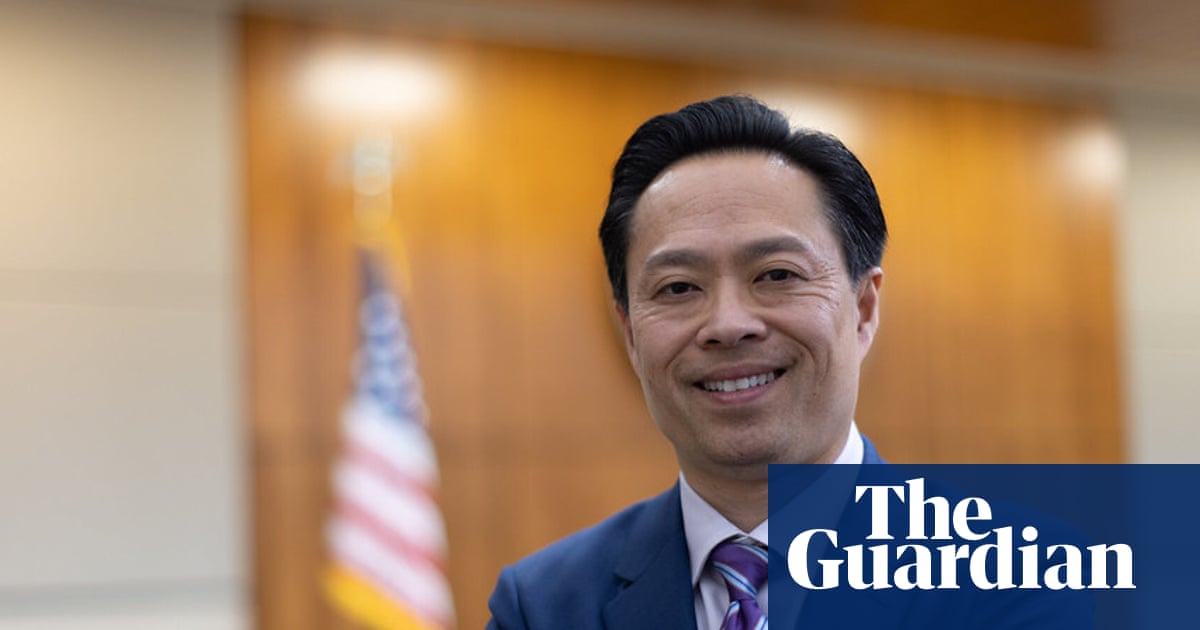
Before Joseph DeAngelo, a 74-year-old navy veteran and former police officer, admitted responsibility for his brutal crimes in court, prosecutor Thien Ho had a request for the judge overseeing the proceedings. He wanted the world to see the killer’s face.
It was 2020, the first year of the pandemic, and social distancing and masking requirements were in full swing. But Ho asked that DeAngelo – the man known as the Golden State Killer, who had covered his face during a more than 10-year reign of terror across California – be required to wear a clear face shield as he pleaded guilty.
“When he finally comes to court to accept responsibility in front of the victims and survivors whose lives he tore apart without regard, he shouldn’t be allowed to hide behind a mask like he has done all his life,” Ho recalled saying to the judge in his new book chronicling the case, The People vs the Golden State Killer.
In the book, Ho, who is now Sacramento county’s district attorney, tells the story of the investigation and DeAngelo’s capture, and recounts his role in one of the largest criminal prosecutions in state history.
DeAngelo was one of California’s most prolific criminals. From 1974 to 1986, he committed more than 100 burglaries in the state’s Central valley, by his own admission, and at least 51 rapes and 13 killings from Sacramento to Orange county. He stalked and terrorized neighborhoods, breaking into homes to rape and torture women and girls, and killing couples and women in their beds. During some of that time, he served as a police officer. And he raised children in one of the same communities he had once targeted.
The crimes remained unsolved for nearly half a century. In 2018, authorities, using a new DNA investigative technique, identified DeAngelo as the killer and rapist. Two years after his arrest, he pleaded guilty and received a sentence of life in prison without parole.
Ho reveals new details of the moments after DeAngelo’s capture, his interactions with investigators in an interrogation room, and parking lot conversations between prosecutors and public defenders about DeAngelo’s plea.
The book also highlights the devastating effects of DeAngelo’s crimes – a father who stopped celebrating birthdays and holidays after DeAngelo killed his daughter, and young women, raped in their homes, whose families told them to never speak of what had happened to them.
In an interview with the Guardian, Ho discussed The People vs the Golden State Killer and his effort to “strip away the mystery of the monster behind the mask and peel away the myths shrouding his deeds”.
This interview has been edited for length and clarity.
How did the Golden State Killer’s crimes affect California, including the communities he attacked and the justice system?
You can see the impact [in] the bars covering the windows and doors in the communities that he struck repeatedly. Somebody told me that their family slept on a roof during this time period. I had a book signing in Sacramento and there was a woman that came up and she said: “When [he was] arrested, we finally – for the first time in 40 years – slept with the windows open.”
The technique pioneered to catch him [is called] investigative genetic genealogy. We, along with other police agencies from around the world, have solved nearly 1,000 cold cases using that technique. It has fundamentally changed the investigation of cold cases.
What was your goal in writing the book?
When I was first assigned the case, I read Michelle McNamara’s book [about the Golden State Killer], I’ll Be Gone in the Dark. Unfortunately, she passed away before he was caught. And then Paul Holes – my colleague and friend – wrote a book on how [DeAngelo] was caught using that technique. [My book is] the first book that covers the investigation, the capture and the prosecution. I call it the third in the trilogy.
The true-crime genre often focuses on the criminal and the crimes. [My book] focuses on the law enforcement officers who never gave up the search for him. And it focuses on the victims and the survivors, amplifying their voices. And that was important to me.
How did you approach writing about their experiences with sensitivity?
Well, first of all, I spoke to the victims. That was important to me to get their voice and their words and their feelings on paper. Secondly, when you’re writing about a serial killer and a serial rapist like the Golden State Killer, you can’t avoid writing about the facts of the case. But I think the way I approached it [wasn’t exploitive]. I gave details, but then I stopped short of going into all the minutiae of it.
I gave a glimpse, but I didn’t delve and wallow in it.
Does one moment in this case stand out to you?
The very first sexual assault victim in Sacramento was Phyllis [Henneman]. When I was assigned the case, that was the first case I read. She was 23 at the time. The first time I show up in court, this woman walks up to me. She’s in her early 60s, gray hair, thick Coke-bottle glasses, a warm smile, but I could see the pain on her face.
She says: “Hi, my name is Phyllis. I’m victim No 1.” And when I held her hand, it was as if I was reaching through time and space. Because I had envisioned her as a 23-year-old, but now I’m talking to a much older woman. And you can see the pain that etched the lines on her face over the years. I struck up a friendship with Phyllis.
Near the end of the case, I found out that she was fighting cancer and she couldn’t be in court … [But] all the other victims stood up for her. Two months later, when he was sentenced, I look across the room and I see her and she’s got this twinkle in her eye. For the first time in 40 years, she was able to obtain a measure of justice. Phyllis passed away three months later.
When I think about the case now, I don’t think about him anymore. I think about her. I think about the closure and the measure of justice that we were able to get for all these victims.
Why do you think DeAngelo ultimately chose to plead guilty and admit his crimes?
The weight of the crime was circling around him. If this was to go to court, all these people testify, all his dirty secrets. He loses absolute control and everything comes out, from his childhood, from his [unusually small] penis, from his failures in relationships. Everything comes out from how he committed his crimes. That is the ultimate form of losing control. And I don’t think he could handle losing control any more than he already lost.
How could he live these double lives, one where he is attacking women and girls, murdering people in their beds, and another where he is a well-regarded father and uncle and co-worker?
He’s a master manipulator. He manipulates people. He’s able to compartmentalize it. He’s able to do these things. He was a police officer when he first committed his crimes, he was wearing a mask. His badge, his uniform, these were masks, his family [was] a mask.
Underneath that mask was nothing more than a monster who loved to control and manipulate people to gain a sense of power. He had a God complex. He wanted to lord it over people and always be under control. That’s just who he is.
How has the justice system changed since these crimes were committed?
The different law enforcement departments are much less siloed today. We communicate with each other much more now. We’re not so isolated.
And then you have all the advances in forensic DNA and forensic science. If you think about it, you can’t commit these crimes in this day and age because everybody has surveillance cameras, everybody has a Ring camera, everybody has a cellphone.
What do you hope that the public takes away from this case?
The resiliency of the human spirit. So many of these people had the very tapestry of their lives shredded. They [went] through years of pain and doubt. They [went] through drug abuse, alcohol, failed relationships. And yet on the other side of it, they were able to find that measure of justice and peace. They were able to turn their pain into power.
People like the Golden State Killer, who had a horrible childhood, still make choices. [Survivor] Gay Hardwick in her impact statement said: “You raped us, you assaulted us. We thought we were going to die. But we didn’t turn around and become serial killers and monsters. It’s a choice that you made.” And I think it’s that duality. The choice is, do we embrace love? Do we embrace hate? Do we embrace lightness or do we embrace darkness? Do we embrace goodness or do we embrace evil? Those are the choices we make every day.
Source link
-

-
-

-

-


