
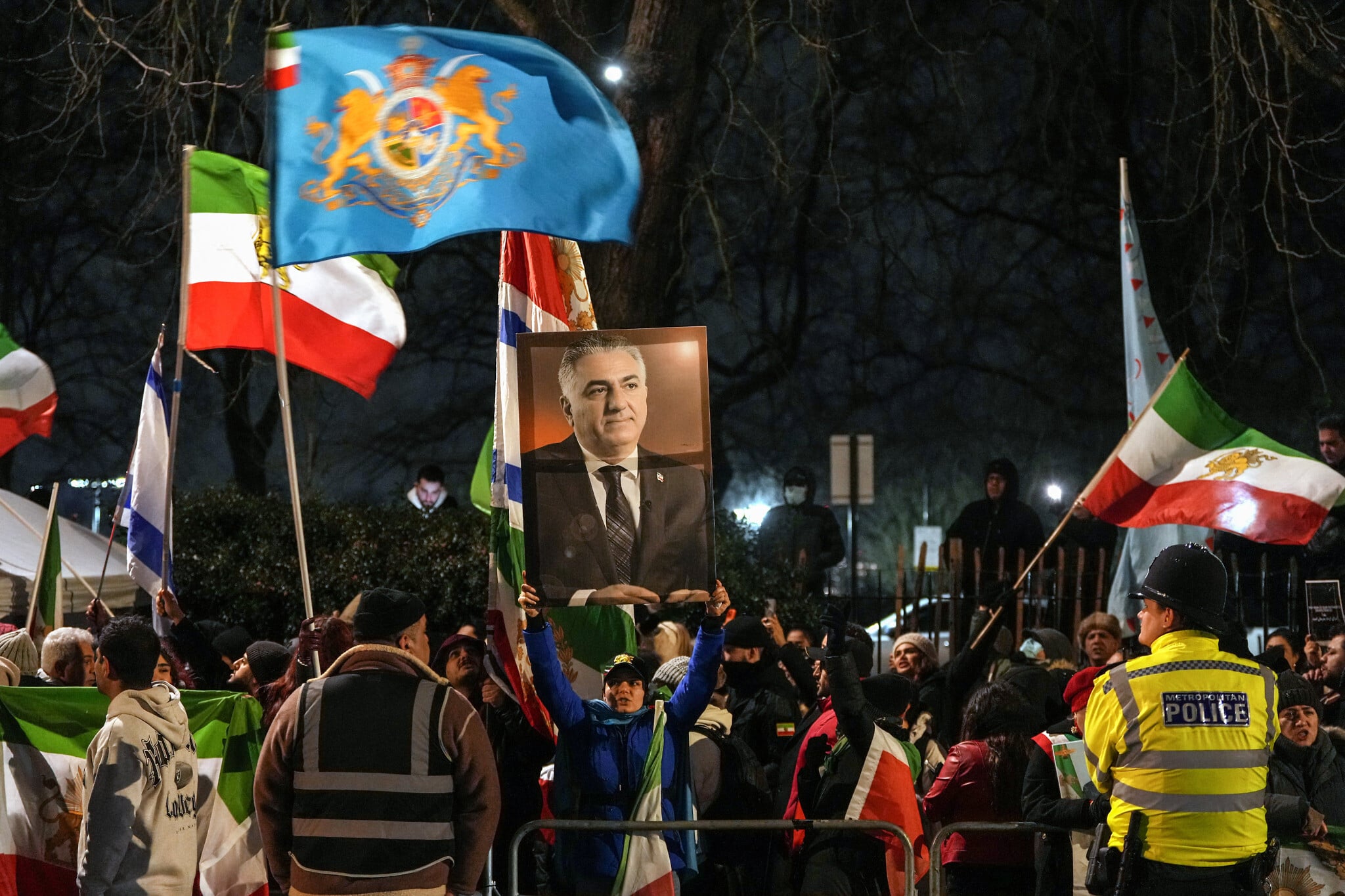
Reuters — Huge antigovernment protests in Iran have galvanized exiled foes of the authorities, but despite their hatred of the ruling clerics, a bitter schism dating to before the 1979 Islamic Revolution still afflicts the leading opposition factions.
That split, between monarchists supporting Reza Pahlavi, son of the ousted shah, and a more organized leftist-Islamist group, the Mujahedin-e Khalq (MEK, or People’s Mujahedeen of Iran), has played out online and even in angry arguments in street protests in Europe and North America.
How much either faction has support inside Iran, or might be able to shape events there in the future, is hard to gauge, though analysts and diplomats have for decades regarded both as being far more popular among emigres than inside the country.
Many other Iranians outside Iran are also deeply skeptical of both the monarchists and MEK, but have no organized opposition network comparable to those factions.
The lack of a universally accepted opposition movement or figurehead has complicated international approaches toward the deadly unrest sweeping Iran, with US President Donald Trump questioning Pahlavi’s support even as the US weighed airstrikes.
“What’s problematic is there has been no inclusive organization that has been built that can bring together Iranians of all walks of life: religious, ethnic, socioeconomic,” said Sanam Vakil, Middle East head at the Chatham House think tank in London.
During the past two weeks of violent unrest, videos in Iranian cities have shown some demonstrators chanting in support of the ousted monarchy and the late shah’s son, who has encouraged the protests.
His father, Shah Mohammad Reza Pahlavi, fled into exile in 1979 and died a year later. He was a close Western ally who harked back to ancient Persian heritage in framing his rule as a national leader and modernizer. But he resisted democratic change as increasing economic disparities destabilized the country.
The 65-year-old son, who is based in the US, says he wants democracy for Iran and has not specified any role he would seek if the current system collapsed. His supporters run one of the main Persian-language satellite television stations broadcasting into Iran.
Reza Pahlavi’s supporters in the West have pointed to the videos of protesters in Iran chanting his name as evidence that his popularity is growing, saying he is the only figure able to unite the country if the Islamic Republic implodes.
Among foreign officials and diplomats following Iran there are mixed views as to whether the latest protests actually show that Pahlavi’s role is growing.
A Western diplomat said Pahlavi’s name may have been used by street protesters because there were few other recognizable opposition figures, but that there was no sign he commanded the sort of domestic support that could make him a future leader.
A European official said a big spike in protest numbers after a call for street action by foreign opponents of the government, including Pahlavi, showed his stature may be broader than was previously understood.
However, any role he would play would need to be in the context of a wider democratic movement, said Iranian analyst and former diplomat Mehrdad Khonsari.
“You need a coalition of people who believe in democratic values in order to sort of lighten the weight and give greater confidence to people,” he said.
There has been no inclusive organization that has been built that can bring together Iranians of all walks of life
The idea that Pahlavi may have popularity inside Iran is not shared by the MEK, whose supporters regard the pre-revolution monarchy as comparable to the current Shiite theocracy.
Its supporters online often use the slogan “No monarchy, no supreme leader.”
The MEK is a movement fusing leftist and Islamist ideas whose cadres carried out bombings inside Iran before and after the revolution, even as mass support was growing for rival factions on the streets.
The ruling clerics banished the MEK in 1981 and it established military bases in Iraq that it used to launch attacks on Iranian troops during the 1980s Iran-Iraq war, something many Iranians remember with fury.
It was listed as a terrorist organization in the United States until 2012, but some Western politicians have voiced backing for the group, including former US secretary of state Mike Pompeo.
However, the European official described the MEK as widely despised inside Iran, partly because of its conduct during the Iran-Iraq war, and analysts say it has had little presence in the country for decades.
The group’s official leader Massoud Rajavi has not been seen since 2002 and is widely thought to be dead, though the MEK has not acknowledged that. His wife, Maryam Rajavi, runs the organization and its affiliate, the National Council for Resistance in Iran.


Group officials say their supporters are widespread in Iran and active, though there has been no public sign of support for the MEK seen by Reuters during the protests.
Monarchists, along with many other Iranian dissidents and Iran’s current rulers, regard the MEK with intense suspicion, pointing to its history of violence and enforcement of ideological purity within its ranks.
For many Iranians, the arguments between the Islamic Republic’s theocratic establishment, monarchists voicing nostalgia for the 1970s, and a revolutionary group that lost out in the early 1980s may seem outdated.
Even as monarchist and MEK supporters remained prominent among émigrés and as the same faces revolved through the upper echelons of the Islamic Republic, Iran’s population was doubling in size and growing more urban and educated.
Most major political movements inside Iran after 1979 sought to either bolster or reform the Islamic Republic, rather than sweep it away entirely, until successive waves of protest in recent years that have demanded more comprehensive change.
“Iranians inside Iran are, I think, not just looking to the diaspora for their future,” said Vakil.
You appreciate our journalism


We’re really pleased that you’ve read X Times of Israel articles in the past month.
You clearly find our careful reporting valuable, in a time when facts are often distorted and news coverage often lacks context.
Your support is essential to continue our work. We want to continue delivering the professional journalism you value, even as the demands on our newsroom have grown dramatically since October 7.
So today, please consider joining our reader support group, The Times of Israel Community. For as little as $6 a month you’ll become our partners while enjoying The Times of Israel AD-FREE, as well as accessing exclusive content available only to Times of Israel Community members.
Thank you,
David Horovitz, Founding Editor of The Times of Israel
Join Our Community
Join Our Community
Already a member? Sign in to stop seeing this
-

-

-
-
-


