Iranian state media confirms top security official Larijani killed
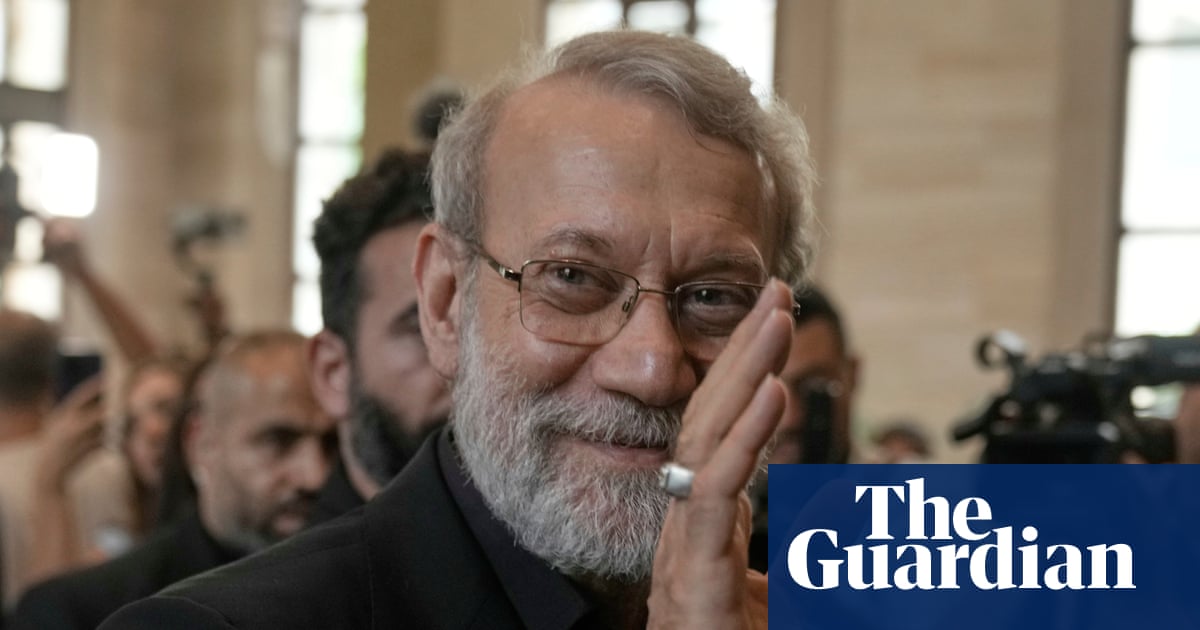
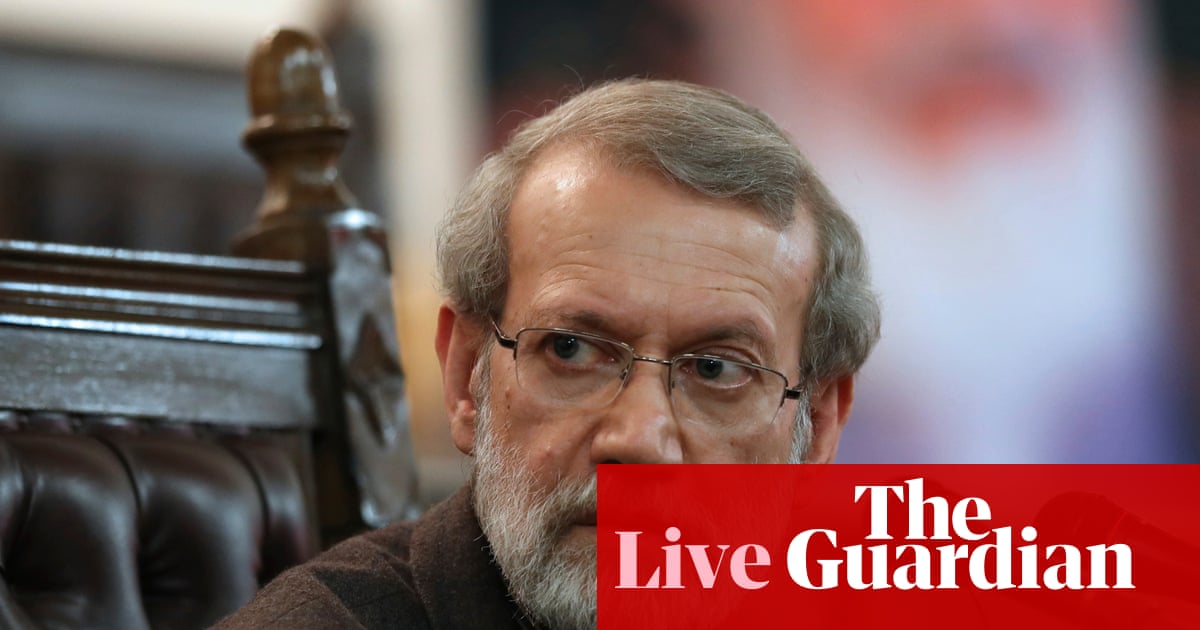
We’re now seeing lines coming through from the Reuters news agency citing Iranian state media confirming that Iran’s national security chief Ali Larijani has been killed.
Israel announced earlier today that he was killed in an overnight strike on Tehran. This marks the first confirmation of his death from Iran.
Key events
-
US targets Iranian missile sites near strait of Hormuz
-
Residents flee Tyre after Israel issues new displacement order of Lebanese city
-
Analysis: Death of influential Larijani a bigger loss to Iran than Khamenei
-
Key Iran leader killed: what does it mean for the war? – podcast
-
Iranian state media confirms top security official Larijani killed
-
The day so far
-
Iranian official warns situation in strait of Hormuz ‘won’t return to its pre-war status’
-
Iranian state media confirms death of Basij commander
-
Israeli attacks on Lebanon may amount to war crimes, UN rights office says
-
Zelenskyy says 200 Ukrainian drone experts are assisting in the Middle East
-
Trump says US ‘not ready to leave Iran yet’ but will be leaving ‘in very near future’
-
UAE could join international effort led by US to secure strait of Hormuz, says adviser
-
Kuwait says drones and missiles intercepted but two people suffered minor injuries
-
‘We don’t need them, but they should’ve been there’: Trump says Nato allies making ‘a foolish mistake’ by not helping with strait of Hormuz
-
‘Iran was a threat’: Trump doubles down, claiming senior counterterrorism official who quit over war was ‘weak on security’
-
Trump lambasts Nato allies over resistance to get involved in war on Iran
-
US started Iran war due to pressure from Israel, top counterterrorism official claims in resignation
-
Top US counter-terrorism official resigns over US-Israeli war on Iran
-
Revealed: UK security adviser attended US-Iran talks and judged deal was within reach
-
Oil and gas prices resume rise after Iran attacks production facilities
-
Trump relied on unverified intelligence to wrongly blame Iran for deadly school strike
-
Summary of the day so far…
-
IDF launches ‘extensive’ airstrikes across Tehran
-
Profile: Who is Ali Larijani?
-
Handwritten note posted on Iranian security chief’s X account after Israel claimed to have killed him in airstrike
-
Heavy loss of life in Iran is ‘alarming’, ICRC says, with families ‘gathering for funerals instead of festivities’
-
Israeli defence minister claims country’s forces have killed Iranian security chief
-
Israel says it has assassinated commander of Iran’s Basij militia unit
-
Israeli military targeted Iran’s security chief in overnight airstrike, Israeli media reports
-
Iran and Iraq discussing passage of oil tankers through strait of Hormuz
-
Mass civilian displacement in Lebanon caused by ‘relentless’ Israeli bombing and blanket evacuation orders, charity says
-
Interim summary
-
Iran’s Guards say 10 ‘foreign spies’ arrested
-
Naval escorts through strait of Hormuz no guarantee of safety, says maritime chief
-
Israel urges evacuation of south Lebanon village ahead of attack
-
Australia hikes interest rates amid inflation fears from Iran war
-
Qatar intercepts missile attack as debris sparks fire
-
US embassy attack came after Iran-backed group’s commander killed
-
US embassy targeted as four reportedly killed in Baghdad house linked to Iran
-
Trump seeks to delay China trip because of Iran war
-
Welcome summary
US targets Iranian missile sites near strait of Hormuz
The United States military said Tuesday that it targeted sites along Iran’s coastline near the strait of Hormuz because Iranian anti-ship missiles posed a risk to international shipping there, Reuters reports.
More than 1,000 cargo ships, mainly oil and gas tankers, have been blocked from transiting the strait of Hormuz by the Israeli-US war against Iran after Tehran closed the key maritime passage, with a potentially large global economic impact.
Read more here on the importance of the strait.
Residents flee Tyre after Israel issues new displacement order of Lebanese city
Earlier, the Israeli military issued a fresh evacuation order for the coastal Lebanese city of Tyre and its surrounding villages and Palestinian refugee camps, sparking an exodus of residents from Lebanon’s fourth largest city.
“Hezbollah’s terrorist activities are forcing the [Israel Defense Forces] to act against it with force. The IDF does not intend to harm you,” the IDF’s Arabic spokesperson Colonel Avichay Adraee claimed in a post on X.
Images on social media showed long traffic jams of cars trying to leave the city. The IDF issued an evacuation warning for Tyre last week, but many residents stayed.
More than one million people in Lebanon – nearly one in five of the population – have been displaced as Israel has placed more than 100 towns and villages under forced evacuation orders in recent weeks.
As I reported earlier, the UN has stated that Israel’s repeated, extensive warnings and displacement orders “may amount to forced displacement, prohibited under international humanitarian law”, and its attacks on residential buildings and civilian infrastructure in Lebanon may amount to war crimes.
Israel’s assault on Lebanon has killed at least 912 people, including 111 children, have been killed and wounded 2,221 others since 2 March, according to the latest figures from the Lebanese public health ministry.
Iran’s supreme national security council confirmed the death of Ali Larijani in a statement on Tuesday evening:
The pure souls of the martyrs embraced the purified soul of God’s righteous servant, Martyr Dr Ali Larijani.
It added that his son and his bodyguards had died with him.
After a lifetime of struggle for the advancement of Iran and of the Islamic Revolution, he ultimately attained his long-held aspiration, answered the divine call, and honourably achieved the sweet grace of martyrdom in the trench of service.
As my colleagues write of Larijani: “His death removes a pivotal figure at the heart of the regime’s political and security establishment at a moment of acute crisis and represents a devastating blow.”
Israel said earlier it had killed Larijani, a linchpin of Iranian politics, in overnight strikes. He is the most senior Iranian figure to die in the war since the supreme leader Ali Khamenei was killed on its first day.
Israel’s defence minister, Israel Katz, said a separate strike had killed the Basij paramilitary force commander, Gholamreza Soleimani, along with other senior Basij figures. Soleimani’s death was later confirmed by Iranian state media.
You can read the full report here:
Analysis: Death of influential Larijani a bigger loss to Iran than Khamenei
Patrick Wintour
Israel’s assassination of Ali Larijani, the secretary of Iran’s supreme national security council and one of the linchpins of Iranian politics, is a devastating body blow to the country and probably a bigger reverse than the loss of the supreme leader Ali Khamenei at the outset of the war.
In any attempt to decapitate the Iranian leadership, Larijani would always be the prime target, largely because of his ability to straddle so many levels of Iranian politics and his huge personal influence not just in Iran but with foreign states including China and Russia.
Indeed, there has been probably no greater loss for the Iranian regime since the US assassination of the Islamic Revolutionary Guard Corps (IRGC) leader Qassem Suleimani in Baghdad in January 2020.
The significance of Larijani’s removal also lies in the confirmation that Israel and possibly the US never regarded him as an alternative leader for Iran in the event of the government breaking up, or in effect surrendering.
Ellie Geranmayeh, an Iran expert at the European Council on Foreign Relations, said:
[Benjamin] Netanyahu is now focused on blocking Trump’s pathways for a ceasefire and follow-up talks with Iran. Larijani would have been the man to get that job done.
You can read Patrick’s full profile of Larijani and analysis of this moment here:
Key Iran leader killed: what does it mean for the war? – podcast
Israel’s assassination of the influential Iranian national security chief Ali Larijani in overnight strikes on Tehran represents a devastating blow to the regime, and makes him the most senior official to die since the assassination of former supreme leader Ali Khamenei on 28 February.
In today’s episode of The Latest podcast, Lucy Hough speaks to the Guardian’s deputy head of international news, Devika Bhat, about its significance.
Iranian state media confirms top security official Larijani killed
We’re now seeing lines coming through from the Reuters news agency citing Iranian state media confirming that Iran’s national security chief Ali Larijani has been killed.
Israel announced earlier today that he was killed in an overnight strike on Tehran. This marks the first confirmation of his death from Iran.
The day so far
-
Iran confirmed the death of the Basij militia commander Gholamreza Soleimani, after Israel earlier claimed its military assassinated him. It marks the highest level assassination in the war since joint US-Israeli strikes killed the former supreme leader Ali Khamenei on 28 February (Iran has yet to confirm the status of national security chief Ali Larijani, whom Israel also claims it killed in an overnight strike on Tehran).
-
Donald Trump continued to lash out at Nato allies, claiming “we don’t need” their help in the Iran war after pressuring them to help the US secure the strait of Hormuz, but added that “they should’ve been there”. Trump said Nato was making a “foolish mistake” and once again framed the issue as a loyalty test for the alliance. It comes after a growing list of countries turned down his request to get involved in his war on Iran. France, for example, said today that it wouldn’t join a taskforce in the strait until the situation was “calmer”.
-
Meanwhile, Iran’s parliamentary speaker Mohammad Bagher Ghalibaf said the situation in the strait of Hormuz “won’t return to its pre-war status” in a post on X. He did not elaborate further.
-
Trump’s former director of the national counterterrorism center Joe Kent quit, saying he “cannot in good conscience support the ongoing war in Iran”. In his resignation letter to Trump, Kent accused “high-ranking Israeli officials and influential members of the American media” of deploying “a misinformation campaign” that ultimately “sowed pro-war sentiments to encourage a war with Iran”. Asked about his resignation, Trump said it was “a good thing” and that Kent had “always been weak on security”, as he doubled down on the supposed threat Iran had posed.
-
Israel’s assault on Lebanon has killed at least 912 people, including 111 children, and wounded 2,221 others, per the Lebanese health ministry, with over a million people displaced.
-
Israeli attacks on residential buildings and civilian infrastructure in Lebanon may amount to war crimes, the United Nations human rights office said. Spokesperson Thameen al-Kheetan said in Geneva: “In many instances, Israeli airstrikes have destroyed entire residential buildings in dense urban environments, with multiple members of the same family, including women and children, often killed together.” Al-Kheetan warned that “such attacks raise serious concerns under international humanitarian law”.
-
Multiple Gulf countries including Qatar, Kuwait and the UAE intercepted Iranian missiles on Tuesday.
-
Israel said it was working to intercept several Hezbollah rockets.
Iranian official warns situation in strait of Hormuz ‘won’t return to its pre-war status’
In a brief post on X, Iran’s parliamentary speaker Mohammad Bagher Ghalibaf wrote that situation in the strait of Hormuz “won’t return to its pre-war status”. He did not elaborate further.
The effective shutdown of traffic through the vital shipping route has had significant consequences for the global economy, causing oil and gas prices to soar.
Donald Trump has been (unsuccessfully) pressuring Nato allies and other countries to help the US secure the critical waterway, but enthusiasm has remained low from other countries not wanting to participate in the US and Israel’s war on Iran.
My colleague Peter Beaumont has this explainer on the situation:
Iranian state media confirms death of Basij commander
A short while ago, Iranian state media reported that the commander of the Basij paramilitary force and a leading figure of Iran’s Revolutionary Guard Corps, Gholamreza Soleimani, has been killed.
The Israeli military earlier announced that it had assassinated Soleimani in an airstrike on Tehran, describing the force under his leadership as a “primary instrument” of repression in Iran.
This is the first confirmation from Iran of his death. It marks the highest level assassination in the war since joint US-Israeli strikes killed the former supreme leader Ali Khamenei on 28 February (Iran has yet to confirm the status of national security chief Ali Larijani, whom Israel claims it killed in an overnight strike on Tehran).
Israeli attacks on Lebanon may amount to war crimes, UN rights office says
Israeli attacks on residential buildings and civilian infrastructure in Lebanon may amount to war crimes, the United Nations human rights office has said.
It comes as at least 912 people, including 111 children, have been killed and 2,221 wounded in Israel’s assault on its northern neighbour since 2 March, according to the latest figures from the Lebanese public health ministry, with over a million people displaced – nearly one in five of the population.
At a news briefing on Tuesday in Geneva, spokesperson Thameen al-Kheetan said:
In many instances, Israeli airstrikes have destroyed entire residential buildings in dense urban environments, with multiple members of the same family, including women and children, often killed together.
Al-Kheetan warned that “such attacks raise serious concerns under international humanitarian law”.
He noted that displaced Lebanese civilians living in tents along the Beirut seafront were killed in Israeli strikes while other attacks since early March also have killed at least 16 health workers.
International humanitarian law demands distinction between military targets and civilians and civilian objects and insists on feasible precautions being taken to protect civilians. Deliberately attacking civilians or civilian objects amounts to a war crime.
In addition, international law provides for specific protections for healthcare workers as well as people at heightened risk, such as the elderly, women, and displaced people.
Meanwhile, Israel has extended its extensive warnings and displacement orders across southern Lebanon, adding the region between the Litani and Zahrani rivers to the broad swath of Lebanese territory already covered by such measures. These orders may amount to forced displacement, prohibited under international humanitarian law.
He also noted that Hezbollah fighters have continued to launch “indiscriminate barrages of rockets at Israel”, where at least 13 people have been killed since the war began.
Zelenskyy says 200 Ukrainian drone experts are assisting in the Middle East
Addressing membres of the UK parliament earlier, Volodymyr Zelenskyy told British MPs and peers that 201 Ukrainian anti-drone experts are in the Middle East helping to counteract Iranian drone attacks, and that there are a further 34 “ready to deploy”.
These are military experts, experts who know how to help, how to defend against drones.
Our teams are already in the Emirates, Qatar, Saudi Arabia and on the way to Kuwait. We are working with several other countries. Agreements are already in place.
The Ukrainian president said that he sent these military experts “at the request of our partners, including the United States”.
Trump says US ‘not ready to leave Iran yet’ but will be leaving ‘in very near future’
In the Oval Office earlier, asked whether he has a “day after” plan for Iran, Donald Trump said that if the US left the military operation now it would take “10 years for [Iran] to rebuild”.
He added:
But we’re not ready to leave yet. But we will be leaving in the near future, we’ll be leaving in pretty much the very near future.
He repeated his point that the US has had “great support” from countries in the Middle East but has had “essentially no support” from Nato.
Asked about his relationship with UK prime minister Keir Starmer, Trump said Starmer “hasn’t been supportive”.
He said that Starmer was willing to send two aircraft carriers “after we won” when there was no threat for them because the war was already “won”.
I like him, I think he’s a nice man, but I’m disappointed.
Irish taoiseach Micheál Martin (who was still there) stepped in at this point to state that the transatlantic relationship between Europe and US is still “very, very important”.
He also vouched for Starmer, calling him an “earnest” and “sound” person that the US president has the capacity to get on with.
In response to a later question about Starmer, Trump repeated that he likes the UK prime minister but added that the US-UK relationship was always the best “before Keir came along”.
He then went on a tangent about windmills.
Germany’s foreign minister Johann Wadephul on Tuesday said it was not realistic to expect controlled regime change in Iran and said the war could not have only a military solution.
“There will be no military solution. And to have a controlled regime change, is, I would say, a hypothetical idea, which is not realistic,” he said, speaking alongside his French counterpart in Berlin at an event hosted by the ZEIT media group.
“So chaos in Iran, as bad as the regime is, is also not in our interest and not in the interest of the region and, of course, in the interest of the people living in Iran.“
Several loud explosions were heard Tuesday evening in Iraq’s capital Baghdad, AFP journalists reported, with a security official reporting a drone and rocket attack on the US embassy.
In a restaurant in the city, where diners did not react to the initial sounds of the blasts, a witness told AFP he saw explosions in the sky caused by the embassy’s air defences intercepting projectiles.
Another witness saw a fire on the embassy grounds from her balcony, with the blaze also reported by the security official, who said it was caused by a drone.
UAE could join international effort led by US to secure strait of Hormuz, says adviser
A diplomatic adviser to the UAE president, Anwar Gargash, said on Tuesday that his country could join an international effort led by the US to ensure the safety and security of the strait of Hormuz.
Speaking in an online event organised by the American think tank the Council on Foreign Relations (CFR), Gargash said that the UAE does not currently have active talks with Iran.
His comments come amid growing concerns over the security of shipping through the strait of Hormuz.
Kuwait says drones and missiles intercepted but two people suffered minor injuries
Kuwait’s defence ministry said earlier that it had detected two ballistic missiles and 13 drones inside the country’s airspace within the last 24 hours.
All were intercepted, it said, but two minor injuries were recorded as a result of falling shrapnel.
The individuals’ conditions are stable and no significant material damage was recorded, it added.
-
-

-

-

-