Key events
Interim summary
In case you’re just tuning in to our live coverage, here’s a snapshot of the latest developments:
-
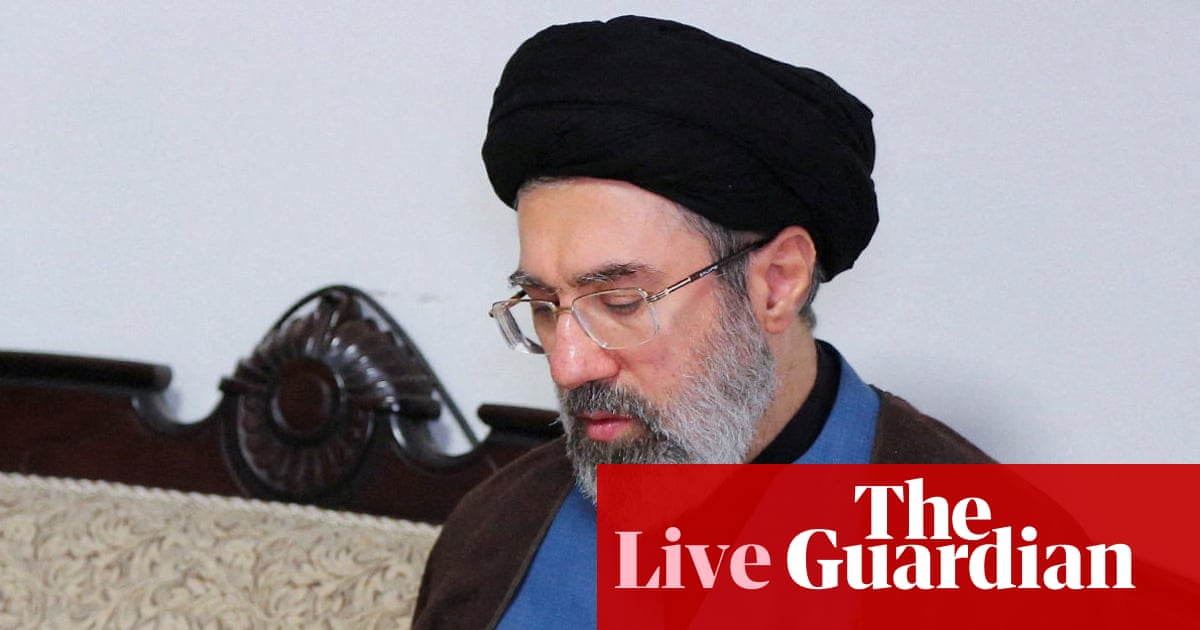
Iran has named Mojtaba Khamenei to succeed his father Ali Khamenei as supreme leader, signalling that hardliners remain firmly in charge,
-
Fresh missile and drone strikes by Israel and Iran reverberated across the Middle East as the US-Israeli war in Iran entered its 10th day. The Israeli military said on Monday it had begun a wave of attacks in central Iran and had struck Hezbollah infrastructure in Beirut.
-
The war has sent oil prices surging and Asian stock markets into a nosedive. Global oil prices surged past $100 (£74, AU$142) a barrel for the first time since 2022 as fallout from the war continues to wipe 20m barrels of oil from the market each day.
-
Iran and its proxies appeared to have launched attacks across the region. They included reports of strikes targeting a US diplomatic facility near Baghdad’s international airport but being intercepted, the interception of a drone east of Saudi Arabia’s northern Jawf region, and thick smoke seen rising from the direction of the Bapco oil refinery in Bahrain.
-
The US military reported a seventh American has died from wounds sustained during Iran’s initial counter-attack. The Israeli military said on Sunday that two of its soldiers had been killed in southern Lebanon.
With agencies
Turkey plans to deploy six F-16 fighter jets to northern Cyprus on Monday to bolster the defences of the Turkish community there, broadcaster NTV said, citing a civil aviation official from the breakaway Turkish Republic of Northern Cyprus.
On Saturday a Turkish defence ministry source said Turkey was considering the deployment of F-16 aircraft to Cyprus, among other steps being taken to ensure the security of the Turkish Cypriot state as conflict spreads in the region, Reuters reported.
Bahrain’s Bapco declares force majeure after oil refinery attack
Bahrain’s state-owned energy company Bapco Energies has declared force majeure on its group operations after Iran attacked the country’s only oil refinery, news reports are saying.
A statement from the company said it “hereby serves notice of force majeure on its group operations which have been affected by the ongoing regional conflict in the Middle East and the recent attack on its refinery complex”.
Last week Qatar – the Gulf’s biggest liquefied natural gas producer – suspended activity at its facilities on Monday and declared force majeure on gas exports on Wednesday, freeing it from contractual obligations to its customers.
Hezbollah says it is fighting Israeli forces who landed in east Lebanon
Hezbollah said on Monday it was fighting Israeli forces who landed in eastern Lebanon by helicopter across the Syrian border, the second such operation since the outbreak of the latest conflict with Israel.
Hezbollah said it detected “the infiltration of approximately 15 Israeli enemy helicopters” from the Syrian side of the border in eastern Lebanon, an area where Hezbollah holds sway.
The Iran-backed militant group said in its statement that its fighters “engaged the helicopters and the infiltrating force with appropriate weapons” and that the confrontation was ongoing, the AFP news agency reported.
Lebanon’s state-run National News Agency earlier said there were “fierce clashes… towards the outskirts of the town of Nabi Sheet to repel Israeli forces that carried out a landing by helicopters” in the area.
Two Hezbollah officials in the Bekaa region, where Nabi Sheet is located, told AFP that an Israeli helicopter was downed.
The Israeli army did not immediately comment on the incident.
It was the second such raid after an Israeli commando operation in Nabi Sheet and its surrounding areas overnight on Friday failed to find the remains of Ron Arad, an airman missing since 1986. The fighting left three Lebanese soldiers and 41 residents of the Bekaa valley dead, according to the Lebanese army and ministry of health.
Donald Trump envoys Steve Witkoff and Jared Kushner are planning to travel to Israel on Tuesday and meet Israeli prime minister Benjamin Netanyahu, according to an Axios reporter.
Barak Ravid’s post on X cited a “US official and a source with knowledge”.
The plan is yet to be officially verified.
Saudi Arabia condemns ‘reprehensible’ Iranian attacks on Gulf states
Saudi Arabia has condemned what it calls Iran’s “reprehensible” and unjustifiable aggression against the kingdom and other Gulf states.
The Saudi foreign ministry said in a statement on X:
The Ministry of Foreign Affairs renews the Kingdom of Saudi Arabia’s categorical condemnation of the reprehensible Iranian aggressions against the Kingdom, the Gulf Cooperation Council states, a number of Arab and Islamic countries, and friendly nations, which cannot be accepted or justified under any circumstances.
The Kingdom affirms its full right to take all measures that ensure the protection of its security, sovereignty, and the safety of its citizens and residents, and to deter aggression.
Nick Visser
More than 2,200 Australians have arrived back home since Middle East conflict started.
As of this morning, more than 2,200 Australians have returned to the country via commercial flights from the Middle East.
Multiple flights from the United Arab Emirates and Qatar are arriving or expected to arrive each day into various Australian airports, after a series of long airspace closures.
The government is still encouraging Australians abroad to register with the Department of Foreign Affairs and Trade’s crisis portal if they are in Bahrain, Iran, Israel, Kuwait, Qatar, Lebanon or the UAE.
Vietnam is considering a plan to scrap tariffs on fuel imports, the government said, as the US-Israeli war with Iran disrupts oil supplies and pushes prices to their highest level since 2022.
The ministry of finance said it had drafted a decree that would slash import tax rates to zero on some petroleum products to “help stabilise the domestic market and ensure national energy security”.
It said in a statement on Sunday:
If the conflict continues and the blockade of the strait of Hormuz persists, alternative supplies on the international market will become scarce and risk driving prices up.
The AFP news agency also reports that since the war began more than a week ago with US and Israeli strikes on Iran, prices of fuel in Vietnam have risen sharply and the government has implemented emergency pricing protocols.
Thick smoke is rising from the direction of the Bapco oil refinery in Bahrain, a witness has just been quoted as saying.
Earlier on Monday Bahrain said an Iranian drone attack on the island of Sitra injured 32 people overnight.
Gulf countries have been reporting new strikes as Iran continues retaliatory attacks across the region.


Jack Snape
Their forward was once suspended when her head scarf slipped off during a goal celebration. They are the women of the Iran football team, who are at the centre of an international diplomatic incident, even as the US and Israel rain missiles down on their family back home.
The team remains in a hotel on Australia’s Gold Coast, where they played their third and final match of the Women’s Asian Cup on Sunday. Their departure from Australia is imminent, even if it’s not clear whether they want to go.
Fears are held for their safety if they return to Iran. The players were dubbed “wartime traitors” by a state-linked commentator, who called for them to be “dealt with more severely”, after they failed to sing the national anthem in their first Asian Cup game.
In subsequent matches not only have the players sung – or at least mouthed the anthem’s words – they have saluted.
Were they to stay in Australia, they face cutting off ties from their family and friends, who may be then vulnerable living under a regime that has already killed tens of thousands. Backlash might extend to teammates, other footballers, and out through community networks still living in Iran.
It is a torrid choice, but one the players may have for only hours more.
The full story is here:

Callum Jones
Continued from previous post:
My colleague Rebecca Ratcliffe reported last week on efforts by the Philippines to conserve energy. Government offices have been told to adopt flexible work arrangements, and to set air conditioning units no lower than 24 degrees. A presidential palace spokesperson said a four-day working week could also be considered, especially if the Middle East crisis worsened, local media reported.
Other south-east Asian countries are also introducing energy-saving measures, Rebecca noted. In Thailand, the defence ministry advised agencies under its control to cut back on the use of air conditioning, and to use video conferencing to avoid unnecessary travel.
In Myanmar, meanwhile, military rulers have banned half of private vehicles from the roads, announcing that from this weekend even-numbered plates will be permitted to drive only on even dates and odd-numbered plates only on odd dates.
Callum Jones
Why does the massive rise in oil prices actually matter? The surge to $100 per barrel might feel a bit abstract – unless you’re in a country scrambling to deal with an energy supply crunch.
Concerns over the strait of Hormuz, which has now been in effect closed for a week, have been compounded by reports of oil production cuts across the Middle East. Asian markets are particularly vulnerable here: they relied on the Middle East for 59% of their crude oil imports last year, according to analytics firm Kpler.
In Bangladesh, Reuters reports that all universities will be closed from Monday, bringing forward the Eid al-Fitr holidays as part of emergency measures to conserve electricity. Officials said the move would not only reduce electricity consumption but also ease traffic congestion, which leads to fuel wastage.
In South Korea, the country’s president has just announced a move to cap domestic fuel prices for the time in almost three decades. The current crisis “is a significant burden on our economy, which is highly dependent on global trade and energy imports from the Middle East”, said Lee Jae Myung.
Continued next post
Qatar arrests more than 300 over alleged ‘misleading information’
Qatar says 313 people of different nationalities have been arrested over allegations of inciting public concern amid the US-Israeli war on Iran.
The arrests were carried out as part of “ongoing efforts to monitor and address the misuse of social media platforms”, the Qatari interior ministry said in a press release posted on X.
It said:
The arrests were made for filming and circulating unauthorized video clips, spreading misleading information and rumours, and disseminating content intended to incite public concern, in violation of official directives.
The interior ministry also said it “stresses the importance of refraining from filming, publishing video clips or circulating rumours related to the current situation, and calls on the public to obtain information solely from approved official sources”.
Source link
-

-

-
-
-