PHOENIX (AZFamily) — Family trauma equals family drama.
Synopsis
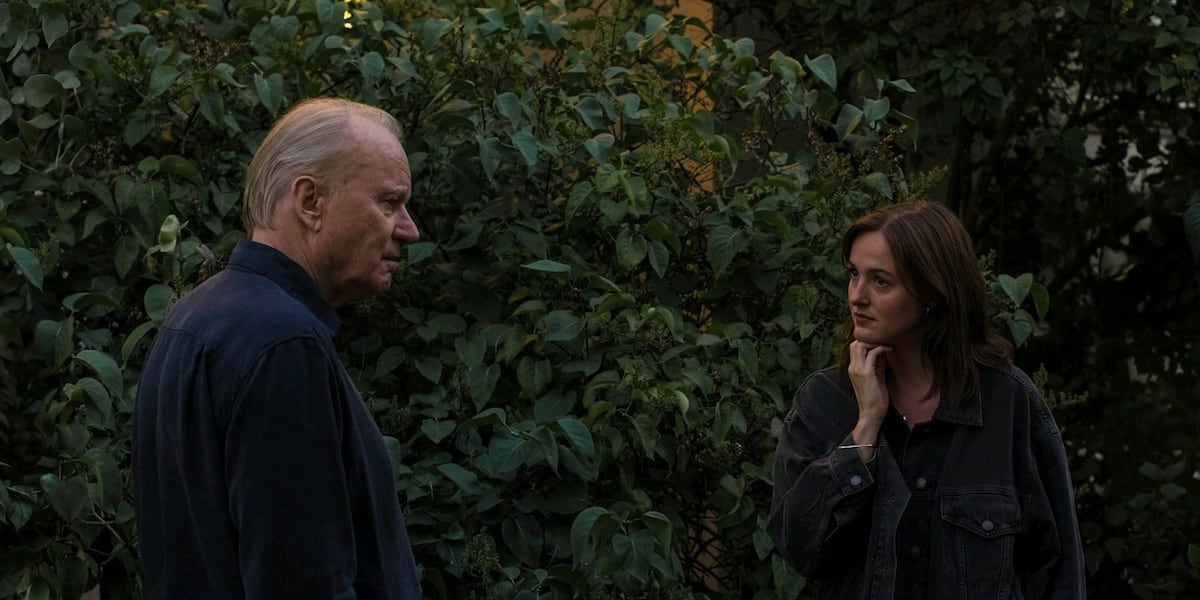
“Sentimental Value” follows Nora Borg (Renate Reinsve), an actor from a theatrical family, as her sister Agnes (Inga Ibsdotter Lilleaas) used to act in films as a child directed by their estranged father, Gustav (Stellan Skarsgård). After the death of their mother, old family drama rears its ugly head as Gustav suddenly reappears in Nora and Agnes’ lives, desperately wanting Nora to star in a film to portray a character based on his own mother. Nora wants nothing to do with the movie or her father, forcing Gustav to hire famous American actor Rachel Kemp (Elle Fanning) to play the role instead.
My thoughts
People often criticize movies about acting, filmmaking or the visual creative process because they perceive them as being self-congratulatory. “Of course, the movie that’s about the love and passion for making movies is going to win a bunch of Oscars,” they might say, but that’s just as dismissive as calling a movie “Oscar bait.” Sure, the voters at the Academy often gravitate toward certain types of movies (that is, mostly great ones), but that doesn’t make the art they vote for any less deserving of appreciation.
While movies are “fake” in a basic sense, the best movies are the ones that have real heart, real emotions and real stories put into them. Beyond wanting to pass the time and be entertained, we love movies because they speak to our emotional core. If simply watching a movie can heal viewers by speaking to their souls, it only makes sense for that to also apply to the people who make them.
When a house becomes a home
Directed by Joachim Trier, who co-wrote the screenplay with Eskil Vogt, “Sentimental Value” explores the intersection between art and generational trauma and how the two shape one another. It goes deeper than the human beings that make up this family, asking the age-old question: what if walls could talk? The house that’s belonged to the Borg family for generations is as much of a character as the people who inhabit it, the opening scene giving us a walkthrough of the house in all its detail, highlighting the emotional effect it has on the inhabitants within.
When it comes to the actual people, Trier explores acting and filmmaking in a fascinating way, displaying just how integral real human history and experiences influence storytelling. To the audience, the film Gustav wants to make will simply be a family drama that ends in tragedy, but to him, he’s finally coming to terms with his mother’s suicide, as well as the broken relationship with his daughters. There’s genuine healing that can come out of art, and even if the audience doesn’t feel it, the artist’s satisfaction is what truly matters.
I certainly felt it, though, as “Sentimental Value” is a brilliantly straightforward, simple piece of filmmaking with tremendous depth. The characters are layered and come off as if they all share a history, thanks to the strong chemistry among the actors. Trier stages the drama with a subtlety that allows the performers to speak for themselves; he and editor Olivier Bugge Coutté know just when to cut to the next shot to capture the maximum impact of these performances.
Silence of the void
Trier gets a little experimental with the filmmaking at times, particularly in the intermittent psychological moments. The opening scene with Nora’s stage fright is one example, but one of the best shots of 2025 consists of close-ups of Nora, Agnes and Gustav fading back and forth through each other, showing how they’re all one and the same. They may be separated by age and gender, but their family history binds them together as one.
There’s a stage-play presentation to “Sentimental Value,” including harsh cuts to black to signify scene transitions, almost like the lights on stage dimming. These were the only bits of editing I didn’t like, especially near the end, when it keeps seeming like it’s finally cutting to the end credits, but we instead get more movie. I would have swapped the last two scenes so the entire film could be bookended with a montage of the Borg’s house. The final scene still hits hard, though.
The contempt Trier appears to have for modernity seeps through the entire picture, whether it’s Gustav being forced to produce his movie through streaming companies like Netflix or the Borg family house having all its character and color stripped down to different shades of white. Despite changing times, when cinematic endeavors by legendary filmmakers are relegated to TV and minimalist decor resembles an insane asylum rather than a home, that doesn’t make all the work, passion and emotion leading up to now null and void. Behind the fresh coat of white paint on the walls lies not only color but also history and memories.
Sister acts
Renate Reinsve as Nora gives one of the most stunning lead performances of 2025, easily my runner-up pick for Best Lead Actress at the Oscars after Jessie Buckley in “Hamnet.” Reinsve has such a spellbinding presence that draws you in from the opening scene where she’s about to go onstage and is suffering from debilitating stage fright. She communicates so much through her eyes, facial expressions, and body language, navigating the entire story with a soulful gaze.
One may see Nora as stubborn because of how much she resents her father, but Reinsve’s vulnerable performance gives the sense that Nora has put up several walls around her. It’s not all conflict, as the sisterly bond between Nora and Agnes provides a more optimistic dramatic throughline to counteract everything involving Gustav. The tenderness and forthrightness they share signify a deep bond developed over decades of relying on one another.
Inga Ibsdotter Lilleaas is also fantastic, playing the more level-headed and emotionally in tune sister of the two. Having a husband and young child has allowed Gustav to be more present in her life than in Nora’s. Still, their relationship is fractured, but Agnes has a deep love for her entire family, which is especially evident when things get heated. Lilleaas tackles it all with assured confidence as Agnes attempts to keep her family’s life from unraveling.
Reminders of mom
Elle Fanning had a tough role to tackle in this one. Trier’s characterization of her movie-star character Rachel Kemp surprised me, as all the pieces are in place for her to simply be a young, attractive muse for Gustav. She’s brimming with enthusiasm when she first meets him, eager to work with such a legendary director. As pre-production of the project carries on and Gustav integrates Rachel into his family by bringing her into the Borg home, she realizes she doesn’t fit in. It’s not just cultural — she’s an American in Norway portraying a Norwegian woman who lived more than a century ago — but emotional as well.
Stellan Skarsgård is putting in some phenomenal work as Gustav, a man carrying a load of trauma just like his two daughters. Clearly the death of his ex-wife and mother of his daughters has weighed heavily on him, making him examine his past, future, and legacy once he’s gone. His mother’s painful upbringing and eventual suicide are events he never truly confronted or shared with others to achieve some semblance of healing. He has the ego and magnetism of a successful filmmaker, and, while selfish, he tries his best to be tender in his own misguided ways.
Gustav almost serves as a proxy for Trier, echoing his own emotional anguish and attitude toward the vapid modern world. Even if he’s smitten with “it girl” Rachel Kemp, he can’t stand her lifestyle that revolves around partying and social media. Regardless, he understands the deeper humanity inside her that initially makes him think she would be a good fit to portray his mother. Skarsgård also understands the deeper humanity of his character — that just because he was a poor father doesn’t mean he’s a poor person.
Final verdict
Frequent moments of silence permeate “Sentimental Value,” featuring characters simply existing in the moment and staring into each other’s eyes. No words are exchanged; none are needed when they’re most honest with each other. The honesty is what makes “Sentimental Value” such a piece of art — a simple, quiet film at a glance, yet thematically profound once Joachim Trier and Eskil Vogt dig deep into generational family trauma. Good or bad, there’s sentimental value to be found in everything, especially when it bonds a family in such a complex way.
My rating: 9.5/10
“Sentimental Value” is currently playing in limited theaters nationwide and is available for rental and purchase on digital platforms.
See a spelling or grammatical error in our story? Please click here to report it.
Do you have a photo or video of a breaking news story? Send it to us here with a brief description.
Copyright 2026 KTVK/KPHO. All rights reserved.
Source link
-

-

-

-

-