

What Is n8n? Why Companies Are Replacing Zapier With Open Automation
How AI workflows, rising automation costs, and self-hosted infrastructure are pushing startups and enterprises away from task-based automation platforms.
What Is n8n? Why Companies Are Replacing Zapier With Open Automation
A workflow that cost $20/month in 2022 can now cost hundreds once AI summaries, branching logic, and enrichment APIs enter the loop. For many startups, automation has quietly become one of the largest invisible operational expenses. As we enter 2026, a shift is occurring: CTOs and Operations leads are hitting a “SaaS Ceiling” where proprietary “per-task” pricing actively punishes innovation.
The move to n8n isn’t just about saving money; it’s about moving from “click-labor” to “logic-infrastructure.”
⚡ Is n8n Better Than Zapier? (The 60-Second Verdict)
n8n is generally better for advanced workflows, AI agents, and self-hosted automation, while Zapier is better for beginners and quick no-code integrations.
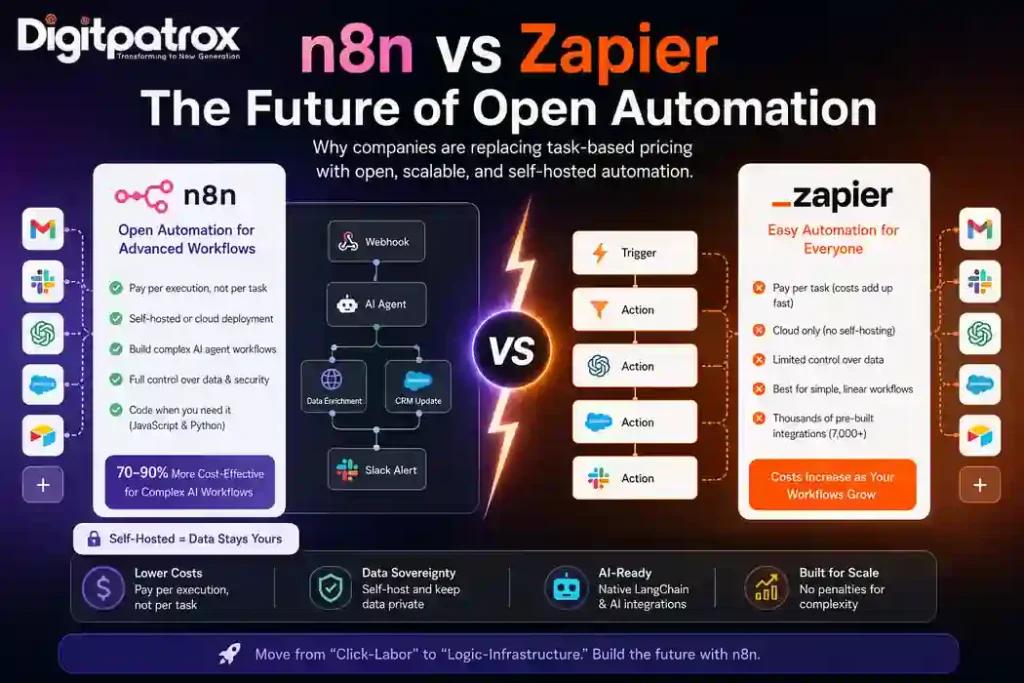
The primary differentiator is the pricing model: Zapier charges per “task” (every single step), whereas n8n charges per “execution” (the entire workflow). After testing both platforms across AI content pipelines and lead enrichment workflows, the biggest difference wasn’t UI-it was pricing behavior at scale. This makes n8n 70–90% more cost-effective for complex, multi-branching AI workflows.
I. What is n8n? (The Simple Explanation)
In simple terms, n8n is a tool that connects your apps (like Gmail, Slack, Salesforce, and ChatGPT) to automate repetitive tasks.
What does n8n actually stand for?
n8n stands for “nodemation,” short for “node-based automation.” The platform uses visual nodes connected together to create a flow of information.
The Story Moment: The Breaking Point
One startup founder I spoke with realized their Zapier bill had crossed $2,000/month-not because the company was growing rapidly, but because they added a single “AI Summarization” step to their lead intake. That one step turned a simple notification into a multi-task “expensive” workflow. They switched to n8n and saw their bill drop to a flat $50/month cloud fee for the same logic.
If Zapier is a “Black Box” where you pay for convenience, n8n is a “Glass Box” where you have full visibility. Because it is open automation, you can host it on your own servers, keeping your company data behind your own firewall.
II. Real Cost Example: The “Task Tax” in Action
To understand the economics, you have to look at the math of a modern AI-driven workflow. Let’s compare a 10-step workflow (e.g., Lead Scraper → AI Categorization → CRM Update → Slack Alert) running 1,000 times per month.
| Feature | Zapier (Professional) | n8n (Pro Cloud) | n8n (Self-Hosted) |
| Billing Unit | 10,000 Tasks | 1,000 Executions | Unlimited |
| Est. Monthly Cost | $299+ | $50 | ~$15 (Server cost) |
| Data Privacy | Shared Cloud | Shared Cloud | Private Infrastructure |
1. The Complexity Penalty
In Zapier, every “Filter,” “Formatter,” or “AI step” increases your bill. This creates a complexity penalty that discourages employees from building better, more detailed automations. In n8n, a 20-node workflow costs the same as a 2-node workflow.
2. Data Sovereignty
In 2026, sending sensitive customer data to a third-party cloud is a massive AI cybersecurity risk. By self-hosting n8n, your customer PII (Personally Identifiable Information) never leaves your infrastructure, which is critical for GDPR and HIPAA compliance.
III. Best Choice by Company Size
Not every company should use the same tool. Here is the operational breakdown:
| Company Type | Best Choice | Why? |
| Solo Creator / Small Biz | Zapier | Priority is speed and zero maintenance. |
| Growth Startup | n8n (Cloud) | Scalable AI costs without managing servers. |
| Marketing Agency | Make.com | Visual modularity for client handoffs. |
| Enterprise / FinTech | n8n (Self-Hosted) | Strict data compliance and infinite complexity. |
IV. Practical Use Cases: Where n8n Shines
-
The AI Content Engine: A workflow that pulls a topic from Airtable, generates a draft with Claude, checks plagiarism via API, uploads to WordPress, and alerts an editor.
-
Lead Enrichment: An agent that takes a new signup, scrapes their website using a local LLM, finds their LinkedIn, and categorizes them.
-
Customer Support Orchestration: Managing the AI handoff workflow between a bot and a human agent based on real-time sentiment analysis.
V. When Zapier Is Still the Better Choice
Despite the cost benefits of n8n, Zapier remains the market leader for a reason. You should stay on Zapier if:
-
Non-technical teams: If you get a headache looking at a JSON object, stay with Zapier.
-
Fast MVPs: When you need to connect two niche apps in under 5 minutes.
-
Niche Integrations: Zapier has 7,000+ apps. n8n has ~400. While n8n can connect to anything with an API, Zapier has the “pre-built” advantage.
-
Zero Maintenance: If you don’t have a developer or technical VA, managing an automation server is a liability.
VI. The Hidden Cost of Migrating
Moving from Zapier to n8n is not a “one-click” process. Prepare for these operational hurdles:
-
Manual Rebuilds: There is no “Import” button. Every workflow must be rebuilt node-by-node.
-
Webhook Re-mapping: You must update the webhook URLs in every third-party service (Typeform, Stripe, etc.).
-
Maintenance Debt: When you self-host, you are the DevOps engineer. If your server runs out of disk space due to execution logs, your business logic stops.
VII. Why n8n Is the Infrastructure for AI Agents
Zapier is built for triggers; n8n is built for orchestration.
As we move toward AI Operating Systems, we need workflows that can “loop” (retry if an AI fails) and “retrieve” (pull context from Vector stores). n8n includes native nodes for LangChain, allowing you to build agents that actually use your company data rather than just summarizing it.
VIII. Final Verdict
In the AI era, the value is no longer in connecting apps. The value is in how intelligently those apps work together. The automation platforms that survive the next decade won’t be those with the most integrations, but those that let companies build intelligent workflows without punishing them for complexity.
By choosing n8n, you are building an infrastructure that is ready for the Post-SaaS era-where the logic is the asset.
IX. SERP Capture Layer
-
5 FAQ Questions:
-
What does n8n stand for? It stands for “nodemation.”
-
Is n8n actually free? The self-hosted version is free for most internal business uses under a “fair-code” license.
-
Can n8n replace Zapier? Yes, for most automation use cases, provided you can map the API logic manually.
-
Does n8n support Python? Yes, it has a native Python node for custom scripts.
-
Is n8n more secure? Yes, because self-hosting keeps data off third-party servers.
-
-
Meta Description: Compare n8n vs. Zapier for 2026. Discover why companies are switching to open automation to save 90% on AI agent costs and reclaim data sovereignty.
-
Citations: n8n Pricing, Zapier Pricing 2026, BetterCloud SaaS Sprawl Report.
-
Schema Markup Recommendation: Use
FAQPage,SoftwareApplication(for n8n), andArticleschema to capture rich snippets.