In an evolving world, emerging research continues to highlight concerns that could impact everyday wellbeing. Here’s the key update you should know about:
RATING – ⭐ ⭐ ⭐ ⭐ 4/5*
Sholay The Final Cut Review movie Talkies:
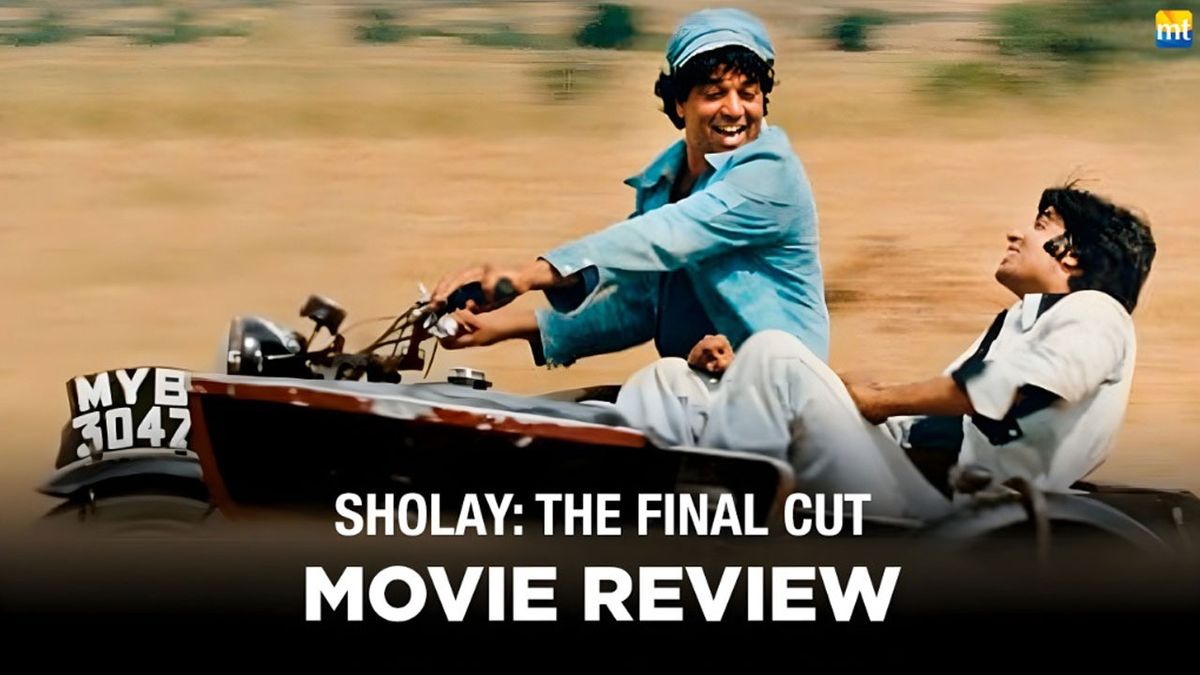
Ramesh Sippy could have made only Sholay and retired, and he would still have been remembered as a legend. That is the power of this film. Among the top five biggest blockbusters of all time, Sholay may not surpass the emotional depth of Mother India or the grandeur of Mughal-E-Azam, but it stands tall as India’s most definitive masala entertainer. Even more astonishing is that it became the biggest blockbuster of Indian cinema despite releasing during the politically turbulent Emergency era—a period hardly favourable for filmmakers.
Growing up, I watched Sholay countless times on TV while listening to my father narrate how he saw the film nearly a dozen times in theatres during his youth. With age, and after watching thousands of films from Hollywood and world cinema, I now understand why Sholay continues to hold such mythical stature. Every scene and dialogue is ingrained in my memory, and revisiting it today feels like revisiting a cinematic textbook that still hasn’t been fully surpassed.
/filters:format(webp)/movietalkies/media/media_files/2025/12/11/sholay-4k-still-6-2025-12-11-19-10-05.jpg)

Many cinephiles often draw parallels between Sholay and Akira Kurosawa’s Seven Samurai (1954). While the influences are undeniable, I find the comparisons incomplete. A more accurate lineage runs through The Magnificent Seven (1960), The Invincible Six (1970), and even Chinagate (1998). Sholay undoubtedly borrows from the Western and Sergio Leone-style Spaghetti Western traditions, but more than 70% of its essence—its emotions, humour, character arcs, music, and dramatic beats—belongs solely to Indian storytelling.
Why Hrithik Roshan Was Forced to Rewrite His Dhurandhar Review? Political Backlash is Bigger Than A Celebrity’s Opinion?
/filters:format(webp)/movietalkies/media/media_files/2025/12/11/sholay-4k-still-7-2025-12-11-19-10-05.jpg)
Hollywood had John Wayne, Gary Cooper, Spencer Tracy, Henry Fonda, and Clint Eastwood—actors who embodied rugged Western heroism. India had Dharmendra, and he carried that mantle with unmatched charm and conviction. No one could deliver a line like “Main iska khoon pee jaunga” the way he did—ferocious yet irresistibly charismatic. He wasn’t just handsome; he radiated an earthy heroism that felt authentic to Indian audiences. His comic timing in the romantic scenes with Basanti, his fury in action sequences, and the raw power visible in something as simple as clenching his fist in the climax—everything about Veeru was iconic, and only Dharmendra could have brought that combination alive.
/filters:format(webp)/movietalkies/media/media_files/2025/12/11/sholay-4k-still-8-2025-12-11-19-10-05.jpg)
Opposite him, Amitabh Bachchan’s Jai was quieter, more thoughtful, and equally unforgettable. He wasn’t the brawny hero, but he was the mind, the strategist, the man who understood the rhythm of danger. His mastery of the coin trick, his subtle humour, and above all, his heartbreaking sacrifice elevated the film’s emotional weight. Jai’s death is not just a plot point—it is the soul of Sholay, the moment that transforms a masala entertainer into a timeless tragedy.
/filters:format(webp)/movietalkies/media/media_files/2025/12/11/sholay-4k-still-10-2025-12-11-19-10-05.jpg)
Hema Malini’s Basanti remains one of the most entertaining female characters ever written for Indian cinema. Her chatterbox persona, her dramatic flair, and even her mare Dhanno are universally known even today. Western cinema never blended glamour with such indigenous humour—Grace Kelly types never danced breathlessly for their lover’s life the way Basanti does. A Western heroine might abandon the hero in his moment of crisis–take High Noon (1952) for instance; Basanti becomes the storm he fights for. Sanjeev Kumar’s Thakur, despite missing limbs, exudes an intimidating presence. Jaya Bachchan speaks oceans with silence—her eyes doing the emotional labour of entire pages of dialogue. You feel sad for her character. She lost her husband and when she was getting another one, she lost him as well. And then comes Amjad Khan’s Gabbar Singh, arguably the most unforgettable villain in the history of Indian cinema. His maniacal laugh, brutal cruelty, and unpredictable madness elevated the film into something mythic. It’s impossible to imagine anyone else in that role. Even the supporting cast—Asrani, Jagdeep, AK Hangal, Sachin Pilgaonkar—appears briefly but leaves lasting impressions. Sholay proves that great casting is not about screen time; it’s about the precision of presence.
/filters:format(webp)/movietalkies/media/media_files/2025/12/11/sholay-4k-still-9-2025-12-11-19-10-05.jpg)
The screenplay of Sholay deserves to be preserved in every film school library. What appears to be a simple revenge Story is actually written with meticulous structure. A random comic sequence connects to a dramatic beat later. A throwaway conversation lays the foundation for a crucial twist. The recurring coin flip is used so consistently that when the truth about the two-headed coin is revealed, it lands like a thunderbolt. The songs—woven seamlessly into the narrative—serve emotional and narrative functions. “Yeh Dosti” begins as a celebration of friendship but returns later with heartbreaking impact. Holi Ke Din continues to be synonymous with the festival even 50 years later. Jab Tak Hai Jaan believed to be shot while Hema danced through real injuries, I mean that was the perception of the people and those beats showcases RD Burman’s genius. And the charmingly underrated Station Se Gaadi Jab stands as one of the sweetest flirtation songs of the era. Mehbooba was a chartbuster then and today’s Nora and Malaika numbers are chai-kam-pani in front of Helen.
Abhishek Bachchan Says His daughter Aaradhya Bachchan is Unaware of Divorce Rumours With Aishwarya Rai –
/filters:format(webp)/movietalkies/media/media_files/2025/12/11/sholay-4k-still-4-2025-12-11-19-10-05.jpg)
The dialogues, crafted by Salim-Javed, remain unmatched in their punch, clarity, humour, and rhythm. No Western classic, despite its literary sharpness, has dialogue writing that became as culturally embedded as “Kitne aadmi the?” or “Tumhara naam kya hai Basanti?” It wasn’t just writing—it was thunder bottled into everyday speech. “Ye vaaad maine kiya toh me aaj me use tod deta, par ye vaada mere dost ne kiya tha isliye…” As for direction, Ramesh Sippy’s craft is nothing short of masterful. The frames, the camera angles, the tension-building, the choreography of action sequences, and the emotional pacing reflect a filmmaker operating at the peak of imaginative precision. Many films have tried to replicate Sholay’s masala formula, but the emotional truth underneath its action and humour remains impossible to recreate. A film can have guns and drama, but without heart, it collapses—and Sholay is a masterclass in emotional anchoring.
/filters:format(webp)/movietalkies/media/media_files/2025/12/11/sholay-4k-still-3-2025-12-11-19-10-05.jpg)
Every time Jai dies, every time Basanti dances for Veeru, every time Thakur confronts Gabbar, you feel the weight of these moments as if watching them for the first time. That is what makes Sholay timeless. It is, as you beautifully described, a “photosynthesis blockbuster”—something audiences absorb naturally, endlessly, and without fatigue. It nourishes the cinematic landscape daily, just as trees generate life through photosynthesis.
/filters:format(webp)/movietalkies/media/media_files/2025/12/11/sholay-4k-still-5-2025-12-11-19-10-05.jpg)
In Sholay The Final Cut, you’ll finally witness the original climax that was changed before theatrical release. A couple of deleted scenes—brief yet intriguing—add another layer of nostalgia. The restored sound and picture quality breathe new life into the film without compromising its soul. Whether you’re a first-time viewer or someone who can recite every dialogue from memory, this new version gives you yet another reason to revisit the legend. Sholay isn’t just a film; it’s a cultural cornerstone, a cinematic scripture, an emotion that has lived across generations—and will continue to live for many more.

Stay tuned to movie Talkies’ website and social media platforms (Facebook, Twitter, Instagram), along with our YouTube channel, for the latest updates, breaking news, box office reports, movie reviews, celebrity spotting, and interviews from Bollywood, television, OTT, Hollywood, and regional cinema, including South Indian films.
By: Digitpatrox