
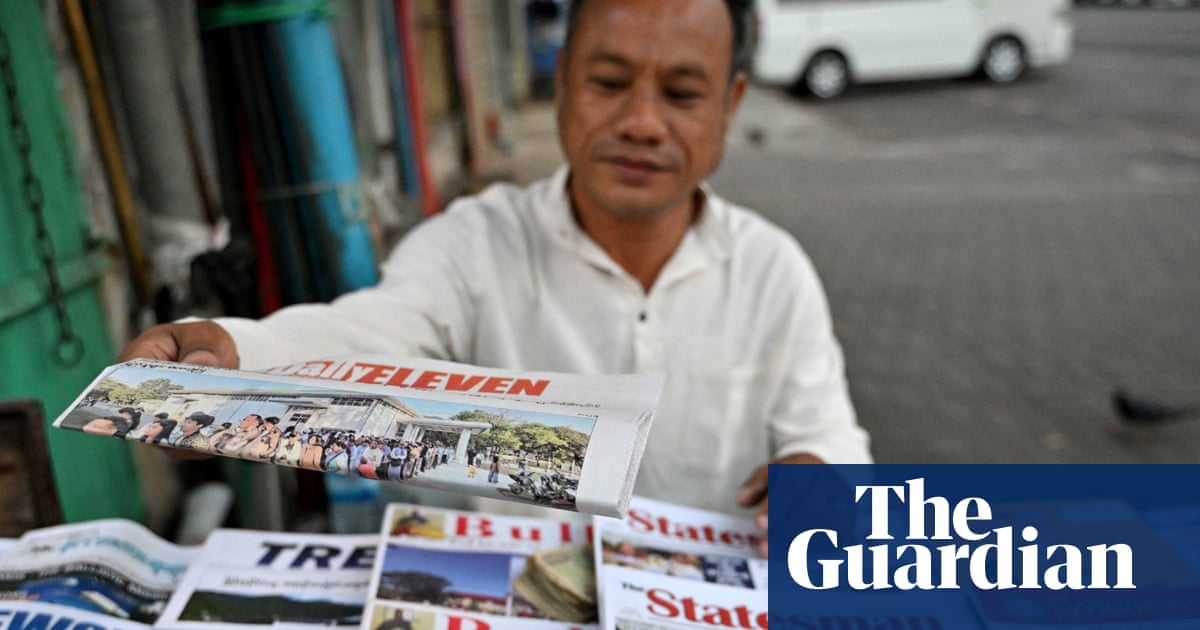
Yangon feels, on the surface, like a normal, bustling city. In downtown areas, commuters stream past roadside sellers and diners perch beneath parasols. Packed buses and cars chug along the roads. At sunset, young people stop to pose for photos opposite the famous Sule pagoda, as it gleams against a pink-blue sky.
But almost five years on from the military seized power in a coup, ousting and imprisoning then de facto leader Aung San Suu Kyi, life for local people feels anything but stable. Myanmar’s military rulers are in the process of holding the first elections since before the coup, a vote that the junta has touted as a return to democracy and stability. The UN and western governments have called the process, which will be held in three phases ending on 25 January, a sham.
“We are always living in fear,” says a commuter, stopping briefly to speak. “[Before the coup] we had such hope for the future. We were not at all afraid of our government. Now all that has changed,” she says.
“We cannot speak our voices to others freely,” she adds. Like everyone interviewed on the streets of Yangon, she didn’t want to give her name, or speak for long.
After the coup on 1 February 2021, these streets were packed with protesters demanding the return of democracy. Hundreds of thousands rallied across the country – until the military crushed protests with deadly force.
More than 400 people were killed in the streets by the end of March. Tens of thousands have been arrested since. Many fled to rural areas to form a patchwork of groups that make up an anti-junta resistance, at times fighting with help from more experienced ethnic armed groups that have long demanded greater autonomy. By late 2023 war had spread across two-thirds of the country.
Yangon is detached from the fierce conflict that is raging elsewhere in the country, where military air and drone strikes happen daily. Attacks have repeatedly been condemned as indiscriminate.
Life in the city is fraught with anxiety, though. “Yangon isn’t like the old Yangon any more,” says an online influencer, who spoke under the pseudonym Hnin Sandar. “Yangon isn’t a happy place like before.”
“My friends remind me, don’t talk about politics even in a taxi or on the bus because they are listening,” she adds. It is safer to keep your head down, and never to speak your mind, even about something non-political, she says: “I feel like I’m living in jail.”
Images of Aung San Suu Kyi, the country’s most loved politician, which were once seen in shops, on the streets and government offices, have been removed. Generators sit on the sides of pavements, a reminder of how businesses have been forced to adapt, at great expense, to worsening power cuts.
At night-time, the streets fall silent. Some young people stay until the early hours in bars and clubs that have been flooded with drugs, looking for a temporary escape from the country’s political turmoil. Most remain at home, terrified they could be arrested or taken by the authorities, and forced to serve the military in the country’s brutal civil war.
Almost everyone knows of someone who has been snatched on the street. Aung Moe*, a Yangon resident, says his friend disappeared after being pulled into a passing taxi. “[They] dragged him inside the car, put a blindfold on him and they took his phone, and made him call his family and ask for a ransom,” he says.
The family were unable to pay the demand of USD$1,200. No one has heard from him since.
Mandatory conscription was enacted by the military in 2024, after it lost vast swathes of territory to anti-coup groups. Young men who had enough money to leave, did so.
Ei* works in a garment factory in the city, but is from Rakhine state, where there is intense conflict between the military, and opposition groups. She hasn’t seen her family for seven years, and agonises over whether she should have returned home earlier, or if she was right to stay working in Yangon, sending money back. In her home village, people have been killed just going out to fish, she says.
“I wish at least for just one week I could escape everything, and not have to think or worry about anything,” Ei Phoo says. “I don’t want to hear bad news any more.”
She can no longer take overtime as it is too unsafe to travel back from work late at night, and her small business, selling cosmetics to colleagues, has stopped because so many people have left the city. At the same time, inflation has surged, driven by the collapse of Myanmar’s currency, the kyat, which has dropped 80% in value since the coup.
Since 2020, Myanmar’s gross domestic product has contracted by 9%, according to the UN, reversing the huge economic progress the country made during its decade-long transition to democracy.
The signs of the rapid transformation Myanmar underwent during those 10 years are imprinted on Yangon. When the country opened up to the world, international investment flooded in: condos, luxury hotels and malls opened in the city. The poverty rate roughly halved from 48.2% in 2005 to 24.8% in 2017, according to the World Bank.
Today, many foreign businesses have withdrawn from the country, and tourists have disappeared. At Bogyoke Aung San market, woven bags and traditional fabrics hang from stall fronts, jewellery and carved wooden souvenirs are displayed in rows. The aisles would once have been packed with travellers from around the world. Nowadays, business is slow, says a shop owner.
“Before the coup, we were rocketing our hopes and dreams,” says Hnin Sandar. “But after the coup, we are doing what we need to survive.”
In past elections, people turned out in their droves to vote, the streets awash in red, the colour of Aung San Suu Kyi’s National League for Democracy. She remains in prison, aged 80, and her party, which won a sweeping victory in 2020, is banned.
A young pro-democracy activist, who speaks from exile in Thailand, says he remains confident the resistance will win. But it will take time, he says. The military’s entrenched power goes back decades.
“We didn’t think we could solve [the military’s dominance] during this five years.” Young people are prepared to continue resisting, he says, guessing it could take another five or ten years.
Activists fear this month’s election, which is happening at a time when the junta, supported by China has regained momentum on the battleground, could give the military greater legitimacy abroad.
At polling stations on Sunday, TV screens played a jarringly upbeat tune. “Hey dear friends, so that a colourful future may bloom, let us choose those who will shape tomorrow,” the lyrics went, as a woman on the screen smiled and swayed. A few metres away, police armed with guns watched on.
Turnout was 52% on Sunday, according to the junta, compared with about 70% in Myanmar’s 2020 and 2015 elections. In some areas people voted out of fear, anxious they could be conscripted as punishment for not doing so, or prevented from leaving the country. Large areas of the country are completely excluded from the vote because they are gripped by intense fighting.
The military has rejected criticism of the election, insisting it will be free and fair.
Will the vote make a difference to the country’s economic and political crisis? “It’s 50-50” says one man, aged 23. He says he didn’t feel excited to vote, but it was his duty.
Many voters declined to speak, worrying it was too unsafe to do so.
Away from the polling stations, a young man pauses to take in the sunset as he makes his way home from work. He was among the protesters who gathered in 2021, he says. Today, doing so is impossible. “The authorities immediately find out and come to arrest them,” he says.
“They pretend, they want to show the world that they made an election, that they go back to democracy, but we all know the result,” he adds. “There is no competitor.”
He did not go to vote, he says. Many in Yangon shared in the same act of quiet defiance.
* Name has been changed
Source link
-

-
-

-

-


