
Anbarasan EthirajanGlobal affairs correspondent

The killing of a Hindu man during recent violent protests in Bangladesh has pushed already strained ties between Dhaka and Delhi into a deeper crisis.
As the two neighbours accuse each other of destabilising relations, questions are growing over whether their once close, time-tested relationship is fraying beyond repair.
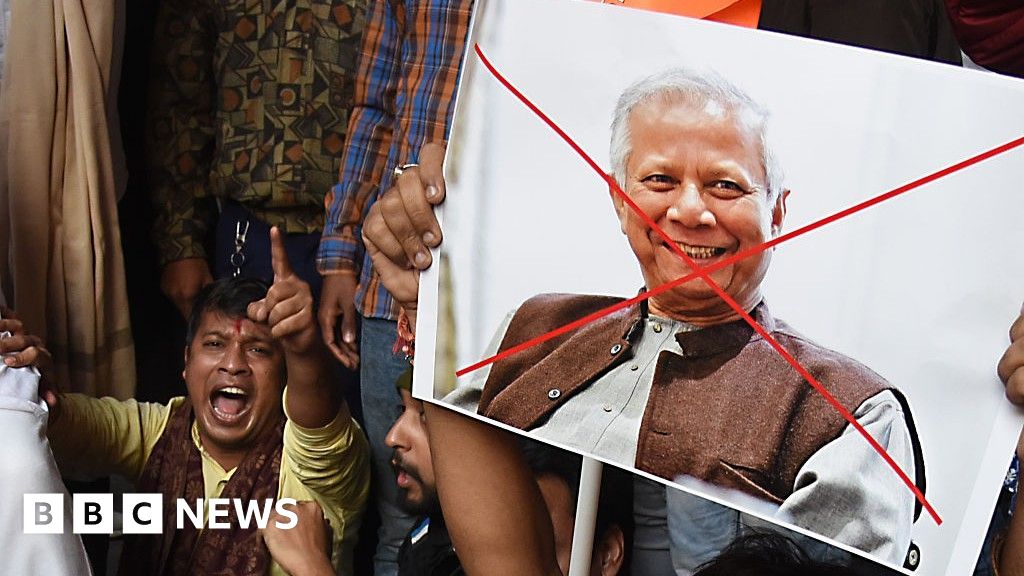
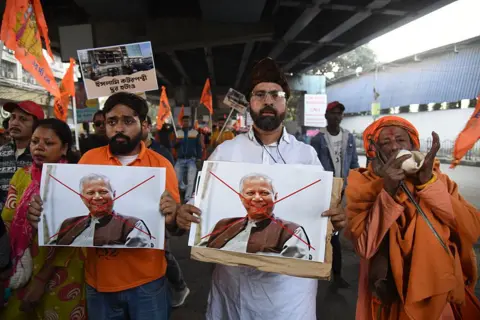
In India, the episode has sparked protests by Hindu nationalist groups. The man who was killed – Dipu Chandra Das, 27 – a member of Bangladesh’s Hindu minority, was accused of blasphemy and beaten to death by a mob last week in Mymensingh, in northern Bangladesh.
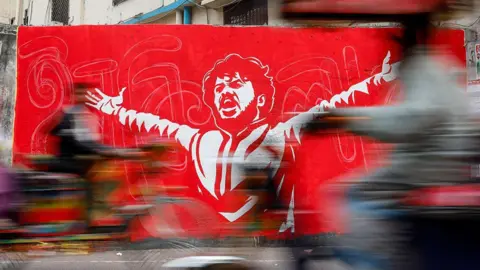
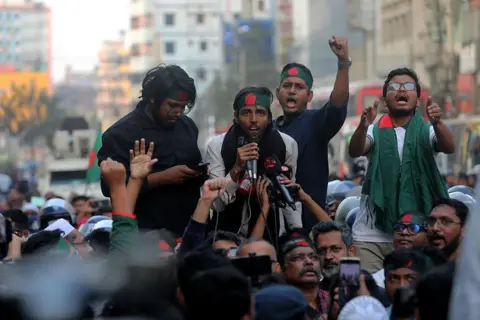
The incident happened hours before violent protests broke out over the murder of Sharif Osman Hadi, a prominent student leader, in the capital, Dhaka.
Hadi’s supporters alleged that the main suspect, who they say is linked to the Awami League – the party of deposed prime minister Sheikh Hasina – had fled to India, further fuelling anti-India sentiment in Muslim-majority Bangladesh. Bangladeshi police, however, said there was no confirmation that the suspect had left the country.
In recent days, the South Asian neighbours have suspended visa services in several cities, including Delhi, and accused each other of failing to ensure adequate security for their diplomatic missions.
The two countries have also summoned each other’s high commissioners to raise their security concerns.
“I sincerely hope tensions don’t escalate further on both sides,” Riva Ganguly Das, a former Indian high commissioner to Dhaka, told the BBC, adding that the “volatile situation” in Bangladesh made it difficult to predict which way things would go.



Anti-India sentiment in Bangladesh is not new.
A section of Bangladeshis has always resented what they see as India’s overbearing influence on their country, especially during Hasina’s 15-year rule before she was deposed in an uprising last year.
The anger has grown since Hasina took refuge in India and Delhi, so far, hasn’t agreed to send her back despite several requests from Dhaka.
In the aftermath of Hadi’s killing, some young leaders are reported to have made provocative anti-India statements.
In recent weeks, Bangladeshi security forces had to stop protesters from marching toward the Indian high commission in Dhaka.
Last week, a mob pelted the Indian assistant high commission building in Chittagong with stones, prompting outrage from Delhi. Police later detained 12 people in connection with the incident, but they were released later without any charge.
There were counter rallies in India. Bangladesh strongly objected to a protest by a Hindu group outside its diplomatic premises in Delhi, calling it “unjustifiable”.
“I have not seen this kind of suspicion and mistrust between the two sides before,” Humayun Kabir, a former senior Bangladeshi diplomat, said.
He added that both sides should protect each other’s diplomatic missions according to established norms.
Some readers may find the details below disturbing.
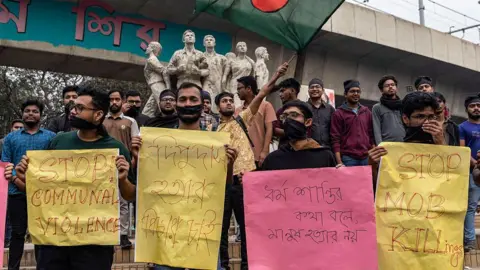
The brutal lynching of Das, a garment factory worker, has only added to the anger on the Indian side.
He was accused of insulting the Prophet Muhammad and was lynched by a mob, who then tied his body to a tree and set it on fire.
Videos of the killing were widely shared on social media, triggering outrage on both sides of the border.
Bangladesh’s interim government, led by Nobel laureate Muhammad Yunus, said there was “no place for such violence in the new Bangladesh”, promising that no one involved in the killing would be spared.
Bangladeshi police say they have arrested 12 people in connection with the killing of Das.
Analysts say his killing has once again raised questions over the safety of minorities and civil society activists in Bangladesh, with religious fundamentalists becoming more assertive and intolerant after Hasina’s exit.
Radical Islamists have desecrated hundreds of Sufi shrines, attacked Hindus, prevented women from playing football in some areas and have also curtailed music and cultural shows.
Human rights groups have also expressed increasing concerns over rising mob violence in Bangladesh in the past year.
“Hardline elements of society now see themselves as the mainstream, and they don’t want to see pluralism or diversity of thought in the country,” Asif Bin Ali, a Bangladeshi political analyst, said.
“These radical elements are dehumanising people and institutions by setting a narrative that they are pro-India. That gives a green light to others on the ground to attack them.”
Many in Bangladesh suspect Islamist radicals to be part of the mob that vandalised and set fire to the buildings of two Bangladesh dailies – The Daily Star and Prothom Alo – and a cultural institution last week, accusing them of being pro-India.
Civil society activists in Bangladesh have criticised the interim administration for failing to stop the recent violence. Even before the protests, the interim government was under scrutiny as it struggled to maintain law and order and deliver results amid the political turmoil.
Experts like Ashok Swain argue that right-wing leaders on both sides are making provocative statements for their own benefit, inflaming tension and public anger.
“A large section of the Indian media is also playing up events in Bangladesh and portraying that the country is descending into communal chaos,” says Mr Swain, a professor of peace and conflict research at Uppsala University in Sweden.
“People should realise that stability in Bangladesh is key to India’s security, particularly in the north-east,” he says.
With the interim administration in Dhaka facing criticism over its lack of control and legitimacy, there is broad consensus that an elected government would be better positioned to address Bangladesh’s domestic and foreign challenges.
The country is scheduled to hold elections on 12 February but until then, Yunus has the difficult task of avoiding further violence.
With Ms Hasina’s Awami League banned from taking part in the polls, it’s widely expected that the Bangladesh Nationalist Party (BNP) will emerge as the winner.
But Islamist political parties like the Jamaat-e-Islami can pose a challenge to the BNP.
There are worries that there could be more violence in the coming days as hardline religious parties exploit anti-India sentiments.
“The biggest victim of this anti-India politics is not India, it’s Bangladeshi citizens themselves – like secular minded individuals, centrists and minorities,” warns Asif Bin Ali.
He says the current narrative shows that anyone or any institution who criticises fundamentalists can be “dehumanised by labelling them pro-India, and attacks on them can be justified”.
Policy makers in India are aware of the changing dynamics in Bangladesh.
An Indian parliamentary panel said developments in Bangladesh pose “the greatest strategic challenge” to Delhi since the country’s independence war in 1971.
Former Bangladeshi diplomats like Humayun Kabir feel that India should accept the ground reality and reach out to Bangladesh to rebuild trust.
“We are neighbours and inter-dependent,” Mr Kabir says.
Delhi has already indicated that it will engage with an elected government in Bangladesh and that could pave the way for a diplomatic reboot.
Until then, experts on both sides caution that anger on the street must not be allowed to further strain bilateral ties.
Source link
-

-

-

-

-


