

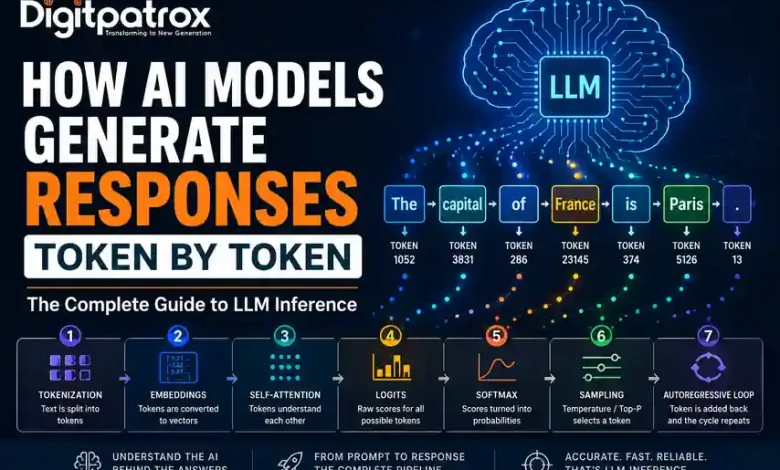
How AI Models Generate Responses Token by Token
Have you ever wondered what happens the exact millisecond you hit “Send” on a prompt to ChatGPT, Claude, or Gemini?
It looks like the AI is pausing, thinking, and carefully writing a unique response just for you. But behind the screen, there is no conscious mind. There is no deep understanding or human-like reflection.
Instead, a massive, lightning-fast math loop runs on powerful graphics cards (GPUs). The AI is playing a non-stop game of statistical roulette. It predicts the next tiny piece of a word, over and over again, until it hits a structural stop sign.
Here is a simple, step-by-step look at how large language models (LLMs) turn your prompts into text. If you want to know how these systems are hosted at scale, check out our guide on setting up your own AI infrastructure.
The Quick Summary: What’s Happening Under the Hood
-
It’s Math, Not Mind: AI models do not hold knowledge the way humans do. They simply predict the next word fragment based on learned statistical patterns. It works like an incredibly advanced version of the predictive text on your smartphone.
-
Words Are Chopped Up: AI doesn’t read whole words. A special piece of software chops your text into tiny mathematical pieces called “tokens.” A single word like “unbelievable” might be split into three or four pieces before the math engine even processes it.
-
“Creativity” Is Controlled Randomness: Creativity in AI comes from combining learned patterns in new ways. Settings like “Temperature” don’t make the AI smarter. They simply tell the engine to take bigger risks and pick less predictable words.
-
Trapped by Its Own Output: Once a piece of text is sent to your screen, the model cannot backspace or edit it. Any small logical mistake it makes early on becomes a permanent part of its memory for the rest of the response.
Summary of the AI Generation Pipeline
| Stage | What Happens Under the Hood |
| 1. Tokenization | Raw text is chopped into numerical token IDs. |
| 2. Embeddings | Token IDs are turned into mathematical meaning vectors. |
| 3. Attention | Tokens share information to figure out how words relate to each other. |
| 4. Logits | The model creates raw prediction scores for its entire vocabulary. |
| 5. Softmax | Raw scores are turned into clean percentage probabilities. |
| 6. Sampling | Randomness filters (Temp/Top-P) select the final winning token. |
| 7. Autoregressive Loop | The output token is shown and fed back into the input until a stop token is hit. |
Before the Loop: Training vs. Inference
Before looking at the step-by-step process, it is important to understand a key difference: Training vs. Inference.
Everything described in this article happens during inference. This is the live process you experience when you chat with an AI model. During inference, the model’s internal settings (called weights) stay completely fixed while it predicts text one token at a time.
In contrast, training is the massive learning phase that happens beforehand. During training, computers analyze billions of pages of text to set those internal weights. For a deeper look at tuning these models after training, see our technical breakdown of LLM fine-tuning techniques.
The Complete 6-Step Generation Pipeline
Every prompt you write travels through this exact sequence to create a response.
1. What is Tokenization? (Chopping Your Text)
When you type a phrase like “aberrant behavior” into an AI, the system doesn’t see those letters the way you do. First, it passes your text through a translator called a tokenizer. This tool reads the text, chops words into chunks called tokens, and gives each chunk an ID number.
Example Token IDs for “unbelievable”:
-
-
un→739 -
belie→2942 -
able→1205
-
(Note: The exact ID numbers change depending on the AI model you use.)
The model never works with individual letters; it only processes these numerical token IDs. This explains why AI models famously struggle with simple word puzzles, like counting the letters in a sentence or reversing a string. The core math engine isn’t looking at characters; it’s looking at the numerical code for the fragment.
Also, because rare words are broken into multiple unfamiliar token pieces, they are harder for the model to interpret. This can cause the model’s logic to trip because it has to process disjointed fragments rather than a single, clean concept.
2. What are Embeddings and Positional Encodings?
Raw numbers like 739 have no built-in meaning. To fix this, the AI passes the IDs into an Embedding Layer. An embedding converts every token ID into a long list of numbers called a high-dimensional vector. This vector acts as a map of meaning.
Python
"king"  -> [ 0.25, -0.44,  0.81, ... (768 numbers) ]
"queen" -> [ 0.23, -0.41,  0.85, ... ]  # Mathematically close to "king"
"apple" -> [-0.89,  0.12, -0.34, ... ]  # Mathematically far away
Tokens with similar meanings are grouped closely together in this math space.
Right after embedding, the system applies Positional Encodings. Because the core math engine processes all tokens at the exact same time, it naturally has no concept of word order. Positional encoding adds a unique mathematical signature to each vector so the model knows if a token appeared at the beginning, middle, or end of your prompt.
3. What is Self-Attention? (Calculating Word Relationships)
With meaning and position set, the vectors enter the core architecture of modern AI: the Transformer. Inside the transformer layers, the model calculates how much the words relate to one another using a system called Self-Attention.
Self-attention lets every token check which earlier tokens deserve the most focus before predicting the next one. To do this, the AI creates three internal roles for every single token:
-
Queries: What a specific token is actively looking for.
-
Keys: The context and definitions that other tokens offer.
-
Values: The actual semantic information inside the token.
By multiplying Queries and Keys together across the prompt, the AI creates an attention score. These weights determine how much information is gathered from each Value vector. This score tells the computer hardware exactly which parts of your prompt matter most at any given millisecond.
4. What are Logits and the Softmax Function?
After calculating the relationships between words, the AI reaches its final prediction layer. The model looks at its entire vocabulary—a massive master list usually containing over 100,000 token options.
First, the model produces raw, unshaped prediction scores for every single token in its vocabulary. These raw scores are called logits. A logit can be any positive or negative number (like 14.2 or -2.1).
To make sense of these scores, the AI passes them through a formula called the Softmax function. Softmax squashes the raw scores into a clean table of percentages that add up to exactly 100%.
Imagine an AI trying to fill in the blank for the sentence: “The capital of France is ______”. The transformation looks like this:
| Next Token Option | Raw Score (Logits) | Statistical Probability (After Softmax) |
| Paris | 18.4 | 94.5% |
| a | 12.1 | 3.2% |
| the | 10.3 | 1.1% |
| London | 6.2 | 0.2% |
The AI doesn’t “know” Paris the way a human does. It simply calculates that based on the billions of pages of text it studied, the token Paris has the highest statistical probability of appearing next.
5. What is Temperature in LLMs? (Adjusting Randomness)
Before a token is selected and displayed on your screen, you can alter how the AI picks from its probability table using sampling filters like Temperature and Top-P. Randomness influences which likely continuation is chosen, but the model’s learned patterns shape what options are available in the first place.
-
Temperature: Think of this as a slider for predictability. Lowering the temperature to 0.0 makes the model choose the highest-probability token every single time. This makes the output highly consistent and repeatable. Turning the temperature up flattens the percentages, lowering the top choice’s lead and giving less predictable tokens a chance to win.
-
Top-P (Nucleus Sampling): This sets a boundary based on total math. If you set Top-P to 0.90, the AI lines up the top token choices from highest to lowest percentage. It cuts off the rest of the vocabulary as soon as the total hits 90%. This protects the model from picking completely random words while still allowing for variety.
If you are using AI to write software code, generate database scripts, or handle strict data extraction, you want your settings locked down to a temperature of 0.0. For more tips on deploying models for strict data pipelines, check out our guide on enterprise LLM deployment strategies.
6. What is Autoregressive Decoding? (The Constant Loop)
AI generation runs in a strict forward loop called an autoregressive process. The system can only calculate one single token at a time. Once a token is selected, it is instantly added to the end of your original prompt. Then, the whole expanded text block is fed right back into the engine to calculate the next step.
Markdown
* Loop 1: Input [Write a story]        -> Predicts -> "Once"
* Loop 2: Input [Write a story Once]   -> Predicts -> "upon"
* Loop 3: Input [Write a story Once u] -> Predicts -> "a"
* Loop 4: Input [Write a story Once u] -> Predicts -> "time"
This loop creates a compounding trap. If the model makes a poor choice early on, that flawed word becomes a permanent part of the prompt history. The model reads its own error, treats it as truth, and alters its attention weights to fit the mistake. This process is a major reason why AI models amplify hallucinations or logical errors once they start down the wrong path.
What is a KV Cache?
To prevent these systems from slowing down during long responses, engineering teams use a high-speed memory trick called KV (Key-Value) Caching.
Without KV caching, the GPU would have to redo the math for every single previous token on every single loop cycle. KV caching stores those intermediate attention states in memory. This means only the newest token requires full computation, which drastically reduces delay and keeps the text streaming smoothly onto your screen.
Quick Answers to Common Technical Questions
Can the AI go back and edit a word it already wrote?
No. Once a token has been sent to the user during normal generation, the process only moves forward. The model cannot change it. (Note: Advanced models can use internal hidden drafts before showing the final text, but once a token hits your chat window, it is locked into the prompt history).
Why does the exact same prompt give different answers?
Unless your temperature setting is locked to absolute zero, the sampling filters use a virtual dice roll to pick from the top choices every time you hit run.
How does the AI know when to stop talking?
The model’s vocabulary includes hidden, built-in structural commands called special tokens, such as <|endoftext|>. When the math engine determines that the “stop talking” token has the highest probability score, the loop shuts down.
Why do long conversations make the AI forget instructions?
As more tokens fill the context window, earlier instructions become less influential and can eventually fall outside the model’s memory span. This dilution means original formatting rules or constraints can get buried under the sheer weight of a lengthy conversation history.
The Takeaway
Every response from ChatGPT, Claude, and Gemini is built one token at a time through a repeating cycle of tokenization, embedding, attention, logit processing, and sampling. While the process can appear remarkably human, it is fundamentally a sequence of mathematical operations optimized to predict the most likely next piece of text. Understanding this pipeline helps explain both the impressive power of modern AI systems and their core limitations.