

ChatGPT Infrastructure Explained: GPUs, Memory, and Distributed Inference
A beginner-friendly guide to how ChatGPT and modern AI models use GPUs, KV cache, high-speed networks, and distributed inference to generate responses in real time.
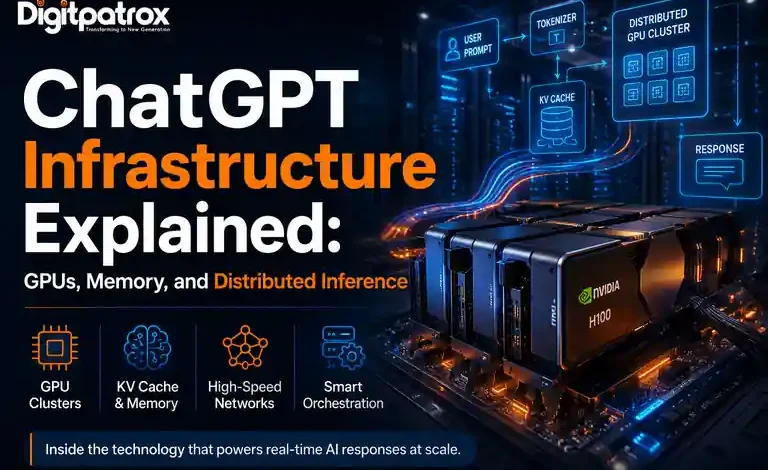
When you ask ChatGPT a question, the hard part isn’t generating the answer. The hard part is moving enormous amounts of data fast enough that the response appears instantly.
Modern AI systems process trillions of parameters across clusters of graphics processing units (GPUs) connected by specialized high-speed networks. Every word you type creates a chain reaction:
-
Memory gets allocated.
-
GPUs exchange data.
-
Networks synchronize.
-
Schedulers rebalance workloads.
The infrastructure behind large AI models behaves less like a standard web app and more like a tightly synchronized supercomputer.
Executive Reality Check
-
Memory bandwidth dominates compute: In many inference workloads, memory bandwidth—the speed at which data moves between a chip’s processing cores and its memory pools—is a larger bottleneck than raw computational throughput.
-
The working memory tax: Long conversations consume substantial memory resources. Every previous token in a chat session must be retained in active storage to generate the next word, creating massive data-shuffling overhead.
-
Interconnect speeds dictate scale: When an inference job spans multiple physical GPUs, performance lives or dies by high-speed specialized interconnect networks rather than individual chip speeds.
-
Dynamic orchestration is mandatory: High-concurrency traffic requires specialized runtime engines to batch incoming requests on the fly. Static or sequential routing causes hardware utilization to collapse.
-
The network is the primary failure domain: Minor network degradation or packet drops across distributed GPU clusters cause significant tail-latency spikes that traditional infrastructure monitoring tools struggle to diagnose.
The Short Answer
Large AI models like ChatGPT are believed to run on massive GPU clusters using specialized hardware like Nvidia H100s or H200s, linked by high-bandwidth fabrics like NVLink or InfiniBand. These systems rely on production orchestration frameworks (such as Triton Inference Server or vLLM) that implement continuous batching and virtualized memory allocation (PagedAttention). By shifting execution pipelines from a stateless model to a highly optimized memory-routing grid, they keep text generation speeds aligned with real-time human reading habits.
Web Architecture vs. LLM Inference
To understand why serving AI models is so resource-intensive, we have to look at how traditional web systems diverge from distributed AI inference workloads.
Traditional Web App
User
 ↓
Load Balancer
 ↓
Web Servers
 ↓
Database

* Each request is independent.
* Servers can scale horizontally.
LLM Inference
User
 ↓
API Gateway
 ↓
Tokenizer
 ↓
Semantic Cache
 ↓
GPU Cluster (GPU 1 ↔ GPU 2 ↔ GPU 3 ↔ GPU 4)
             ↳ Shared KV Cache & Shared State
In a standard software architecture, requests are independent and stateless. If traffic spikes, you scale out by spinning up identical web containers behind a standard load balancer. The containers read from a central database, serve the response, and immediately clear their local memory.
LLM generation inverts these assumptions. It is highly stateful and computationally interdependent. To generate a new token (the basic unit of text, roughly four characters), the model must combine the current token with information stored from the entire conversation history and process it through billions of parameters. This requires a dedicated, continuous relationship between memory allocation and processing loops.
A web application scales by adding more servers. An LLM often scales by adding more GPUs and making them communicate faster.
The Network Layer: Why Networking Is the Compute Pipeline
Large AI models do not fit inside the memory of a single graphics card. Slicing these models across multiple physical devices requires a technique called tensor parallelism—breaking down the giant mathematical layers of the network so separate chips process different sections of the same calculation simultaneously.
Because every layer of a transformer model requires the participating GPUs to exchange their intermediate calculations before moving to the next layer, the network fabric becomes part of the compute pipeline itself.
The Single Biggest Shift
In AI infrastructure, the network is no longer adjacent to computation. The network becomes computation.
Production environments use high-speed interconnect physical bridges like NVLink inside a single server enclosure, or InfiniBand networking architectures across multiple racks. These interfaces offer massive throughput capacities compared to standard datacenter Ethernet.
If a single network interface experiences minor degradation—such as dropping a tiny fraction of its packets—the entire cluster stalls. Because the computation is synchronous, every GPU in the cluster must wait for the missing data packets to re-transmit before anyone can compute the next token. This network degradation can significantly increase tail latency and time-to-first-token (TTFT), turning an otherwise healthy hardware cluster into an operational bottleneck.
Memory Architecture: The KV Cache Working Memory
To generate a coherent response, the model needs immediate access to the history of the current interaction. This active working memory is known as the KV (Key-Value) Cache. It stores the mathematical representations of all previous tokens in the session so the system doesn’t have to recalculate the entire history from scratch for every single new word. Think of it simply as the model’s transient working memory.
The KV cache scales linearly with conversation length, hidden dimensions of the model, and layer count. This is where abstract computing constraints translate into severe infrastructure friction.
KV Cache Memory Footprint Profile
[ Prompt: "Hello" ] ───> [ Negligible HBM Footprint (Megabytes) ]
[ Prompt: 300-Page Codebase ] ───> [ Massive HBM Footprint (Gigabytes per user session) ]
A user asking a simple question consumes negligible memory. However, an enterprise user pasting a 300-page codebase can easily consume gigabytes of High-Bandwidth Memory (HBM)—the hyper-fast, specialized memory built directly onto AI chips.
On large models, the KV cache for a single long conversation can consume hundreds of megabytes or even several gigabytes of GPU memory, reducing the number of users a server can support simultaneously. The GPU cluster must guarantee and lock down this physical allocation before it can generate a single new token.
Because traditional memory allocation models reserve maximum-capacity blocks up front to prevent errors, unoptimized systems experience extreme memory fragmentation. Huge swathes of expensive HBM sit completely empty while waiting for long conversations that may never happen. Modern inference stacks overcome this by using virtual memory allocation algorithms like PagedAttention, which dynamically slices the KV cache into small, non-contiguous memory blocks. This allows multi-tenant applications to pack requests tighter into physical hardware without triggering sudden Out-Of-Memory (OOM) cluster restarts.
To explore how these technical allocation boundaries impact application design over time, see our full breakdown on ai context windows explained.
Pre-Inference Middleware: The Request Routing Mesh
Hitting raw GPU clusters is the absolute most expensive path for any incoming query. To protect these hardware resources, many production AI systems place a preprocessing and routing layer in front of the inference cluster.
[ Incoming User Prompt ]
          │
          ▼
  [ Optional Cache ] ─── (Cache Hit) ───> [ Return Prior Stored Text ]
          │
     (Cache Miss)
          │
          ▼
[ Safety Filters & Guardrails ]
          │
          ▼
[ Context Injection / RAG Layer ] ───> [ Outbound to Distributed GPU Cluster ]
Depending on the specific platform architecture, this mesh handles tasks sequentially:
-
Request Routing & Tokenization: Translating raw text into raw tokens and managing initial cluster load.
-
Semantic Caching: If a new query is semantically similar to a recent request, some systems may reuse or adapt previously computed results instead of performing a full inference pass. The exact implementations vary widely across providers. If a hit occurs, the text can be served instantly without waking up a single GPU. For insight into how platforms execute these high-speed lookups across massive datasets, see how ai search engines rank sources.
-
Safety Filters & Guardrails: Screening input context for malicious strings, injection attacks, or policy violations on cheap commodity x86 servers before it hits core silicon.
-
Context Injection (RAG): Some AI applications augment prompts with external information before sending them to the model. This process is often called Retrieval-Augmented Generation (RAG) and may include pulling from company documents, product manuals, user preferences, or database records.
Dynamic Batching: How Orchestrators Prevent Idle Hardware
GPUs are structurally optimized to perform massive matrix mathematics in parallel. Processing prompts individually is highly inefficient, leaving up to 90% of the silicon’s processing capabilities completely idle while waiting for data loops to complete.
To maximize throughput, production inference servers use continuous batching (also called iteration-level scheduling). Traditional batching models group a set of queries together and process them as a single block; the entire block must finish running before any single user receives their answer.
Traditional Static Batching
Batch Run: [ User 1 (Short) | User 2 (Long) | User 3 (Medium) ] ──> Entire batch locks until User 2 finishes.

Continuous Batching Pipeline
Iteration 1: [ User 1 ] [ User 2 ] [ User 3 ] ──> User 1 finishes token generation.
Iteration 2: [ User 99 (New) ] [ User 2 ] [ User 3 ] ──> Dynamic injection fills empty slot instantly.
Continuous batching operates at the single-token level. After every single execution loop, the orchestration manager checks if any active prompt has finished generating text. If User 1 completes their sentence, the orchestrator immediately drops them from the execution matrix and inserts User 99 from the incoming queue on the very next cycle.
This dynamic swapping mechanism keeps the underlying hardware running at maximum capacity. However, it introduces significant complexity for software teams trying to track operational metrics. Because resources are constantly shared and interleaved mid-flight, measuring clean per-user performance requires highly specialized monitoring configurations. If you are designing platforms around these tracking challenges, see our complete guide on ai observability explained.
Why Trillion-Parameter Models Are Actually Sparse
Modern large models may contain trillions of parameters in total, but they don’t use all of them to process every single word. Running a trillion-parameter “dense” model where every single number is calculated for every single token would require an economically impossible amount of hardware infrastructure. Instead, the industry relies heavily on an architecture known as Mixture of Experts (MoE).
Dense Model Architecture
Every Token ──> [ Evaluates Against ALL Parameters Simultaneously ]

Mixture of Experts (MoE) Architecture
Every Token ──> [ Router / Gating Network ]
                      │
         ┌────────────┴────────────┐
         ▼                         ▼
   [ Expert Node 5 ]         [ Expert Node 22 ]
In an MoE framework, the model is split into specialized subnetworks (“experts”). When you pass a token to the system, an algorithmic router directs it only to the top two or three experts best suited for that specific piece of text. The experts themselves are mathematical splits rather than human-interpretable labels like “coding expert” or “creative expert,” but they allow the overall system to act with high specialization.
This architectural shift radically alters inference economics:
-
Memory Pressure: The entire model must still live across the collective memory pools of the cluster, meaning memory footprint demands remain massive.
-
Compute Savings: Because only a fraction of the parameters activate for any given token, the actual mathematical execution cost ($TFLOPS$) per token scales down drastically.
-
Network Optimization: The internal interconnect network faces heavy traffic demands because tokens must be routed dynamically between different physical GPU expert configurations on the fly.
The 6-Month Reality Check: What Breaks Post-Deployment
Building a stable architecture that works in a controlled environment is fundamentally different from maintaining that same system under sustained production stress. Over a six-month window, inference operations face specific, structural friction points:
-
Silent Hardware Performance Drifts: Silicon components don’t always fail catastrophically. A single GPU can experience minor thermal throttling or memory bus degradation where it remains active but runs 20% slower than its neighbors. Because tensor parallelism requires lock-step synchronization, your entire cluster will silently throttle down to match the speed of that single degraded card.
-
Prompt Profile Evolution: User behaviors naturally drift. If your users transition from writing short summaries to pasting long, multi-part document templates, your memory configurations will experience severe strain. The sudden increase in average KV cache footprints can trigger tail-latency spikes and resource exhaustion on clusters that were perfectly stable for months.
-
Driver and Orchestration Debt: Managing dependencies across specialized machine learning software stacks is notoriously difficult. A minor patch update to your container OS can introduce subtle runtime bugs or memory allocation mismatches with underlying CUDA drivers, requiring hours of low-level tracing to isolate.
Final Infrastructure Matrix
Choosing the right operational tier for your AI application depends on a clear understanding of long-term infrastructure trade-offs.
                    [ Compute Infrastructure Strategy ]
                                     │
         ┌───────────────────────────┴───────────────────────────┐
         ▼                                                       ▼
[ Public Frontier APIs ]                                [ Private Self-Hosted Infra ]
  - Zero Driver Management                                 - Total Hardware/Driver Control
  - Out-of-the-box Caching                                 - Custom PagedAttention Tuning
  - Variable Global Tail-Latency                           - Predictable Internal Tail-Latency
Deployment Strategy Comparison
| Evaluation Dimension | Managed Frontier APIs (OpenAI / Anthropic) | Self-Hosted Clusters (vLLM / Triton on Dedicated Compute) |
| Best Use Case | Rapid application rollouts; projects with highly volatile or unpredictable traffic patterns. | Enterprise environments with strict data security mandates or steady, predictable baseline traffic. |
| Worst Use Case | High-volume applications with specialized data protection regulations. | Small software operations lacking full-time, dedicated platform infrastructure teams. |
| Maintenance Burden | Near zero; scaling, driver optimization, and clustering are handled entirely by the provider. | Extremely high; requires persistent engineering focus on low-level drivers, networking fabrics, and memory layers. |
| Scalability Ceilings | High; bounded primarily by your operational budget and vendor rate limits. | Finite; constrained entirely by your physical hardware allocations and cluster configurations. |
For organizations evaluating the long-term cost and capability tradeoffs between primary API options, read our direct evaluation on openai vs anthropic for enterprise ai. Alternatively, if your immediate goals favor localized containment before building large-scale distributed setups, see our tactical walkthrough on how to build a local rag system.
Summary: The Infrastructure Paradigm Shift
Twenty years of software engineering trained us to think about CPUs, databases, and stateless application servers. Large language models completely invert those baseline assumptions.
The dominant bottlenecks have shifted:
-
Memory bandwidth often matters more than CPU cycles as the primary processing gateway.
-
The KV Cache introduces a new category of transient state alongside traditional databases.
-
NVLink and InfiniBand become critical as models span many separate GPUs.
-
Tail latency ($P99$) becomes more important than average response times for user experience.
The hardest part of serving ChatGPT isn’t teaching the model what to say. It’s moving trillions of parameters and billions of cached tokens through a distributed supercomputer quickly enough that the answer feels instantaneous to the human reader.
