

The Spotify Illusion: Spotify Doesn’t Recommend Music-It Models You
Most people think Spotify is trying to find songs they'll like. In reality, modern recommendation systems are uncertainty-reduction machines that continuously update their best guess about who you're becoming.
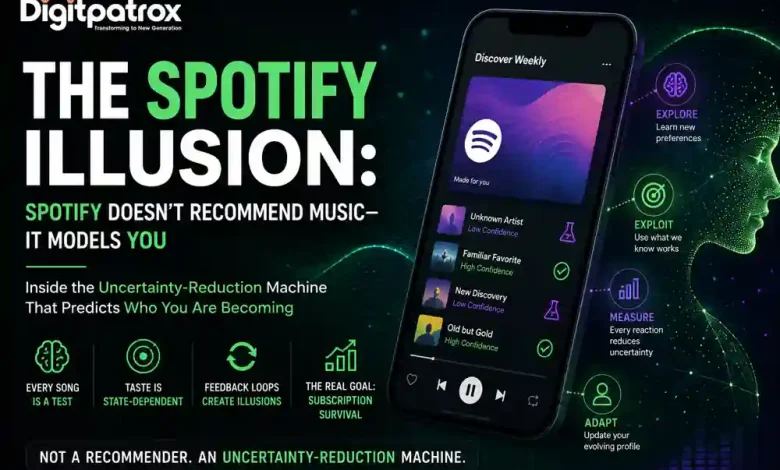
Most people assume Spotify works like a digital matchmaker:
You like Indie Rock ──► Spotify finds Indie Rock ──► Spotify recommends it
It sounds simple, but that isn’t what happens at all.
If an algorithm only did that, it would fail within a week. Why? Because human taste isn’t a static folder of favorite songs. It is an unstable, shape-shifting target.
The tracks you want at 7:00 AM in the gym, 2:00 PM at your desk, and 11:00 PM trying to fall asleep are entirely different. If Spotify only recommended “Indie Rock,” it would inevitably serve an upbeat guitar anthem while you are trying to sleep, causing you to immediately close the app.
Spotify is not a music recommendation engine. It is a massive, continuous uncertainty-reduction machine. It uses music as a measurement system for understanding user behavior, answering a much harder engineering question: Who are you right now, and how fast is your taste drifting?
While Spotify has publicly discussed parts of its recommendation architecture, much of the large-scale production behavior described here reflects common patterns used across modern recommendation systems rather than a complete public blueprint of Spotify’s internal stack.
Executive Reality Check
-
The Core Paradox: The primary battle isn’t data matching; it’s balancing exploitation (giving you what it knows you like) with exploration (intentionally playing things you might hate to gather high-value data).
-
The State Trap: Taste is context-dependent. The machine isn’t tracking what you love; it’s tracking your current mental, physical, and environmental state.
-
The Self-Created Evidence: Algorithms suffer from feedback loops. If the system forces a song onto your screen, you click it, and the system assumes you love it-creating its own skewed data.
-
The True Metric: Large platforms rarely optimize for Song Like Probability alone. They optimize for Subscription Survival. The system will gladly play a song with a lower instant click chance if it is statistically proven to prevent you from churning months from now.
Every Song Is a Test
Imagine Spotify is only 60% sure it understands your current mood. It has two choices:
[ Play it Safe ] ──► Song you already know ──► High chance you listen (Low Info Gain)
[ Take a Risk ]  ──► Song you've never heard ──► Maybe you hate it / Maybe a new discovery (High Info Gain)
Most people assume recommendations exist to maximize immediate clicks. In reality, a significant portion of what you are served in algorithmic playlists exists purely to collect information.
The algorithm treats your feed as a scientific experiment. If it only plays songs it is 99% sure you’ll enjoy, your world shrinks. You get the same artists, same genres, and same moods forever. Eventually, the app becomes boring, and you leave.
To prevent this, large-scale recommendation systems intentionally serve songs they aren’t sure about. They deliberately risk a skip to find out where the exact edges of your taste lie.
The retrieval stage relies on the same core idea that powers modern semantic search explained: representing users and content as vectors and finding nearby neighbors efficiently in a shared multi-dimensional space.
The Real Product Is Certainty
Think about every micro-action you take while using the app:
-
A 10-second skip
-
A track replay
-
An immediate volume change
-
Switching from headphones to a smart speaker
-
Adding a track to a personal playlist
You think you are just listening to music. Spotify sees a constant stream of diagnostic data. Every action answers a single internal question: How confident are we that we understand this person right now?
Music is not the final product; music is simply the instrument used to measure you.
This is fundamentally a data infrastructure problem. Every skip, replay, and playlist addition must be captured, processed, and incorporated into the recommendation pipeline in near real time, which is why large recommendation platforms rely on sophisticated architectures like the ai infrastructure stack 2026.
Why Spotify Sometimes Feels “Stuck”
Have you ever noticed your daily mixes playing the exact same type of music over and over, trapping you in a loop? This is the deepest structural flaw in recommendation engineering: The Feedback Loop.
Recommend Song ──► User Plays It ──► Model Sees Play ──► Recommend Similar Songs
When the system shows you a song, you play it-frequently just because it is right there in front of you. The model notes the play, assumes it made a perfect prediction, and serves more songs exactly like it. You play those too, because your choices are limited to what’s visible.
Eventually, the system creates its own evidence. It stops reflecting your actual taste and starts reflecting its own past recommendations. Every major discovery engine fights this battle, constantly trying to separate organic human preference from automated algorithmic bias.
This phenomenon is a classic observability challenge. Engineers must distinguish between genuine user preference and behavior created by the algorithm itself, an issue thoroughly examined in our breakdown of ai observability explained.
The Pipeline Behind the Screen
To balance this data collection with business realities without melting their cloud infrastructure budgets, modern platforms run a multi-stage funnel that downsamples millions of assets in under 200 milliseconds:
-
Candidate Generation: The system strips down the 100M+ global catalog to roughly 10,000 possibilities using fast, lightweight vector lookup indexes.
-
Filtering: The remaining pool is instantly cleaned by hard rules, purging tracks you’ve skipped recently or artists you’ve explicitly blocked.
-
Neural Ranking: A heavy deep learning model evaluates the remaining songs, scoring them against your real-time session state. Architecturally, this resembles the separation between long-term planning systems and real-time execution systems found when contrasting ai workflows vs ai agents.
-
Exploration & Diversification: The system applies mathematical routing models (often built on contextual multi-armed bandit frameworks) to inject deliberate, low-confidence experiments and settle on the final playlist layout.
The Objective Function Nobody Talks About
Data science content often pretends that platforms optimize solely for user happiness. But engineering teams operate under strict business metrics. Spotify’s true objective function is not maximizing the probability of you liking a single song; it is maximizing long-term subscriber lifetime value while balancing ecosystem economics.
The recommendation engine continuously calculates a trade-off between user retention, cloud infrastructure costs, and label licensing agreements. The system will consciously choose to bypass your absolute favorite track if another song carries a higher statistical weight for long-term platform survival or satisfies broader ecosystem distribution commitments.
Taste Is a Moving Target
People think Spotify models a static profile of their musical taste. It doesn’t. It models taste drift.
[ Yesterday's You ] ──► [ Today's You ] ──► [ Tonight's You ] ──► [ Future You ]
The hardest part of the engineering problem isn’t figuring out who you are; it’s figuring out who you are becoming.
Human preferences are fundamentally unstable. You are constantly discovering new genres, outgrowing old phases, and shifting your habits based on lifestyle changes.
The challenge is similar to maintaining long-term memory in AI systems: determining which signals represent permanent change versus temporary noise. This delicate balancing act is a core focus within ai agent memory systems explained.
Most people think Spotify is trying to learn what music they like. The harder problem is that people don’t stay the same. Every recommendation engine is attempting to model a target that changes faster than it can be measured.
Spotify doesn’t continuously learn what music you like. It continuously updates its best statistical guess about who you’re becoming.
